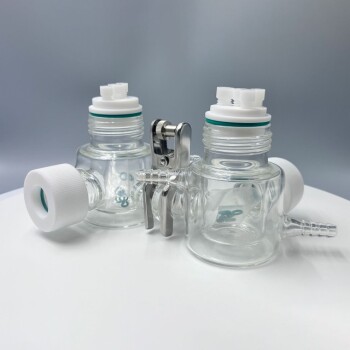
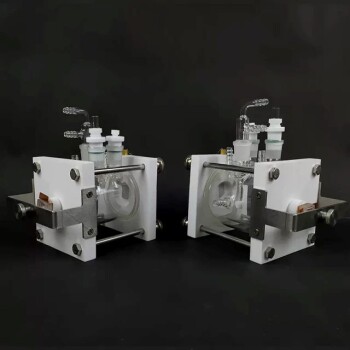
The standard H-type electrolytic cell features a specific, asymmetrical arrangement of ports designed to accommodate a three-electrode system and gas flow. One chamber is equipped with two 6.2mm electrode ports and two 3.2mm gas ports, while the opposing chamber contains one 6.2mm electrode port and two 3.2mm gas ports.
Core Takeaway This specific port configuration is designed to facilitate a standard three-electrode setup, typically separating the working and reference electrodes from the counter electrode via an ion-exchange membrane. The inclusion of dedicated gas ports on both sides ensures independent aeration and venting for each chamber.
Anatomy of the Cell Openings
The Primary Chamber Configuration
The first side of the H-type cell is designed to house the bulk of your sensing equipment. It features two 6.2mm ports, which are typically used for the Working Electrode and the Reference Electrode.
In addition to the electrode interfaces, this side includes two 3.2mm gas ports. These are essential for introducing gas (purging) and venting exhaust, allowing for controlled atmospheric conditions during experimentation.
The Secondary Chamber Configuration
The opposing side of the cell is slightly more streamlined. It contains one 6.2mm electrode port, generally intended for the Counter Electrode.
Like the primary chamber, this side maintains environmental control via two 3.2mm gas ports. This symmetry in gas ports allows reactions in both the anode and cathode chambers to proceed independently with proper ventilation.
Optical and Membrane Interfaces
Beyond the top-mounted ports, the cell functions through a central connection. The two chambers are separated by an opening for a replaceable ion-exchange membrane, which isolates the electrolytes while permitting specific ion transport.
Additionally, the cell is equipped with a quartz optical window. This opening is crucial for photoelectrochemical research, as it facilitates the precise entry and exit of light for optical observation and measurement.
Operational Considerations and Limitations
Fixed Port Dimensions
The standard openings are strictly machined to 6.2mm for electrodes and 3.2mm for gas lines.
If your electrode shafts or gas tubing do not match these dimensions, you will require specific adapters or Teflon tape to ensure a seal. Relying on makeshift seals can compromise the gas-tight nature of the experiment.
Material Fragility
The cell is constructed from glass, making the area around the openings vulnerable to stress.
Forcing an oversized electrode into a 6.2mm port can easily crack the vessel. Always ensure your fittings slide in smoothly and handle the cell with extreme care during assembly and cleaning.
Configuring Your Experiment
If your primary focus is standard electrochemical testing: Utilize the chamber with two 6.2mm ports for your Working and Reference electrodes to keep them in close proximity, while placing the Counter electrode in the single-port chamber.
If your primary focus is photoelectrochemistry: Orient your setup so that your light source aligns directly with the quartz optical window, ensuring the light path is not obstructed by the electrode shafts.
If your primary focus is gas evolution analysis: Connect your gas collection or analysis equipment to the 3.2mm outlet ports on both sides to measure anodic and cathodic gas products independently.
Proper utilization of these specific openings ensures experimental reproducibility and the integrity of your electrochemical data.
Summary Table:
| Opening Type | Port Diameter | Quantity (Chamber 1) | Quantity (Chamber 2) | Typical Application |
|---|---|---|---|---|
| Electrode Ports | 6.2 mm | 2 | 1 | Working, Reference, & Counter Electrodes |
| Gas Ports | 3.2 mm | 2 | 2 | Purging, Aeration, and Gas Venting |
| Central Interface | N/A | 1 | 1 | Ion-exchange Membrane separation |
| Optical Interface | N/A | 1 | 0 | Photoelectrochemical Research (Quartz Window) |
Elevate Your Electrochemical Research with KINTEK Precision
Precision is critical in electrolytic cell configuration. At KINTEK, we specialize in high-performance laboratory equipment, offering a comprehensive range of electrolytic cells and electrodes, high-temperature furnaces, and battery research tools designed for demanding scientific applications.
Whether you need standardized H-type cells or custom laboratory solutions like high-pressure reactors and ultrasonic homogenizers, our expert team is ready to support your workflow.
Enhance your experimental accuracy today—Contact our specialists now to find the perfect equipment for your lab.
Related Products
- H-Type Double-Layer Optical Electrolytic Electrochemical Cell with Water Bath
- H Type Electrolytic Cell Triple Electrochemical Cell
- Customizable PEM Electrolysis Cells for Diverse Research Applications
- Super Sealed Electrolytic Electrochemical Cell
- Electrolytic Electrochemical Cell with Five-Port
People Also Ask
- What is the overall structure of the H-type double-layer optical water bath electrolytic cell? Precision Design for Controlled Experiments
- How is the electrolyte managed in H-type electrolytic cells for specific reactions? Achieve Precise Control and High Purity
- What checks should be performed on the H-type electrolytic cell before use? Ensure Accurate Electrochemical Data
- What is important regarding temperature control for the H-type electrolytic cell? Ensure Precision and Data Integrity
- What is the overall structure of the H-type electrolytic cell? Understanding Dual-Chamber Electrochemical Designs