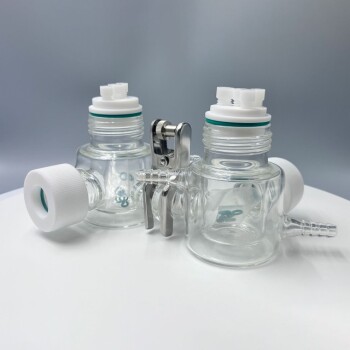
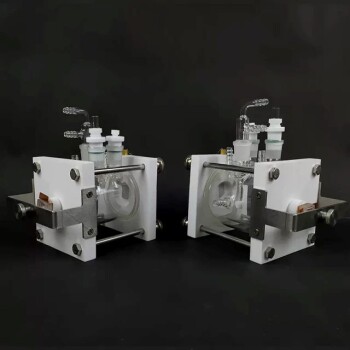
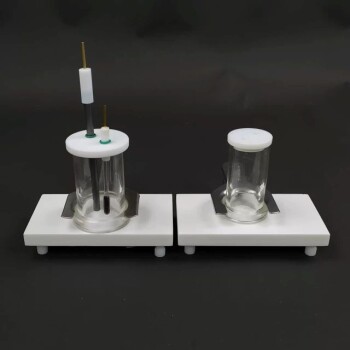
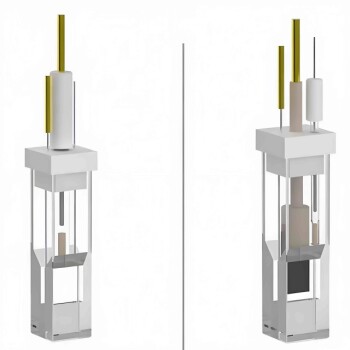
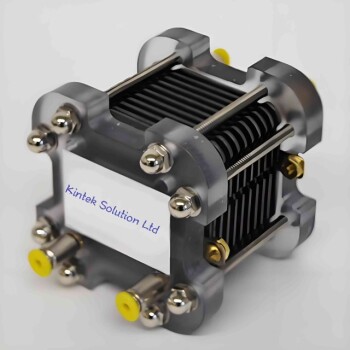
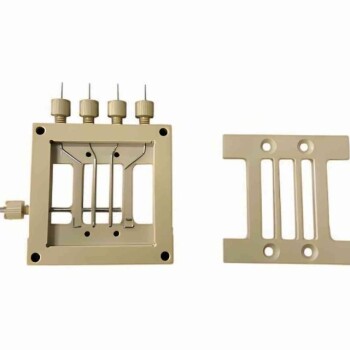
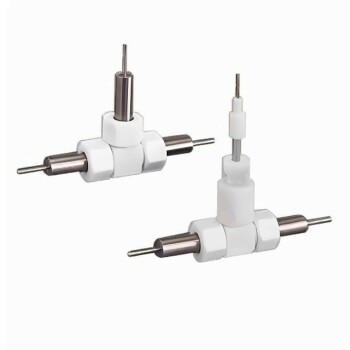
The overall structure of the H-type electrolytic cell is defined by its distinctive H-shaped geometry, which physically separates the device into two distinct compartments: an anode chamber and a cathode chamber. These two half-cells are connected by a bridge containing a replaceable ion-exchange membrane, which isolates the chemical products of each chamber while still permitting the necessary flow of ions to maintain the circuit.
Core Insight: The H-type design solves the problem of product cross-contamination. By isolating the anode and cathode environments, it ensures that oxidation and reduction reactions occur independently, guaranteeing experimental accuracy and reproducibility that single-chamber cells cannot provide.
The Architecture of Separation
The Dual-Chamber Configuration
Unlike standard electrolytic cells where electrodes share a single bath, the H-type cell uses two separate reservoirs.
One reservoir houses the anode (the positive electrode where oxidation occurs), and the other houses the cathode (the negative electrode where reduction occurs).
This physical separation is critical for accurate electrochemical analysis, preventing the products generated at one electrode from diffusing and interfering with the reaction at the other.
The Ion-Exchange Membrane
The bridge connecting the two vertical chambers is fitted with an ion-exchange membrane.
This membrane acts as a selective barrier; it effectively blocks the bulk mixing of the electrolyte solutions and reaction products.
Simultaneously, it allows specific ions to migrate between chambers, maintaining the electrical continuity required for the reaction to proceed.
The primary reference notes that this membrane is replaceable, allowing researchers to customize the cell for different ion types or replace degraded components.
Functional Components
The Electrodes
While the H-structure defines the vessel, the cell requires two stable electrodes connected to an external power source.
The external power source drives the non-spontaneous redox reactions by creating a potential difference between these terminals.
The Electrolyte Solution
Both chambers are filled with an electrolyte, typically a solution containing dissolved ions or a molten salt.
This medium facilitates charge transfer, allowing ions to move freely toward the electrode with the opposite charge to complete the circuit.
Understanding the Trade-offs
Added Complexity
The H-type cell is mechanically more complex than a standard single-beaker electrolytic cell.
It requires careful assembly to ensure the membrane is properly sealed and to prevent leaks between the two independent chambers.
Internal Resistance
Introducing a membrane creates a physical barrier that can increase the internal resistance (IR drop) of the cell.
This requires the external power source to exert slightly more energy to drive ions across the membrane compared to an open solution.
Making the Right Choice for Your Goal
- If your primary focus is product purity: Choose the H-type cell to completely isolate the anodic and cathodic products for precise analysis.
- If your primary focus is preventing interference: Use this structure to ensure that species generated at the counter electrode do not diffuse back and react at the working electrode.
- If your primary focus is simple bulk electrolysis: A single-compartment cell may be more efficient due to lower resistance, provided product mixing is not a concern.
The H-type cell remains the definitive tool for researchers demanding rigorous separation of half-cell chemistries without breaking the electrical circuit.
Summary Table:
| Component | Function | Key Feature |
|---|---|---|
| Anode Chamber | Houses the positive electrode | Isolated environment for oxidation reactions |
| Cathode Chamber | Houses the negative electrode | Isolated environment for reduction reactions |
| Ion-Exchange Membrane | Selective ion transport | Replaceable barrier preventing product mixing |
| Connecting Bridge | Links the two chambers | Maintains electrical circuit continuity |
| Electrolyte | Conductive medium | Facilitates charge transfer via ion movement |
Elevate Your Electrochemical Research with KINTEK
Precision is paramount in electrochemical analysis. KINTEK specializes in high-quality laboratory equipment, including specialized electrolytic cells and electrodes designed to ensure experimental accuracy and reproducibility. Whether you are conducting complex redox studies or standard electrolysis, our H-type cells provide the rigorous separation your research demands.
Beyond electrochemical tools, we offer a comprehensive range of:
- High-Temperature Furnaces (Muffle, Tube, Vacuum, CVD)
- High-Pressure Reactors & Autoclaves
- Advanced Milling & Crushing Systems
- Battery Research Consumables & Precision Cooling Solutions
Ready to optimize your lab's performance? Contact KINTEK today to discover how our expert-engineered solutions can support your scientific breakthroughs.
Related Products
- H-Type Double-Layer Optical Electrolytic Electrochemical Cell with Water Bath
- H Type Electrolytic Cell Triple Electrochemical Cell
- Customizable PEM Electrolysis Cells for Diverse Research Applications
- Super Sealed Electrolytic Electrochemical Cell
- Electrolytic Electrochemical Cell with Five-Port
People Also Ask
- What is the overall structure of the H-type double-layer optical water bath electrolytic cell? Precision Design for Controlled Experiments
- How is the electrolyte managed in H-type electrolytic cells for specific reactions? Achieve Precise Control and High Purity
- What checks should be performed on the H-type electrolytic cell before use? Ensure Accurate Electrochemical Data
- What is important regarding temperature control for the H-type electrolytic cell? Ensure Precision and Data Integrity
- What checks should be performed before using an H-type electrolytic cell? Ensure Experiment Safety and Data Accuracy