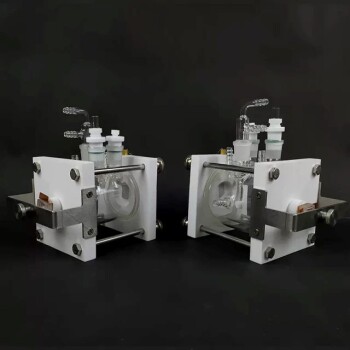
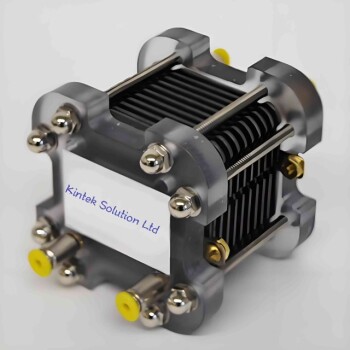
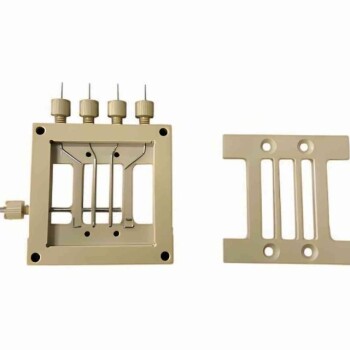
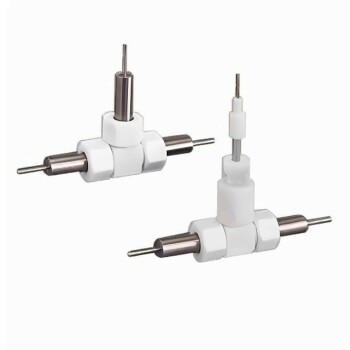
The distinct optical feature of the H-type electrolytic cell is its high-quality quartz optical window. This specific design element is engineered to facilitate the efficient entry and exit of light during operation. It allows researchers to introduce external light sources directly onto the working electrode for advanced experimentation.
Core Takeaway: By incorporating a quartz window into a dual-chamber design, this cell bridges the gap between traditional electrochemistry and optical science. It enables precise photoelectrochemical measurements while preserving the benefits of separating anodic and cathodic reactions.
The Function of the Quartz Window
High-Fidelity Light Transmission
The primary purpose of the quartz window is to allow light to pass through with minimal interference. Unlike standard glass, quartz is typically chosen for its ability to transmit a broader spectrum of light, which is essential for accurate quantitative analysis.
Enabling Photoelectrochemical Research
This feature is the critical enabler for experiments that require light irradiation to drive chemical reactions. It transforms the unit from a standard chemical vessel into a reactor capable of testing solar energy conversion and photocatalysis.
Real-Time Optical Observation
Beyond driving reactions, the window facilitates convenient optical measurement. Researchers can observe physical changes on the electrode surface or use spectroscopic techniques to monitor the reaction environment in real-time.
Integrating Optics with the H-Type Design
Maintaining Chemical Isolation
While the window allows light in, the H-shape structure keeps the chemical environments distinct. The anode and cathode chambers remain separated to prevent the mixing of reaction products, ensuring that the optical experiment does not compromise chemical purity.
Connectivity via Ion Exchange
Despite the physical separation of the chambers, a replaceable ion-exchange membrane allows for necessary connectivity. This ensures ions can transport freely to complete the electrical circuit without compromising the isolation required for accurate data collection.
Electrode Accommodation
The cell design positions the working electrode specifically to benefit from the optical window. It simultaneously accommodates the counter and reference electrodes to maintain a standard three-electrode system during optical experiments.
Understanding the Trade-offs
Handling Fragile Materials
The cell is constructed from glass and quartz, making it inherently fragile. You must handle the unit with extreme gentleness to avoid chipping the optical window or cracking the chamber body, as thermal or mechanical shock can destroy the cell.
Sealing and Maintenance Risks
Because the cell involves specialized windows and membranes, regular safety inspections are vital. You must frequently check for leaks in the sealing and signs of aging in the wiring to prevent safety accidents and ensure experimental reproducibility.
Making the Right Choice for Your Goal
To get the most out of the H-type electrolytic cell, align your specific research goals with its design features:
- If your primary focus is Photoelectrochemistry: Prioritize the alignment of your light source with the quartz window to maximize photon delivery to the working electrode.
- If your primary focus is Product Separation: Rely on the H-shape configuration and the ion-exchange membrane to keep oxidation and reduction products distinct, using the window only for visual monitoring.
By leveraging the quartz window within the isolated H-structure, you ensure both optical precision and chemical accuracy in your research.
Summary Table:
| Feature | Description | Benefit |
|---|---|---|
| Quartz Window | High-transparency optical port | Enables broad-spectrum light irradiation & spectroscopic analysis |
| Dual-Chamber Design | Physical H-shape separation | Prevents product mixing while allowing light-driven reactions |
| Ion-Exchange Membrane | Selective ionic conductivity | Maintains electrical circuit without compromising chemical isolation |
| Three-Electrode Support | Optimized electrode positioning | Facilitates precise photoelectrochemical measurements |
| Material Build | Borosilicate glass & Quartz | Ensures chemical resistance and high-fidelity optical clarity |
Elevate Your Photoelectrochemical Research with KINTEK
Unlock the full potential of your experiments with KINTEK’s precision-engineered H-type electrolytic cells. Our specialized cells, featuring high-purity quartz windows and robust dual-chamber isolation, are designed specifically for researchers demanding the highest accuracy in solar energy conversion, photocatalysis, and real-time spectroscopic monitoring.
As a global leader in laboratory equipment, KINTEK provides a comprehensive range of solutions for advanced material science, including:
- Electrolytic cells and electrodes tailored for precision electrochemistry.
- High-temperature furnaces and reactors for material synthesis.
- Battery research tools and consumables for energy storage innovation.
Ready to optimize your laboratory setup? Contact us today to consult with our technical experts and discover how our high-quality glass and quartz solutions can drive your next breakthrough.
Related Products
- H-Type Double-Layer Optical Electrolytic Electrochemical Cell with Water Bath
- H Type Electrolytic Cell Triple Electrochemical Cell
- Customizable PEM Electrolysis Cells for Diverse Research Applications
- Electrolytic Electrochemical Cell with Five-Port
- Super Sealed Electrolytic Electrochemical Cell
People Also Ask
- What is the overall structure of the H-type double-layer optical water bath electrolytic cell? Precision Design for Controlled Experiments
- How is the electrolyte managed in H-type electrolytic cells for specific reactions? Achieve Precise Control and High Purity
- What checks should be performed on the H-type electrolytic cell before use? Ensure Accurate Electrochemical Data
- What is important regarding temperature control for the H-type electrolytic cell? Ensure Precision and Data Integrity
- What is the overall structure of the H-type electrolytic cell? Understanding Dual-Chamber Electrochemical Designs