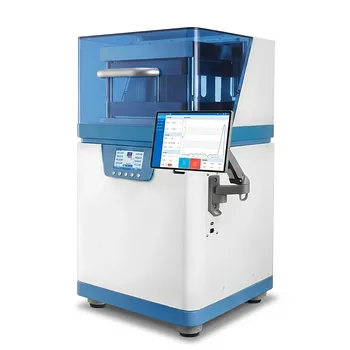
For the catalytic hydrogenolysis of sucrose to 1,2-propanediol, a stainless steel high-pressure batch reactor provides the critical combination of high-intensity thermal energy and high-density hydrogen saturation. Specifically, it maintains initial hydrogen pressures of up to 6 MPa and operating temperatures ranging from 180 to 240 °C. These conditions are essential for driving the complex sequence of isomerization, retro-aldol condensation, and hydrogenation required for the reaction.
The core value of a high-pressure batch reactor lies in its ability to sustain a stable, sealed environment that facilitates multi-step chemical pathways. By integrating precise thermal and pressure controls, the reactor ensures that sucrose molecules interact effectively with catalyst active sites to achieve high selectivity.
Precise Control of the Reaction Environment
Sustained High-Pressure Hydrogenation
The reactor is designed to safely handle initial hydrogen pressures as high as 6 MPa. This high-pressure environment is vital for ensuring that enough hydrogen is dissolved in the liquid phase to interact with the catalyst.
This density of hydrogen facilitates the final hydrogenation step, which is necessary to convert intermediates into 1,2-propanediol. Without this pressure, the reaction may stall at intermediate stages or produce unwanted byproducts.
High-Temperature Thermal Ranges
Operating at temperatures between 180 and 240 °C, the reactor provides the activation energy needed for sucrose conversion. This specific range is required to trigger retro-aldol condensation, a key step in breaking down the sucrose backbone.
The stainless steel construction allows the vessel to withstand these temperatures for extended periods without compromising structural integrity. This thermal stability is critical for maintaining a consistent reaction rate throughout the batch cycle.
Real-Time Monitoring and Mass Transfer
Integrated Sensing and Safety
Equipped with precision pressure gauges and temperature sensors, the reactor allows for real-time monitoring of the internal state. This visibility is crucial for tracking the progress of the hydrogenolysis and ensuring the reaction stays within safe parameters.
Real-time data helps operators understand the timing of the isomerization and condensation phases. This level of control is what allows for the high selectivity required to produce 1,2-propanediol efficiently.
Efficient Reactant Mixing
While the primary focus is on pressure and heat, these reactors also utilize precision stirring systems to ensure thorough contact between reactants. High-speed stirring (often around 400 rpm) prevents the catalyst from settling and eliminates mass transfer limitations.
By keeping the catalyst particles in constant contact with the gas and liquid phases, the reactor maximizes the efficiency of the metal active sites. This synergy is what ultimately drives the 100% conversion rates seen in successful laboratory settings.
Understanding the Trade-offs and Pitfalls
Material Compatibility and Corrosion
While stainless steel is robust, the combination of high temperatures and specific catalysts can lead to leaching or surface degradation over time. Users must ensure the grade of stainless steel is compatible with the specific acid-base sites used in the catalyst.
Thermal Lag and Temperature Overshoot
In a batch setup, reaching the target 240 °C can involve significant thermal lag. If the heating system is not finely tuned, "overshooting" the temperature can lead to the degradation of sucrose into carbonaceous "char," which deactivates the catalyst.
Pressure Management Risks
Operating at 6 MPa requires rigorous safety protocols to prevent catastrophic depressurization. Regular maintenance of seals and gaskets is mandatory, as the hydrogenolysis process involves small molecules that can easily escape through micro-fissures at high pressure.
Applying These Conditions to Your Project
Recommendations for Success
To achieve the best results in the hydrogenolysis of sucrose, you must align your reactor settings with your specific production goals.
- If your primary focus is Maximum Yield of 1,2-Propanediol: Prioritize the upper range of temperature (near 240 °C) and maintain maximum hydrogen pressure to ensure complete hydrogenation.
- If your primary focus is Catalyst Longevity: Operate at the lower end of the temperature scale (180-200 °C) to minimize thermal stress and potential leaching of the metal active sites.
- If your primary focus is Process Safety and Stability: Focus on the precision of the stirring system and the integrity of the pressure sensors to prevent localized "hot spots" within the batch.
By mastering the balance of pressure, temperature, and agitation, you can transform sucrose into high-value glycols with precision and safety.
Summary Table:
| Parameter | Specification | Key Role in Reaction |
|---|---|---|
| Operating Temp | 180 - 240 °C | Triggers retro-aldol condensation and activation |
| Hydrogen Pressure | Up to 6 MPa | Ensures liquid-phase saturation for hydrogenation |
| Agitation Speed | ~400 rpm | Eliminates mass transfer limits and catalyst settling |
| Vessel Material | Stainless Steel | Provides structural integrity under high thermal stress |
| Monitoring | Integrated Sensors | Real-time tracking of isomerization & safety |
Elevate Your Chemical Synthesis with KINTEK Precision
Unlock the full potential of your catalytic research with KINTEK’s high-temperature, high-pressure reactors and autoclaves. Designed for rigorous laboratory environments, our reactors provide the stability and precise thermal/pressure control required to achieve 100% conversion rates and high selectivity in complex pathways like sucrose hydrogenolysis.
Beyond our industry-leading reactors, KINTEK offers a comprehensive suite of laboratory solutions, including:
- High-Temperature Furnaces: Muffle, tube, and vacuum systems for advanced material processing.
- Sample Preparation: Precision crushing, milling, and hydraulic presses (pellet, hot, isostatic).
- Specialized Consumables: High-quality PTFE products, ceramics, and crucibles.
Ready to optimize your yields and ensure process safety? Contact our laboratory specialists today to find the perfect high-pressure reactor configuration for your research goals!
References
- Shizhuo Wang, Zheng Shen. Catalytic production of 1,2-propanediol from sucrose over a functionalized Pt/deAl-beta zeolite catalyst. DOI: 10.1039/d2ra07097a
This article is also based on technical information from Kintek Solution Knowledge Base .
Related Products
- Stainless High Pressure Autoclave Reactor Laboratory Pressure Reactor
- Mini SS High Pressure Autoclave Reactor for Laboratory Use
- Customizable High Pressure Reactors for Advanced Scientific and Industrial Applications
- Customizable Laboratory High Temperature High Pressure Reactors for Diverse Scientific Applications
- High Pressure Laboratory Autoclave Reactor for Hydrothermal Synthesis
People Also Ask
- Why is a laboratory high-pressure reactor necessary for synthesizing fly ash-based zeolite? Achieve Pure Crystallization
- Why is a laboratory high-pressure reactor used in the hydrothermal synthesis of hydroxyapatite catalysts?
- What role does a laboratory high-pressure reactor play in the leaching process of spent cathode materials? Optimize Recovery
- What conditions do laboratory high-pressure reactors provide for HTC? Optimize Your Biochar Production Processes
- How are high-pressure reactors used to prepare metaphosphate electrocatalysts? Master In-Situ Precursor Growth