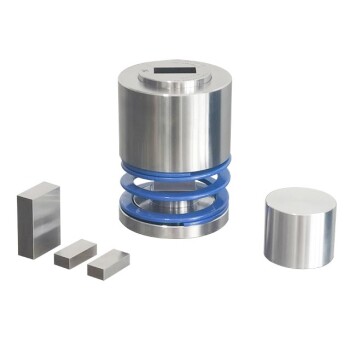
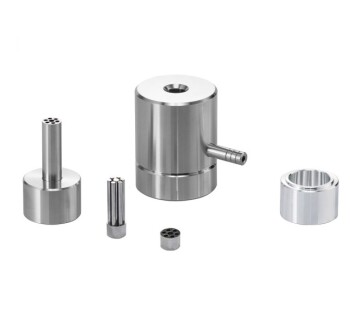
The primary utility of a laboratory high-pressure reactor in this synthesis is to generate a closed, autogenous environment that drastically elevates the reaction activity of hydroxyapatite precursors. This specialized environment is strictly necessary to ensure that molybdate anions are uniformly incorporated into the hydroxyapatite lattice. Simultaneously, these conditions drive the formation of a mesoporous structure, resulting in a heterogeneous catalyst defined by high thermodynamic stability and a substantial specific surface area.
Core Takeaway The reactor does not merely speed up the reaction; it creates a subcritical state that fundamentally alters the material's crystallization. This enables the atomic-level substitution of molybdate ions into the lattice and the mesoscale self-assembly of high-surface-area porous networks, neither of which is achievable under standard atmospheric conditions.
Achieving Uniform Chemical Integration
Overcoming Reaction Barriers
In a standard open vessel, the energy required to force molybdate anions into the hydroxyapatite structure is often insufficient. The high-pressure reactor creates an environment where reaction activity is significantly increased. This allows the precursors to overcome thermodynamic barriers that would otherwise prevent integration.
Lattice Substitution
The defining feature of this synthesis is the need for the molybdate anions to enter the crystal lattice. Under the closed, autogenous pressure conditions provided by the reactor, the chemical environment facilitates the uniform doping of these anions. This transforms the material from simple hydroxyapatite into a complex, functionalized catalyst.
Enhanced Solubility
The reactor maintains temperatures exceeding the atmospheric boiling point, bringing the aqueous solution into a subcritical state. In this state, the solubility of the precursors is greatly enhanced, ensuring that the reactants are fully dissolved and available for the substitution process.
Engineering the Physical Microstructure
Inducing Mesoporous Structures
Beyond chemical composition, the reactor controls the physical architecture of the material. The hydrothermal environment promotes anisotropic crystal growth and guides the self-assembly of the material into a mesoporous structure. This structural arrangement is critical for allowing reactants to diffuse in and out of the catalyst during future applications.
Maximizing Specific Surface Area
A major goal of using this reactor is to produce a heterogeneous catalyst with a high specific surface area. By regulating the pressure and temperature, the reactor prevents the collapse of pores and ensures high crystallinity. A larger surface area translates directly to more active sites for catalytic reactions.
Ensuring Consistency and Stability
Thermodynamic Stability
Catalysts synthesized in this environment exhibit high thermodynamic stability. Because the structure is formed under high energy conditions, the resulting crystal lattice is robust and resistant to degradation during subsequent chemical oxidation reactions.
Reproducibility via Closed Systems
The sealed nature of the reactor ensures highly uniform contact between reactants in the liquid phase. This eliminates variables such as evaporation or concentration gradients, allowing for high reproducibility of the phase composition and material properties across different batches.
Understanding the Trade-offs
Sensitivity to Parameters
While the reactor offers precise control, the outcome is highly sensitive to the specific parameters chosen. Slight deviations in reaction temperature, pressure, or time can drastically alter the phase composition or morphology. Achieving the correct "mesoporous" state requires rigorous optimization of these variables.
Complexity of Scale
The autogenous pressure mechanism relies on the volume of liquid relative to the vessel size (filling degree). Scaling this process up or down requires careful recalculation of these ratios to maintain the same subcritical conditions, making the process less linear to scale than atmospheric reactions.
Making the Right Choice for Your Goal
To maximize the utility of the high-pressure reactor for your specific catalytic needs:
- If your primary focus is Catalytic Activity: Prioritize the optimization of the mesoporous structure, as the high specific surface area will determine the efficiency of the heterogeneous catalysis.
- If your primary focus is Chemical Functionality: Focus on the pressure and temperature parameters that maximize the solubility of the molybdate source to ensure complete and uniform lattice doping.
The high-pressure reactor is not just a vessel; it is a thermodynamic tool that forces the precise atomic and structural alignment required for high-performance catalysis.
Summary Table:
| Feature | Hydrothermal Synthesis Impact | Catalyst Benefit |
|---|---|---|
| Autogenous Pressure | Creates subcritical states & increases solubility | Uniform molybdate anion lattice integration |
| Subcritical Temp | Facilitates anisotropic crystal growth | Formation of high-surface-area mesoporous structures |
| Closed Environment | Prevents evaporation & concentration gradients | Enhanced thermodynamic stability & reproducibility |
| Energy Density | Overcomes thermodynamic reaction barriers | Higher catalytic activity for chemical oxidation |
Elevate Your Material Synthesis with KINTEK Precision
Unlock the full potential of your research with KINTEK’s industry-leading high-temperature high-pressure reactors and autoclaves. Whether you are engineering mesoporous catalysts, developing advanced hydroxyapatite structures, or conducting complex battery research, our equipment provides the precise thermodynamic control required for atomic-level substitution and structural self-assembly.
From muffle and vacuum furnaces to crushing systems and PTFE consumables, KINTEK specializes in providing laboratory equipment that ensures high reproducibility and superior material performance for our global customers.
Ready to optimize your catalytic results? Contact our experts today to find the perfect reactor for your lab.
References
- Slava Tsoneva, Petya Marinova. Anthranilic acid amide and its complex with Cu(II) ions. DOI: 10.21175/rad.abstr.book.2023.23.5
This article is also based on technical information from Kintek Solution Knowledge Base .
Related Products
- Customizable Laboratory High Temperature High Pressure Reactors for Diverse Scientific Applications
- Stainless High Pressure Autoclave Reactor Laboratory Pressure Reactor
- High Pressure Laboratory Autoclave Reactor for Hydrothermal Synthesis
- Mini SS High Pressure Autoclave Reactor for Laboratory Use
- Customizable High Pressure Reactors for Advanced Scientific and Industrial Applications
People Also Ask
- How do high-pressure and high-temperature reactors ensure the effective treatment of lignocellulosic wastewater in WAO?
- What equipment is required for high-pressure high-temperature reactions? Master Extreme Chemistry Safely
- How do you control high pressure in a reactor? A Guide to Safe & Stable Operation
- Why is argon better than nitrogen for inert atmosphere? Ensure Absolute Reactivity & Stability
- How does initial oxygen pressure affect the wet oxidation of pharmaceutical sludge? Master Your Oxidation Depth