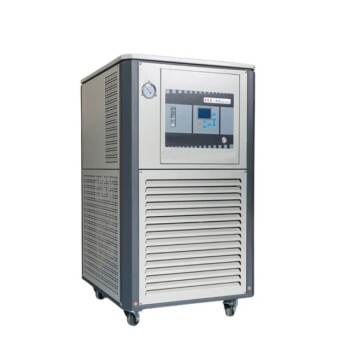
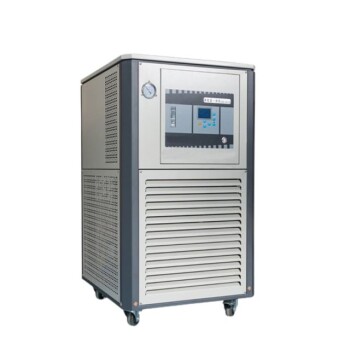
The high-temperature and high-pressure reactor acts as the catalyst for creating a precise, sealed hydrothermal environment. By maintaining temperatures around 180 °C, the reactor generates the necessary internal pressure to force an in-situ chemical reaction between iron (Fe) powder and cobalt salt solutions directly on the particle surfaces.
The reactor's pressurized environment drives the growth of a uniform, nanometer-scale CoFe2O4 insulating layer directly onto iron particles, creating a tight core-shell structure that is fundamental to enhancing the composite's electrical resistivity.
The Mechanism of In-Situ Oxidation
Creating a Hydrothermal Environment
The primary function of the reactor is to provide a sealed system capable of withstanding significant thermal and mechanical stress.
Unlike open-air reactions, this closed environment prevents the loss of volatile precursors and solvents. It ensures that all chemical potential is directed toward the reaction between the iron powder and the cobalt salts.
Driving Surface Reactions
At elevated temperatures (specifically around 180 °C), the pressure within the reactor increases significantly.
This high pressure promotes the in-situ oxidation of cobalt ions. Instead of reacting randomly in the solution, the pressure forces the reaction to occur specifically on the surface of the iron powder, anchoring the new material to the core.
Achieving the Core-Shell Structure
Uniform Layer Growth
The controlled environment of the reactor ensures that the deposition of the new material is not sporadic or uneven.
It facilitates the growth of a nanometer-scale CoFe2O4 layer that coats the iron particles uniformly. This uniformity is difficult to achieve without the omnidirectional pressure provided by the reactor.
Enhancing Electrical Resistivity
The ultimate goal of this synthesis is to modify the electrical properties of the iron powder.
The CoFe2O4 layer acts as an insulating shell around the conductive iron core. By ensuring this shell is tight and continuous, the reactor enables the production of a composite material with significantly higher electrical resistivity compared to raw iron.
Understanding the Critical Controls
The Importance of the Seal
The efficacy of this process relies entirely on the reactor's ability to maintain a hermetic seal.
Any leakage results in a loss of pressure and precursor material, which disrupts the in-situ oxidation process. A compromised seal leads to uneven coating and a failure to achieve the desired core-shell architecture.
Temperature-Pressure Correlation
The temperature setting is not arbitrary; it is the lever used to control internal pressure.
Setting the reactor to 180 °C provides the specific thermodynamic conditions required for the cobalt ions to react efficiently with the iron surface. Deviating from this temperature can result in either incomplete coverage (too low) or uncontrolled crystal growth (too high).
Optimizing Your Synthesis Strategy
To ensure you achieve the desired magnetic and electrical properties in your composites, align your process with these objectives:
- If your primary focus is high electrical resistivity: Ensure the reactor maintains a consistent 180 °C to guarantee a continuous, insulating CoFe2O4 shell formation.
- If your primary focus is coating uniformity: Prioritize the integrity of the reactor's seal to maintain the constant pressure required for even nanometer-scale growth.
By controlling the reactor's environment, you transition from simple mixture preparation to precise material engineering.
Summary Table:
| Process Parameter | Role of the Reactor | Impact on Material |
|---|---|---|
| Hydrothermal Seal | Prevents precursor loss and sustains pressure | Directs chemical potential to particle surfaces |
| 180 °C Temp Control | Drives in-situ oxidation of cobalt ions | Ensures thermodynamic efficiency for shell growth |
| Internal Pressure | Forces omnidirectional reaction on Fe powder | Creates a tight, nanometer-scale uniform coating |
| Environment Stability | Maintains constant reaction conditions | Enhances electrical resistivity via insulating layer |
Elevate Your Material Synthesis with KINTEK Precision
Achieving the perfect core-shell architecture for CoFe2O4/Fe magnetic composites requires uncompromising environmental control. KINTEK specializes in advanced high-temperature high-pressure reactors and autoclaves engineered to maintain the hermetic seals and precise thermal stability essential for in-situ oxidation.
Whether you are developing soft magnetic composites, advancing battery research, or exploring complex chemical synthesis, our comprehensive range of laboratory equipment—including crushing and milling systems, vacuum furnaces, and PTFE consumables—is designed to meet the rigorous demands of modern material science.
Ready to optimize your hydrothermal processes? Contact our technical experts today to find the ideal reactor solution for your lab!
References
- Shi-Geng Li, Xiang Xiong. Novel Functional Soft Magnetic CoFe2O4/Fe Composites: Preparation, Characterization, and Low Core Loss. DOI: 10.3390/ma16103665
This article is also based on technical information from Kintek Solution Knowledge Base .
Related Products
- Customizable Laboratory High Temperature High Pressure Reactors for Diverse Scientific Applications
- High Pressure Laboratory Autoclave Reactor for Hydrothermal Synthesis
- Stainless High Pressure Autoclave Reactor Laboratory Pressure Reactor
- Customizable High Pressure Reactors for Advanced Scientific and Industrial Applications
- Mini SS High Pressure Autoclave Reactor for Laboratory Use
People Also Ask
- How do high-pressure and high-temperature reactors ensure the effective treatment of lignocellulosic wastewater in WAO?
- What equipment is required for high-pressure high-temperature reactions? Master Extreme Chemistry Safely
- How do you control high pressure in a reactor? A Guide to Safe & Stable Operation
- How does initial oxygen pressure affect the wet oxidation of pharmaceutical sludge? Master Your Oxidation Depth
- Why is argon better than nitrogen for inert atmosphere? Ensure Absolute Reactivity & Stability