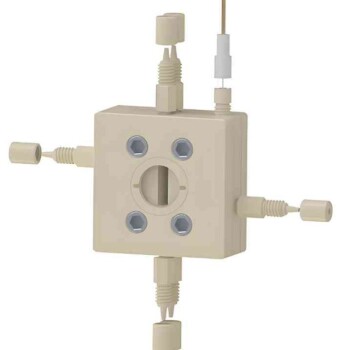
A three-electrode electrochemical cell functions as a standardized, high-precision architecture for evaluating coating performance, specifically designed to isolate the behavior of the sample material. By separating the current-carrying circuit from the potential-measuring circuit, this system provides the stable environment necessary for Electrochemical Impedance Spectroscopy (EIS) to quantify corrosion resistance without destroying the coating.
The Core Insight: The three-electrode setup solves the problem of signal interference. By using a chemically inert counter electrode to handle current and a stable reference electrode to set the baseline, the system ensures that all measured impedance data—specifically charge transfer and pore resistance—originates exclusively from the coating and substrate being tested.
The Anatomy of the System
To understand how this system evaluates corrosion, you must understand the distinct role of each component within the circuit.
The Working Electrode (The Sample)
This is the specific material you are evaluating, such as a magnesium alloy or borided steel coated with a protective layer.
In this configuration, the sample is the only variable. The system measures how this specific surface reacts to electrical perturbations, providing data on the coating's integrity and lifespan.
The Reference Electrode (The Baseline)
To measure change accurately, you need a standard that does not change. The reference electrode, often Silver/Silver Chloride (Ag/AgCl) or Saturated Calomel (SCE), provides this stable potential baseline.
It does not participate in the current flow. Its sole function is to maintain a fixed potential against which the working electrode is measured, ensuring data is reproducible across different tests.
The Counter Electrode (The Conduit)
Also known as the auxiliary electrode, this component completes the current loop with the working electrode.
Crucially, it is made of highly conductive, chemically inert materials like platinum. Because platinum resists reaction even in harsh environments (like HCl or H2SO4), it ensures that the electrode itself does not corrode or skew the data.
Quantifying Protection via EIS
The primary output of this system is data derived from Electrochemical Impedance Spectroscopy (EIS). The three-electrode setup enables the calculation of specific resistance parameters.
Measuring Pore Resistance
The system detects the difficulty electrical current faces when passing through pores or defects in the coating.
High pore resistance generally indicates a barrier that is intact and effectively blocking corrosive elements from reaching the metal substrate.
Measuring Charge Transfer Resistance
This parameter measures the ease with which electrons can transfer at the metal-electrolyte interface beneath the coating.
This is critical for assessing active protection. If the coating releases corrosion inhibitors, the charge transfer resistance will reflect the effectiveness of these inhibitors in slowing down the electrochemical reactions at the surface.
Quantitative, Non-Destructive Evaluation
Unlike salt spray tests which rely on visual inspection after failure, this setup provides quantitative data (such as Polarization Resistance, Rp).
It allows you to predict the anti-corrosion lifespan of the sample without physically destroying it, allowing for time-dependent monitoring of coating degradation.
Understanding the Trade-offs
While the three-electrode system is the gold standard for accuracy, it introduces complexities that simpler measurements avoid.
Complexity of Setup
Unlike a simple two-electrode resistance test, this system requires precise geometric alignment. The placement of the reference electrode relative to the working electrode is critical to minimize voltage drop errors (uncompensated resistance).
Material Costs and Maintenance
The reliability of the system hinges on the quality of the non-working electrodes. Platinum counter electrodes are expensive, and reference electrodes (like Ag/AgCl) require careful storage and maintenance to prevent potential drift, which would invalidate the "stable baseline."
Making the Right Choice for Your Goal
The three-electrode system is a tool for precision. Here is how to apply it based on your specific objectives.
- If your primary focus is evaluating new inhibitor technology: Focus on the charge transfer resistance trends over time to see if the inhibitors are actively passivating the metal surface.
- If your primary focus is Quality Control of barrier coatings: Focus on pore resistance values to detect microscopic defects or insufficient coating thickness before visible failure occurs.
- If your primary focus is testing in harsh acidic environments: Ensure your counter electrode is platinum, as lesser materials will degrade and contaminate the electrolyte, rendering the impedance data useless.
Ultimately, the three-electrode cell transforms corrosion testing from a subjective observation of rust into an objective, quantifiable science.
Summary Table:
| Component | Role | Common Material | Key Function in Evaluation |
|---|---|---|---|
| Working Electrode | Sample under test | Coated Metal/Alloy | Acts as the variable to measure coating degradation. |
| Reference Electrode | Stable baseline | Ag/AgCl or SCE | Provides a fixed potential to ensure measurement reproducibility. |
| Counter Electrode | Current conduit | Platinum | Completes the circuit without reacting or contaminating data. |
| EIS Analysis | Data Output | Impedance Metrics | Quantifies pore resistance and charge transfer resistance. |
Elevate Your Corrosion Research with KINTEK
Precision in electrochemical analysis starts with reliable hardware. KINTEK specializes in high-performance laboratory equipment, providing researchers with the high-quality electrolytic cells and electrodes (including platinum counter electrodes and stable reference probes) necessary for accurate corrosion evaluation.
Whether you are developing advanced coatings for magnesium alloys or testing barrier resistance in harsh acidic environments, our comprehensive range of laboratory solutions—from high-temperature furnaces for material synthesis to precision milling systems—ensures your lab is equipped for excellence.
Ready to achieve more accurate, reproducible data? Contact our technical experts today to find the perfect electrochemical setup for your specific research goals.
References
- Jen Yang Yap, Zakaria Man. Release kinetics study and anti-corrosion behaviour of a pH-responsive ionic liquid-loaded halloysite nanotube-doped epoxy coating. DOI: 10.1039/d0ra01215g
This article is also based on technical information from Kintek Solution Knowledge Base .
Related Products
- H Type Electrolytic Cell Triple Electrochemical Cell
- PTFE Electrolytic Cell Electrochemical Cell Corrosion-Resistant Sealed and Non-Sealed
- Electrolytic Electrochemical Cell with Five-Port
- Electrolytic Electrochemical Cell Gas Diffusion Liquid Flow Reaction Cell
- FS Electrochemical Hydrogen Fuel Cells for Diverse Applications
People Also Ask
- What is a H type cell? A Guide to Divided Electrochemical Cells for Accurate Experiments
- How should the electrolyte be prepared and added to the H-type electrolytic cell? Best Practices for Purity and Safety
- What is the technical necessity of using an H-type electrolytic cell for NO3RR tests? Protect Your Ammonia Yields
- How does the design of an H-type electrolytic cell benefit the neutral water electrolysis process for metal recovery?
- What is the primary function of an H-type electrolytic cell in NitRR? Ensure Accurate Product Yields