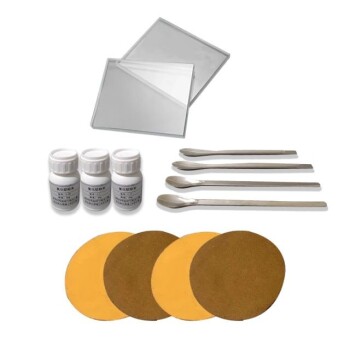
Physical grinding serves as a critical mechanical restoration technique for electrode surfaces. By utilizing fine sandpaper or high-purity alumina polishing slurries, you physically strip away stubborn contaminants or passivated layers that chemical solvents are unable to dissolve.
When chemical cleaning proves insufficient, physical grinding mechanically removes degraded surface layers to expose fresh, electrochemically active material. This process is essential for recovering the electron transfer speed of passivated electrodes.
The Mechanism of Surface Renewal
Mechanical Stripping
Over time, electrode surfaces accumulate deposits or form passivated oxide layers that block electrochemical activity.
Chemical solvents are often unable to dissolve these stubborn barriers. Physical grinding uses abrasion to mechanically scrape these layers off the surface, rather than relying on chemical reactions to remove them.
Exposing Active Sites
The fundamental mechanism at play is the exposure of fresh material.
By grinding away the degraded outer surface, you reveal underlying electrochemical sites that are pristine and active. This direct exposure is necessary to re-establish an efficient interface for electron transfer.
Purpose and Application
Restoring Response Speed
Degraded surfaces often result in sluggish electrochemical responses.
For materials like glassy carbon or various metals, the physical removal of the "dead" layer is critical. This restoration allows the electrode to recover its original electrochemical response speed and sensitivity.
Addressing Chemical Limitations
This method is specifically designed for scenarios where chemical solvents fail.
It acts as a more aggressive, definitive solution for cleaning when standard solvent-based washing cannot dislodge strong deposits or break down chemically inert oxide layers.
Operational Considerations
Subtractive Process
It is important to recognize that physical grinding is a subtractive method.
Unlike washing with a solvent, you are intentionally removing a portion of the electrode material to reach the active layer beneath. This distinguishes it as a restoration procedure rather than a simple cleaning step.
Making the Right Choice for Your Goal
To determine if physical grinding is the correct approach for your current electrode state, consider the following:
- If your primary focus is removing light, soluble contamination: Attempt cleaning with chemical solvents first to preserve the electrode surface.
- If your primary focus is reviving a sluggish or passivated electrode: Use physical grinding to mechanically strip the oxide layer and expose fresh active sites.
Physical grinding is the definitive method for resetting an electrode's surface state when chemical methods are exhausted.
Summary Table:
| Feature | Physical Grinding/Polishing | Chemical Cleaning |
|---|---|---|
| Mechanism | Mechanical abrasion & surface stripping | Chemical dissolution of residues |
| Best For | Passivated layers & stubborn deposits | Light, soluble surface contaminants |
| Result | Exposes fresh, active material | Cleans existing surface without removal |
| Effect | Restores electron transfer speed | Maintains surface integrity |
| Materials | Alumina slurries, fine sandpaper | Solvents, acids, or bases |
Elevate Your Electrochemical Precision with KINTEK
Is your research being hindered by sluggish electrode responses or surface passivation? KINTEK specializes in premium laboratory equipment and high-performance consumables designed for the most demanding scientific applications. From precision electrolytic cells and electrodes to specialized crushing and milling systems for sample preparation, we provide the tools you need to maintain peak analytical accuracy.
Whether you are performing battery research or high-temperature material synthesis, our comprehensive range—including high-temperature furnaces, vacuum systems, and ceramic crucibles—ensures your lab operates at the cutting edge.
Don't let degraded equipment compromise your results. Contact KINTEK today to discover how our expert solutions and high-quality consumables can streamline your workflow and restore your lab's efficiency!
References
- Arthur J. Shih, Marc T. M. Koper. Water electrolysis. DOI: 10.1038/s43586-022-00164-0
This article is also based on technical information from Kintek Solution Knowledge Base .
Related Products
- Electrode Polishing Material for Electrochemical Experiments
- Graphite Disc Rod and Sheet Electrode Electrochemical Graphite Electrode
- Laboratory CVD Boron Doped Diamond Materials
People Also Ask
- How do you prepare the polishing setup for an electrode? Achieve a Flawless Mirror Finish for Reliable Electrochemistry
- What is the general procedure and what precautions should be taken during the polishing process? Achieve a Flawless Electrode Finish
- What are the electrode materials? A Guide to Choosing the Right Conductor for Your Application
- What are the examples of electrode materials? From Platinum to Graphite for Your Application
- How is a polished electrode tested for quality? Validate Performance with Cyclic Voltammetry