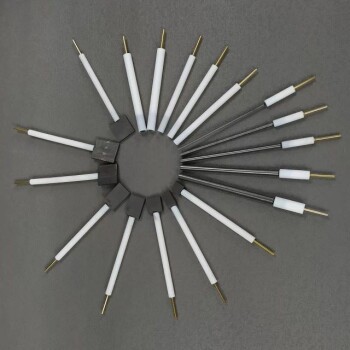
The necessity of an RRDE system lies in its unique ability to isolate and quantify intermediate species in real-time. By using a dual-electrode configuration, researchers can capture hydrogen peroxide ($H_2O_2$) at the ring electrode immediately after it is generated at the disk. This setup provides the definitive data required to calculate $H_2O_2$ selectivity and determine whether a catalyst follows a 2-electron or 4-electron pathway.
The RRDE system, paired with a multi-channel electrochemical workstation, transforms a standard reduction experiment into a diagnostic tool. It bridges the gap between measuring total current and understanding the specific chemical mechanism by providing real-time detection of reaction intermediates.
Controlling Mass Transfer with Precision
Eliminating Diffusion Limitations
The RRDE system establishes a controlled mass transfer environment at the electrode surface by precisely regulating the rotation frequency. High-speed rotation creates a stable laminar boundary layer, ensuring that reactants are delivered to the electrode at a consistent rate.
Establishing Steady-State Conditions
By controlling the rotation, researchers can eliminate the unpredictability of diffusion within the bulk solution. This allows for the extraction of intrinsic kinetic parameters, such as exchange current density and half-wave potential, which are otherwise masked in stationary setups.
The Dual-Electrode Mechanism
Real-Time Intermediate Detection
The core advantage of RRDE is the presence of the ring electrode surrounding the central disk. As the disk electrode reduces oxygen, the resulting products are swept outward by centrifugal force toward the ring.
Simultaneous Monitoring
A multi-channel electrochemical workstation (or bipotentiostat) allows for the simultaneous monitoring of oxygen reduction currents on the disk and intermediate oxidation currents on the ring. This dual-stream data is essential for identifying chemical species that exist only briefly during the reaction.
Distinguishing Reaction Pathways
The system is indispensable for distinguishing between the two-electron pathway (which produces $H_2O_2$) and the four-electron pathway (which produces $H_2O$). By measuring the ring current, researchers can calculate the electron transfer number (n) and the exact yield of peroxide intermediates.
Hardware and Selectivity Calculations
The Necessity of a Bipotentiostat
Studying $H_2O_2$ generation requires a specialized electrochemical workstation capable of independent potential control. A bipotentiostat is required to hold the disk at a reduction potential while simultaneously holding the ring at an oxidation potential to "catch" the intermediates.
Quantifying Faradaic Efficiency
The RRDE technique enables the quantitative analysis of 2-electron reaction pathway selectivity. By comparing the ring current to the disk current, scientists can determine the Faradaic efficiency of the $H_2O_2$ synthesis process.
Understanding the Trade-offs and Pitfalls
Collection Efficiency Limitations
Not every molecule of $H_2O_2$ produced at the disk will reach the ring; some escape into the bulk solution. Researchers must accurately determine the collection efficiency (N) of their specific electrode geometry to ensure their selectivity calculations are mathematically sound.
Surface and Alignment Sensitivity
The accuracy of RRDE data is highly dependent on the physical condition of the electrodes. Improper alignment or surface roughness can disrupt the laminar flow, leading to turbulence that invalidates the standard mass-transfer equations used for kinetic analysis.
Making the Right Choice for Your Research
If you are evaluating new catalysts for fuel cells or peroxide production, choosing the right electrode configuration is critical to your success.
- If your primary focus is intrinsic kinetics: Use a standard Rotating Disk Electrode (RDE) to extract exchange current densities and overpotentials without the complexity of a ring electrode.
- If your primary focus is reaction pathway elucidation: Utilize a full RRDE system with a multi-channel workstation to quantify $H_2O_2$ yield and distinguish between 2e- and 4e- mechanisms.
- If your primary focus is H2O2 synthesis efficiency: Deploy the RRDE setup to calculate Faradaic efficiency and optimize catalyst selectivity for peroxide production.
The RRDE system remains the gold standard for any researcher needing to move beyond simple current measurements to achieve a deep, mechanistic understanding of electrochemical reactions.
Summary Table:
| Feature | Function in RRDE System | Research Benefit |
|---|---|---|
| Controlled Rotation | Establishes stable laminar boundary layer | Eliminates diffusion limits; extracts intrinsic kinetics |
| Ring Electrode | Captures intermediates (e.g., $H_2O_2$) from disk | Distinguishes between 2-electron and 4-electron pathways |
| Bipotentiostat | Independent potential control for disk and ring | Simultaneous monitoring of reduction and oxidation currents |
| Collection Efficiency (N) | Mathematical calibration of electrode geometry | Enables precise calculation of Faradaic efficiency |
| Mass Transfer Control | Regulates reactant delivery rate | Provides steady-state conditions for kinetic analysis |
Elevate Your Electrochemical Research with KINTEK
To accurately decipher complex reaction mechanisms like $H_2O_2$ generation, precision is non-negotiable. KINTEK specializes in providing high-performance laboratory equipment designed for the most demanding electrochemical applications. Whether you are developing next-generation fuel cell catalysts or optimizing peroxide synthesis, our precision-engineered electrolytic cells, electrodes, and multi-channel workstations provide the reliability your data deserves.
Beyond electrochemistry, KINTEK offers a comprehensive range of solutions, including:
- High-Temperature Systems: Muffle, tube, vacuum, and CVD furnaces.
- Material Processing: Hydraulic presses, crushing, milling, and sieving equipment.
- Reaction & Storage: High-pressure reactors, autoclaves, and ULT freezers.
- Lab Essentials: PTFE products, ceramics, and high-purity crucibles.
Ready to achieve definitive mechanistic insights? Contact our technical experts today to find the perfect RRDE setup and consumables tailored to your research goals.
References
- Fengting He, Shaobin Wang. Rejoint of Carbon Nitride Fragments into Multi‐Interfacial Order‐Disorder Homojunction for Robust Photo‐Driven Generation of H<sub>2</sub>O<sub>2</sub>. DOI: 10.1002/adma.202307490
This article is also based on technical information from Kintek Solution Knowledge Base .
Related Products
- RRDE rotating disk (ring disk) electrode / compatible with PINE, Japanese ALS, Swiss Metrohm glassy carbon platinum
- Rotating Platinum Disk Electrode for Electrochemical Applications
- Metal Disc Electrode Electrochemical Electrode
- Gold Disc Electrode
- Graphite Disc Rod and Sheet Electrode Electrochemical Graphite Electrode
People Also Ask
- What is the rotating ring disk electrode method? Unlock Real-Time Reaction Analysis
- Role of RRDE & Workstations in Aerogel Catalysis: Master Precise Kinetic Analysis & Electron Transfer Pathways
- What role does the RRDE play in catalyst evaluation for H2O2 synthesis? Enhance Selectivity and Kinetic Precision
- What is the RRDE in electrochemistry? Unlock Detailed Reaction Pathways with Dual-Electrode Analysis
- What is the application of RRDE? Unlock Quantitative Catalyst and Reaction Insights