Grinding raw materials to less than 75 microns is a critical preparation step designed to ensure extreme chemical homogenization and maximize the reaction contact area. This micron-level pulverization eliminates component segregation and accelerates solid-state reactions during the carbothermic reduction process. By removing physical barriers to interaction, researchers can accurately isolate and measure how specific chemical variables, such as the $Al_2O_3/SiO_2$ ratio, influence slag formation kinetics.
In smelting simulations, reducing particle size to the micron level transforms a heterogeneous mixture into a reactive pseudo-homogeneous medium. This allows for the precise study of chemical interactions by ensuring that reaction rates are governed by chemistry rather than physical proximity.
The Role of Particle Size in Reaction Kinetics
Maximizing Effective Surface Area
Smelting is fundamentally a contact-driven chemical process. By grinding materials like manganese ore and coke to less than 75 microns, the total surface area available for chemical interaction increases exponentially. This ensures that solid-state reactions occur rapidly once high temperatures are reached.
Eliminating Component Segregation
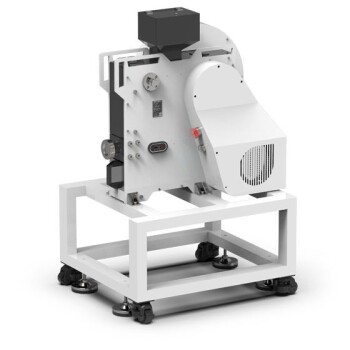
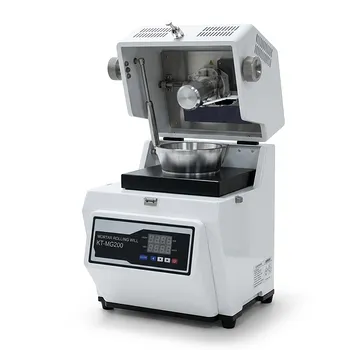
Raw materials possess varying densities, shapes, and sizes which naturally lead to "nesting" or separation. Micron-level grinding using laboratory-grade milling equipment ensures these materials are distributed evenly throughout the sample. This uniform distribution is essential for producing repeatable and reliable experimental data.
Accelerating Carbothermic Reduction
The reduction of manganese ore by coke requires intimate physical contact at the atomic level. Pulverizing the mixture ensures that the carbon source is always in immediate proximity to the ore particles. This setup mimics the "ideal" state required to observe the true chemical potential of the reduction process.
Ensuring Experimental Accuracy
Isolating Chemical Variables
In metallurgical research, the goal is often to observe how a specific ratio, such as $Al_2O_3$ to $SiO_2$, affects slag fluidity and formation. If particles are too large, the results are skewed by the "luck" of which particles happen to be touching. Fine grinding removes this "noise," allowing the chemical influence of the slag components to be the primary driver of the results.
Promoting Rapid Slag Formation
As the temperature rises, the ground particles begin to fuse into a liquid slag phase. Small particles melt and interact much more predictably than large chunks. This allows for a granular look at the kinetics of slag formation, providing a clear window into how the melt evolves over time.
Understanding the Trade-offs
Equipment and Energy Requirements
Achieving a consistent sub-75-micron powder requires specialized planetary ball mills or high-energy vibratory mills. This process is energy-intensive and time-consuming compared to standard crushing. Researchers must weigh the need for precision against the time required for sample preparation.
Practicality vs. Simulation
It is important to recognize that industrial smelting furnaces do not operate with 75-micron powders; they use much larger "lump" ore and coke. These laboratory simulations are not intended to replicate the physical furnace burden exactly. Instead, they are designed to establish the fundamental chemical limits and behaviors of the materials involved.
How to Apply These Standards to Your Project
Recommendations for Material Preparation
- If your primary focus is kinetic precision: Utilize a 75-micron threshold to ensure that your data reflects chemical reaction rates rather than physical transport limitations.
- If your primary focus is evaluating raw material quality: Ensure you use laboratory-grade milling to prevent the inherent impurities in manganese ore from clustering in the sample.
- If your primary focus is industrial scaling: Use the results from these fine-powder simulations as a "best-case scenario" baseline to compare against larger-scale pilot tests.
Achieving the 75-micron threshold is the definitive method for isolating fundamental chemical behavior from physical interference in metallurgical simulation.
Summary Table:
| Key Factor | Impact on Smelting Simulation |
|---|---|
| Surface Area | Exponentially increases contact area to accelerate carbothermic reduction. |
| Homogeneity | Eliminates component segregation to ensure repeatable, reliable data. |
| Reaction Kinetics | Ensures reaction rates are driven by chemistry rather than physical proximity. |
| Variable Isolation | Allows precise study of slag formation kinetics (e.g., $Al_2O_3/SiO_2$ ratios). |
Optimize Your Smelting Research with KINTEK Precision
Achieving the perfect 75-micron threshold requires high-performance laboratory equipment. KINTEK specializes in the tools you need for accurate metallurgical simulation, including:
- Sample Preparation: High-energy planetary ball mills and crushing systems for consistent micron-level pulverization.
- Smelting Simulation: A comprehensive range of high-temperature furnaces (muffle, atmosphere, vacuum, and induction melting) to study slag kinetics.
- Analysis & Processing: Sieving equipment for particle size verification and hydraulic presses for pelletizing raw materials.
Ensure your experimental data reflects true chemical potential—not physical limitations. Contact KINTEK today to find the ideal solution for your laboratory’s research and development needs!
References
- Michel Kalenga WA KALENGA, Didier Kasongo NYEMBWE. impact of Al2O3/SiO2 on the SLAG system in the COKE BED zone during high carbon ferromanganese production using basic manganese ores. DOI: 10.37904/metal.2023.4625
This article is also based on technical information from Kintek Solution Knowledge Base .
Related Products
- Laboratory Jaw Crusher
- Laboratory Grinding Mill Mortar Grinder for Sample Preparation
- Laboratory Jar Mill with Agate Grinding Jar and Balls
- High Energy Planetary Ball Mill Milling Machine for Laboratory
- High Energy Planetary Ball Mill Milling Machine for Laboratory
People Also Ask
- What role do laboratory crushers and standard sieves play in Datura stramonium pretreatment? Optimize Your HTL Yield
- What is a laboratory crusher? The First Step to Accurate Sample Analysis
- What is the primary function of a laboratory crusher? Optimize Biomass & Coal Co-Gasification Efficiency
- What is a jaw crusher for labs? The Essential First Step for Accurate Sample Analysis
- How does a jaw crusher contribute to the primary processing of slate waste? Optimize Your Size Reduction Workflow