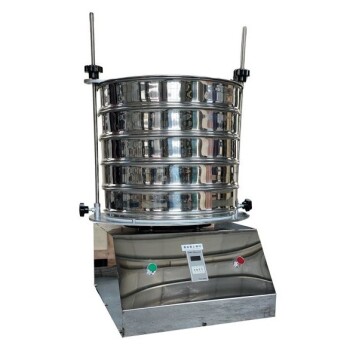
Using a 100 mesh standard sieve is a critical quality control step that ensures biomass raw materials possess a uniform particle size before undergoing thermal and chemical processing. By unifying these dimensions, researchers eliminate variances in heat and mass transfer that occur when particles have different diameters. This synchronization allows pyrolysis and activation reactions to proceed at a consistent rate, resulting in activated carbon with a uniform pore structure and predictable adsorption performance.
Grading biomass with a 100 mesh sieve creates a homogeneous material foundation that synchronizes reaction kinetics. This precision ensures that every particle undergoes identical thermal and chemical treatment, which is essential for producing activated carbon with scientifically reproducible properties and stable performance.
Synchronizing Reaction Kinetics
Eliminating Heat and Mass Transfer Gradients
When biomass particles vary in size, heat penetrates the core of smaller particles faster than larger ones. Using a 100 mesh sieve (which filters particles to approximately 150 microns) ensures that thermal energy is distributed evenly across the entire sample. This uniformity prevents the "over-processing" of fines or the "under-processing" of larger chunks, leading to a more homogeneous carbonized product.
Achieving Chemical Homogeneity
The preparation of activated carbon often involves mixing biomass with chemical activators like KOH, H3PO4, or ZnCl2. A uniform particle size ensures that the surface-to-volume ratio remains constant across the sample, allowing the activator to penetrate the biomass structure evenly. This consistency is vital for creating a regularity in the resulting pore structure, which directly influences the performance of the final composite material.
Impact on Pore Development and Adsorption
Structural Uniformity in the Carbon Matrix
The primary goal of activation is to develop a high internal surface area through a network of micro and mesopores. By grading the material to a specific mesh size, the reaction rates remain consistent throughout the activation stage. This results in a carbon matrix where the pore distribution is balanced, rather than having localized areas of high or low porosity.
Ensuring Reproducibility in Kinetic Studies
For researchers, the use of a standard analytical sieve is a prerequisite for scientific accuracy. Consistent particle sizes eliminate the influence of varying dimensions on diffusion rates during adsorption experiments. This allows for the establishment of accurate predictive models and ensures that results can be compared across different studies without the "noise" of particle size interference.
Understanding the Trade-offs
While grading to a 100 mesh size offers superior control, it introduces specific challenges into the production workflow. Material loss is a common issue, as biomass that does not meet the strict size requirement must be reground or discarded, potentially lowering the overall yield of the process.
Furthermore, extremely fine powders can lead to processing difficulties in industrial settings. Very small particles can cause high pressure drops in fixed-bed reactors or lead to dusting issues. It is important to balance the need for uniformity and high surface area with the practical fluid dynamic characteristics required for the final application.
How to Apply This to Your Project
Making the Right Choice for Your Goal
- If your primary focus is scientific research and kinetics: Utilize a 100 mesh sieve to ensure maximum reproducibility and to eliminate particle size as a variable in your adsorption models.
- If your primary focus is maximizing adsorption capacity: Use the sieve to guarantee that chemical activators like KOH react synchronously with the biomass, creating the most uniform pore distribution possible.
- If your primary focus is industrial-scale production: Consider the trade-offs between the precision of 100 mesh grading and the energy costs of grinding, potentially opting for a slightly coarser grade if mass transfer limits allow.
By precisely controlling the particle size of your raw materials, you lay the necessary foundation for high-performance, predictable, and scientifically sound activated carbon production.
Summary Table:
| Key Aspect | Impact of 100 Mesh Sieving | Benefit to Activated Carbon |
|---|---|---|
| Particle Size | Ensures uniformity (~150 microns) | Prevents localized over/under-processing |
| Heat Transfer | Eliminates thermal gradients | Homogeneous carbonization and reaction kinetics |
| Mass Transfer | Uniform surface-to-volume ratio | Even penetration of chemical activators (KOH, ZnCl2) |
| Pore Structure | Synchronized reaction rates | Regular distribution of micro and mesopores |
| Scientific Data | Standardized material baseline | Reproducible adsorption models and results |
Elevate Your Activated Carbon Research with KINTEK Precision
Achieving scientific reproducibility in activated carbon production starts with the right equipment. KINTEK specializes in high-performance laboratory solutions designed to streamline your material preparation and thermal processing workflows.
Whether you are grading biomass, refining chemical activation, or scaling up production, we offer:
- Sieving & Milling: Precision analytical sieving equipment and crushing systems to achieve the perfect 100 mesh consistency.
- Thermal Processing: High-temperature muffle, tube, and vacuum furnaces for precise carbonization and activation.
- Chemical Synthesis: Advanced high-temperature high-pressure reactors and autoclaves for chemical impregnation.
- Auxiliary Tools: High-purity ceramics, crucibles, and specialized laboratory consumables.
Ready to ensure the highest quality for your carbon matrix? Contact KINTEK today to consult with our experts on the ideal equipment configuration for your lab's specific needs!
References
- Min Hou, Can Liu. Preparation of Biomass Biochar with Components of Similar Proportions and Its Methylene Blue Adsorption. DOI: 10.3390/molecules28176261
This article is also based on technical information from Kintek Solution Knowledge Base .
Related Products
- Custom PTFE Teflon Parts Manufacturer for PTFE Mesh F4 Sieve
- Three-dimensional electromagnetic sieving instrument
- Laboratory Test Sieves and Sieving Machines
People Also Ask
- What are the primary reasons for selecting PTFE as a matrix? Enhance Composites with Carbon Nanotube Reinforcement
- How is PTFE utilized for insulation in Alloy 22 corrosion setups? Ensure Signal Purity & Accuracy
- Is PTFE corrosion resistant? Discover the Ultimate Chemical Resistance for Your Lab
- What are the specific applications of PTFE in micro-batch slug flow systems? Enhance Your Microfluidic Reaction Purity
- What is the mesh size of a sieve? A Guide to Particle Size and Sieve Selection