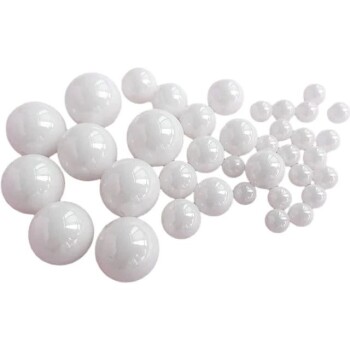
High-hardness zirconia grinding balls serve a dual critical function: delivering the necessary impact force to refine hard materials while strictly maintaining chemical purity. They are specifically selected to pulverize robust ceramic fillers, such as garnet-type LLZO, into fine particles without shedding contaminants into the mixture. This combination of physical power and chemical inertness ensures the resulting PEO-based composite electrolyte retains both high ionic conductivity and electrochemical stability.
The use of zirconia media is a strategic choice to balance mechanical efficiency with material integrity. By generating high-energy impact without introducing wear debris, these grinding balls enable the creation of the ultra-fine, pure fillers required to maximize lithium-ion transport.
The Role of Mechanical Refinement
Overcoming Material Hardness
Inorganic fillers used in solid-state electrolytes, particularly garnet-type ceramics like LLZO, are inherently hard.
Softer grinding media cannot generate sufficient force to break these materials down effectively.
High-density zirconia balls provide the intense impact energy required to fracture these robust ceramic structures efficiently.
Increasing Specific Surface Area
The goal of the milling process is to reduce fillers to the micrometer or nanometer scale.
Zirconia balls facilitate this by delivering consistent, high-energy collisions in a planetary ball mill.
This pulverization ensures a uniform particle size distribution, which drastically increases the specific surface area of the filler material.
Enhancing PEO Conductivity
The physical size of the filler directly impacts the chemistry of the PEO (polyethylene oxide) polymer.
Fine, nanometer-sized fillers inhibit the crystallization of PEO polymer chains.
By preventing crystallization, these fillers increase the proportion of amorphous regions in the polymer, which significantly improves the efficiency of lithium-ion transport.
Ensuring Chemical Integrity
Preventing Metallic Contamination
Standard metal grinding balls, such as steel, pose a significant risk of introducing impurities like iron fragments into the powder.
Zirconia offers exceptional wear resistance, ensuring that the grinding media does not degrade and mix with the product even during high-energy processing.
Maintaining Chemical Inertness
PEO-based electrolytes are sensitive to chemical composition changes.
Zirconia is chemically stable and inert, meaning it will not react with the ceramic fillers or the polymer matrix.
This inertness is vital for preventing side reactions that could degrade the material's performance.
Safeguarding Electrochemical Stability
The presence of impurities—whether metallic debris or reaction byproducts—can prove fatal to a battery's function.
Contaminants can lead to a decrease in ionic conductivity or a narrowing of the electrochemical window.
By eliminating these variables, zirconia media ensures the final electrolyte remains stable under operating voltage conditions.
Understanding the Trade-offs
The Risk of Insufficient Hardness
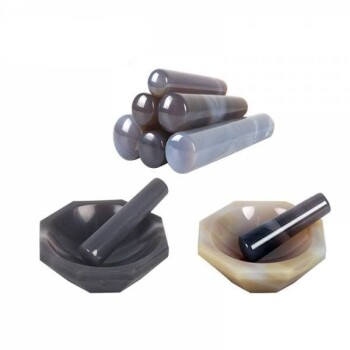
Using grinding media softer than zirconia (such as agate or lower-grade alumina) often results in inefficient milling.
This leads to larger particle sizes, which fail to effectively reduce PEO crystallinity, resulting in poor ionic conductivity.
The Cost of Contamination
While metallic grinding media may be less expensive or readily available, the "savings" are negated by performance failure.
Even trace amounts of metallic wear debris can create conductive pathways that lead to short circuits or catalytic degradation of the electrolyte.
In the context of PEO-based composites, there is no acceptable trade-off for purity; the use of wear-resistant ceramic media is a technical necessity, not a luxury.
Making the Right Choice for Your Goal
When setting up your milling protocol for composite electrolytes, align your parameters with your specific performance targets:
- If your primary focus is maximizing ionic conductivity: Prioritize high-energy milling with zirconia to achieve the smallest possible filler particle size, maximizing the amorphous regions in the PEO matrix.
- If your primary focus is electrochemical stability: Ensure the use of high-quality, wear-resistant zirconia to absolutely minimize impurity introduction and prevent voltage window degradation.
By selecting high-hardness zirconia, you ensure that the physical processing of your materials does not compromise their chemical potential.
Summary Table:
| Feature | Zirconia Grinding Media | Benefit for PEO-based Electrolytes |
|---|---|---|
| High Hardness | Effectively pulverizes hard ceramics like LLZO | Achieves nanometer-scale fillers for better Li-ion transport |
| Wear Resistance | Minimal degradation during high-energy milling | Prevents metallic contamination and short circuits |
| Chemical Inertness | Does not react with polymer or ceramic fillers | Maintains electrochemical stability and voltage window |
| High Density | Increases impact force in planetary mills | Reduces PEO crystallinity to boost ionic conductivity |
Elevate Your Battery Research with KINTEK Precision
Achieving the perfect balance of particle size and chemical purity is critical for high-performance PEO-based composite electrolytes. KINTEK specializes in providing top-tier laboratory equipment, including high-density zirconia grinding balls, advanced crushing and milling systems, and high-precision planetary ball mills designed for rigorous research environments.
Whether you are processing garnet-type fillers or optimizing polymer matrices, our comprehensive range of tools—from hydraulic pellet presses to vacuum furnaces and ULT freezers—ensures your materials meet the highest standards of excellence.
Ready to optimize your milling process? Contact us today to find the perfect grinding solutions for your lab!
Related Products
- Precision Machined Zirconia Ceramic Ball for Engineering Advanced Fine Ceramics
- Engineering Advanced Fine Ceramics Head Tweezers with Pointed Elbow Zirconia Ceramic Tip
- Laboratory High Throughput Tissue Grinding Mill Grinder
- High Energy Planetary Ball Mill Milling Machine for Laboratory
- High Energy Planetary Ball Mill Milling Machine for Laboratory
People Also Ask
- What are the applications of zirconia ceramics? Unlock High-Performance Solutions for Extreme Environments
- What is the physical mechanism for selecting hard grinding media? Optimize Your ZrC-Al Matrix Composite Production
- Why are zirconia milling balls preferred for P2-type layered oxides? Ensure High Purity and Grinding Efficiency
- What is the purpose of using zirconia milling balls of different diameters? Optimize Solid Electrolyte Processing
- Why are zirconia grinding jars and balls required for solid-state electrolyte powders? Ensure High Purity & Performance