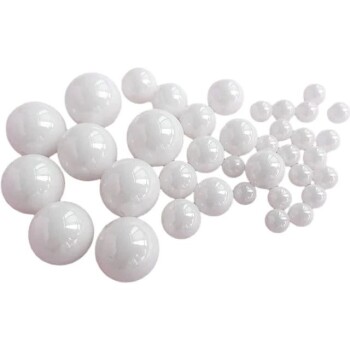
The recommendation to use zirconia grinding balls stems from a critical need to eliminate metallic contamination and chemical side reactions. Sulfide solid electrolytes are exceptionally sensitive materials; using standard metallic grinding media inevitably introduces conductive impurities like iron or chromium. Zirconia offers a unique combination of extreme chemical inertness, high hardness, and sufficient density to pulverize these materials efficiently without degrading their electrochemical performance.
The Core Insight Sulfide electrolytes rely on high purity to maintain ionic conductivity, yet they are highly reactive to metals and moisture. Zirconia media acts as a necessary barrier, providing the mechanical force required for synthesis while remaining chemically invisible to the process.
Preserving Chemical Integrity
The primary challenge in synthesizing sulfide solid electrolytes is their chemical instability. The milling environment must be strictly controlled to prevent the material from degrading before it is even used.
Eliminating Side Reactions
Sulfide electrolytes are chemically fragile. If they come into contact with reactive grinding media, they can undergo unwanted side reactions.
Zirconia is chemically inert. It does not react with sulfide precursors, ensuring the final product remains chemically stable and true to its intended composition.
Preventing Metallic Contamination
Standard steel balls shed microscopic particles during high-energy milling. For a solid electrolyte, these particles (specifically iron and chromium) act as conductive bridges that can ruin performance.
Zirconia’s superior wear resistance prevents the introduction of these metallic impurities. This is vital for maintaining the electrical insulation required within the electrolyte layer.
The Mechanics of Efficient Milling
Beyond purity, the milling process requires significant mechanical energy to alter the material's structure. Zirconia provides the physical properties necessary to achieve this efficiently.
Facilitating Amorphization
The goal of ball milling in this context is often mechanochemical synthesis, specifically driving the material toward an amorphous (glassy) state.
Zirconia has a high density. This provides the necessary impact energy during collisions to promote amorphization effectively, often shortening the required reaction times.
Withstanding High-Energy Processing
Milling cycles for these materials can last for hours (e.g., five hours or more). Soft media would degrade rapidly under these conditions.
Zirconia’s extreme hardness allows it to withstand long durations of high-speed impact without fracturing or wearing down, ensuring consistency from the start of the batch to the finish.
Common Pitfalls to Avoid
While zirconia is the correct material choice, the physical setup of the milling process introduces other risks that must be managed to ensure success.
The Risk of Environmental Exposure
Sulfide electrolytes are not only sensitive to metals but are also prone to hydrolysis and oxidation if exposed to moisture or air.
Using zirconia balls is not enough; they must be utilized within high-quality, sealed zirconia jars. These jars must maintain an inert argon gas environment to prevent the atmosphere from degrading the moisture-sensitive sulfides.
Ignoring Media Wear
Even though zirconia is wear-resistant, it is a consumable. Over extended periods, even ceramic media can degrade.
While zirconia wear is far less detrimental than metal wear, maintaining the high ionic conductivity of the electrolyte requires minimizing all foreign matter. High-quality, high-density zirconia should always be prioritized to minimize wear debris.
Making the Right Choice for Your Goal
When setting up your ball milling parameters for sulfide electrolytes, your choice of media directly dictates the quality of your output.
- If your primary focus is Ionic Conductivity: Prioritize zirconia to absolutely prevent metallic doping, which blocks ion flow and causes short circuits.
- If your primary focus is Process Efficiency: Rely on the high density of zirconia to provide the kinetic impact energy needed to shorten reaction times and achieve homogenization quickly.
Zirconia is not just a durable consumable; it is a critical process enabler that ensures your sulfide electrolytes retain the purity required for high-performance electrochemical cycling.
Summary Table:
| Key Feature | Benefit for Sulfide Electrolytes | Impact on Final Product |
|---|---|---|
| Chemical Inertness | Prevents unwanted side reactions | Maintains chemical stability |
| Metallic-Free | Eliminates iron and chromium impurities | Prevents internal short circuits |
| High Hardness | Exceptional wear resistance | Reduces debris and contamination |
| High Density | Provides intense kinetic impact energy | Promotes efficient amorphization |
| Durability | Withstands long-duration high-energy milling | Ensures consistent batch quality |
Maximize Your Electrolyte Performance with KINTEK
Don't let metallic contamination compromise your solid-state battery research. KINTEK specializes in high-purity laboratory solutions, providing the specialized crushing and milling systems, zirconia jars, and high-density grinding media required for sensitive sulfide electrolyte synthesis.
From high-performance planetary ball mills to precision hydraulic presses and high-temperature furnaces, our comprehensive portfolio is designed to meet the rigorous demands of advanced material science.
Ready to elevate your research precision? Contact our technical experts today to find the perfect milling configuration for your lab's success.
Related Products
- Laboratory Jar Ball Mill with Alumina Zirconia Grinding Jar and Balls
- Precision Machined Zirconia Ceramic Ball for Engineering Advanced Fine Ceramics
- Laboratory Jar Mill with Agate Grinding Jar and Balls
- Laboratory Ball Mill Jar Mill with Metal Alloy Grinding Jar and Balls
- Laboratory Micro Tissue Grinding Mill Grinder
People Also Ask
- What are the primary functions of using a ball mill for BZCY72 powder? Achieve High Purity and Enhanced Sintering
- In what way does a laboratory ball mill affect material properties when modifying PHBV/pulp fiber composites?
- Why is a laboratory ball mill required for ultra-fine fly ash? Unlock Nano-Scale Adsorption Power
- What is the function of a laboratory ball mill in the preparation of AMMCs? Optimize Dispersion & Grain Refinement
- What is the function of a laboratory ball mill in the pretreatment of waste tire char (WTC)? Optimize Material Reactivity