Zirconium Oxide (ZrO2) is the industry standard for processing sulfide solid electrolytes because it offers a critical balance of physical durability and chemical neutrality. Specifically, it prevents metallic contamination that would otherwise degrade the electrolyte's performance, while providing the high density required to generate sufficient impact energy for the synthesis reaction.
The Core Insight Sulfide solid electrolytes are exceptionally sensitive to impurities and require intense mechanical energy to synthesize. Zirconium Oxide is the only material that can deliver the necessary kinetic impact without introducing conductive metal contaminants that destroy the electrolyte's ionic conductivity.
Preserving Chemical Purity
Eliminating Metallic Contamination
The primary danger in ball milling sulfide electrolytes is "doping" the material with iron or other metals from the grinding media.
Because Zirconium Oxide is a ceramic with exceptional hardness and wear resistance, it drastically reduces the amount of debris generated during milling. Unlike stainless steel, it does not shed metallic particles that would create conductive pathways and short-circuit the electrolyte's function.
Ensuring Chemical Inertness
Sulfide precursors are highly reactive materials.
ZrO2 is chemically inert, meaning it will not undergo side reactions with the active sulfide raw materials. This stability ensures that the final product maintains the specific chemical structure required for high ionic conductivity and electrochemical stability.
Benign Wear Debris
No grinding media is completely immune to wear.
However, because Zirconium Oxide is an electrical insulator, minute amounts of wear debris are far less detrimental to the electrolyte's performance than conductive metal particles. This "failure safety" is crucial for maintaining the purity of high-performance battery materials.
Maximizing Mechanical Efficiency
High Density for Impact Energy
Ball milling is not just about mixing; for solid electrolytes, it is often a mechanochemical reaction.
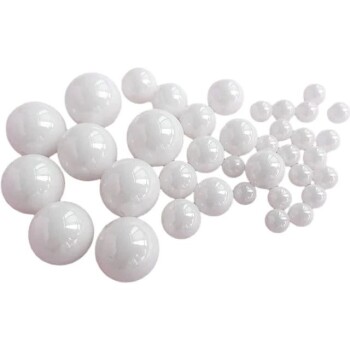
ZrO2 has a high density, which translates to greater mass per ball. This allows for the transfer of significant kinetic energy during impact, effectively driving the synthesis reaction and refining the particle size more efficiently than lighter ceramic alternatives.
Shortening Reaction Times
The combination of hardness and density allows for high-energy milling regimes.
By delivering more energy per collision, ZrO2 media can significantly shorten the reaction time required to fully homogenize the precursors. This efficiency is vital for scaling production and ensuring a uniform crystal structure.
Operational Constraints and Trade-offs
The Necessity of Sealed Environments
While the material itself is inert, the milling process introduces a secondary challenge: atmospheric sensitivity.
References highlight the use of sealed ZrO2 jars to maintain an inert Argon environment. Because sulfide electrolytes degrade rapidly upon exposure to moisture (hydrolysis), the hardness of ZrO2 must be paired with high-quality sealing mechanisms to prevent oxidation during the extended milling times.
Material Matching
It is critical to match the hardness of the jar to the balls.
Using ZrO2 balls in a softer jar (or vice versa) can lead to rapid degradation of the softer component. To maintain the purity advantages described above, both the grinding jars and the grinding balls must be made of Zirconium Oxide.
Making the Right Choice for Your Goal
When setting up your synthesis protocol, ensure your equipment aligns with your specific performance targets:
- If your primary focus is Electrochemical Stability: Prioritize high-purity ZrO2 media to eliminate any risk of metallic iron contamination, which causes voltage instability.
- If your primary focus is Process Efficiency: Utilize high-density ZrO2 balls to maximize impact energy, allowing for faster mechanochemical synthesis and finer particle distribution.
Ultimately, Zirconium Oxide is required because it is the only material tough enough to drive the reaction yet inert enough to leave the chemistry untouched.
Summary Table:
| Feature | Benefit for Sulfide Electrolytes | Impact on Battery Quality |
|---|---|---|
| High Density | Increases kinetic impact energy | Ensures complete mechanochemical synthesis |
| Wear Resistance | Minimizes debris and shedding | Prevents particle contamination |
| Chemical Inertness | No side reactions with precursors | Maintains high ionic conductivity |
| Electrical Insulation | Wear debris is non-conductive | Prevents internal short circuits |
| Material Hardness | Facilitates high-energy milling | Achieves ultra-fine particle size distribution |
Elevate Your Battery Research with KINTEK
Precise material synthesis requires precision tools. KINTEK specializes in high-performance laboratory equipment, offering premium Zirconium Oxide (ZrO2) grinding jars and balls specifically designed for the rigorous demands of sulfide solid electrolyte research.
Beyond milling solutions, we provide a comprehensive suite of equipment for advanced battery development, including:
- Crushing & Milling Systems: High-density ZrO2 solutions and planetary ball mills.
- Thermal Processing: Muffle, vacuum, and atmosphere furnaces for controlled sintering.
- Sample Preparation: Hydraulic pellet presses (manual, hot, and isostatic) and high-precision sieving equipment.
- Specialized Hardware: High-temperature high-pressure reactors, autoclaves, and electrolytic cells.
Don't compromise the purity of your solid-state materials. Contact us today to optimize your lab's workflow and ensure superior electrochemical performance!
Related Products
- Laboratory Jar Ball Mill with Alumina Zirconia Grinding Jar and Balls
- Laboratory Jar Mill with Agate Grinding Jar and Balls
- Precision Machined Zirconia Ceramic Ball for Engineering Advanced Fine Ceramics
- Laboratory Ball Mill Jar Mill with Metal Alloy Grinding Jar and Balls
- Laboratory Four-Body Horizontal Jar Mill
People Also Ask
- What are the primary functions of using a ball mill for BZCY72 powder? Achieve High Purity and Enhanced Sintering
- In what way does a laboratory ball mill affect material properties when modifying PHBV/pulp fiber composites?
- Why is a laboratory ball mill required for ultra-fine fly ash? Unlock Nano-Scale Adsorption Power
- What is the function of a laboratory ball mill in the preparation of AMMCs? Optimize Dispersion & Grain Refinement
- What is the function of a laboratory ball mill in the pretreatment of waste tire char (WTC)? Optimize Material Reactivity