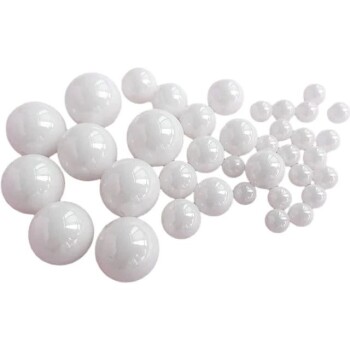
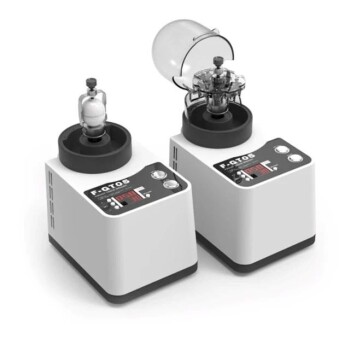
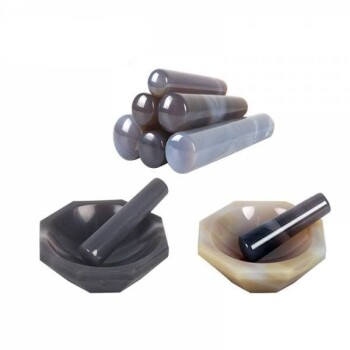
Zirconia grinding balls are the superior choice for preparing NiCrAlY-Mo-Ag composite powders because they solve the dual challenge of mechanical durability and chemical purity. They possess the high hardness and wear resistance required to refine metal powders over extended milling cycles (such as 20 hours) while their chemical stability prevents the introduction of harmful impurities that would degrade the composite's final properties.
The Core Insight Mechanical alloying is a destructive process by nature; the goal is to destroy the powder structure without destroying the grinding media. Zirconia is preferred because it withstands the kinetic energy required for refinement without shedding contaminants that would alter the chemical composition of the NiCrAlY-Mo-Ag matrix.
The Physical Requirement: Durability Under Stress
High Hardness for Effective Refinement
The preparation of NiCrAlY-Mo-Ag powders requires significant mechanical force to fracture and cold-weld particles into a composite state.
Zirconia balls possess extreme hardness, allowing them to deliver the necessary impact energy to refine these metal powders effectively. Softer media would simply deform or degrade without achieving the required particle size reduction.
Resistance to Wear During Extended Cycles
Achieving the correct composite structure often requires long processing times, specifically noted as up to 20 hours for these materials.
Zirconia exhibits excellent wear resistance, maintaining its spherical shape and mass throughout these prolonged high-energy cycles. This durability ensures consistent milling efficiency from the first hour to the last.
The Chemical Requirement: Maintaining Purity
Chemical Stability
The introduction of foreign elements during milling is a primary failure mode for composite powders.
Zirconia is chemically stable and inert. Unlike metal grinding media, it does not react with the NiCrAlY-Mo-Ag precursors, ensuring that the chemical identity of the powder remains intact.
Minimizing Impurity Contamination
In standard milling, the "wear" from the balls ends up in your powder. If you use steel balls, you introduce iron contamination, which can be detrimental to the alloy's performance.
Zirconia minimizes this issue entirely. Because of its wear resistance, very little material is lost; and because of its chemical nature, any trace wear that does occur does not introduce metallic impurities or cause side reactions within the composite.
Understanding the Trade-offs
The Reality of Media Wear
While zirconia is highly resistant, no grinding media is perfectly immune to wear during violent mechanical alloying.
The trade-off here is one of risk management: while denser materials (like tungsten carbide) might mill faster, they introduce heavy metal contamination. Zirconia strikes the optimal balance, offering enough density and hardness to grind effectively while ensuring that the inevitable micro-wear does not poison the NiCrAlY-Mo-Ag system.
Material Compatibility
In some specific applications, grinding media is chosen because it matches the material being milled (e.g., using zirconia balls to mill zirconia powder).
However, for NiCrAlY-Mo-Ag, the selection is based on inertness. You are using zirconia not because it matches the powder, but because it is distinct enough to remain neutral and refrain from altering the conductive or structural properties of the final composite.
Making the Right Choice for Your Goal
To ensure the success of your powder preparation, align your media choice with your specific processing constraints:
- If your primary focus is Purity: Select zirconia to prevent metallic contamination and side reactions, ensuring the chemical integrity of the NiCrAlY-Mo-Ag composite.
- If your primary focus is Process Stability: Rely on zirconia’s high hardness to maintain consistent grinding efficiency over long milling durations (20+ hours) without media degradation.
Ultimately, zirconia is the standard for this application because it is the only material tough enough to do the work and clean enough not to leave a trace.
Summary Table:
| Feature | Zirconia Grinding Balls | Benefit for NiCrAlY-Mo-Ag Preparation |
|---|---|---|
| Hardness | Extremely High | Effectively fractures and refines tough metal powders |
| Wear Resistance | Superior | Maintains media integrity over 20+ hour milling cycles |
| Chemical Stability | Inert | Prevents metallic contamination and side reactions |
| Milling Efficiency | Consistent | Ensures uniform particle size and composite structure |
Elevate Your Powder Synthesis with KINTEK Precision
Don't let media wear compromise your material research. KINTEK specializes in premium laboratory equipment and high-performance consumables designed for the most demanding mechanical alloying processes. From our high-density zirconia grinding balls and specialized crushing and milling systems to our precision sieving equipment and high-temperature furnaces, we provide the tools you need to achieve chemical purity and structural perfection.
Whether you are developing NiCrAlY-Mo-Ag composites or exploring new battery materials, our experts are ready to help you optimize your milling efficiency.
Contact KINTEK today for a customized solution
Related Products
- Laboratory Jar Ball Mill with Alumina Zirconia Grinding Jar and Balls
- Precision Machined Zirconia Ceramic Ball for Engineering Advanced Fine Ceramics
- Laboratory Jar Mill with Agate Grinding Jar and Balls
- Laboratory Ball Mill Jar Mill with Metal Alloy Grinding Jar and Balls
- Laboratory Micro Tissue Grinding Mill Grinder
People Also Ask
- What are the primary functions of using a ball mill for BZCY72 powder? Achieve High Purity and Enhanced Sintering
- In what way does a laboratory ball mill affect material properties when modifying PHBV/pulp fiber composites?
- Why is a laboratory ball mill required for ultra-fine fly ash? Unlock Nano-Scale Adsorption Power
- What is the function of a laboratory ball mill in the preparation of AMMCs? Optimize Dispersion & Grain Refinement
- What is the function of a laboratory ball mill in the pretreatment of waste tire char (WTC)? Optimize Material Reactivity