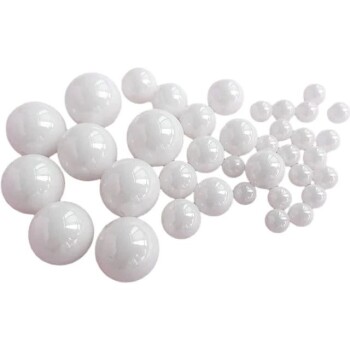
3mm zirconia grinding balls are the critical enabler for this synthesis because they provide the necessary kinetic energy without compromising the material's purity. Their high density and hardness generate sufficient impact force to drive the mechanochemical reaction between the NaFePO4 precursor and Na2CO3, while their chemical inertness prevents the contamination of the final product with iron debris.
Core Takeaway Mechanical alloying is a delicate balance between generating force and maintaining purity. Zirconia media is selected specifically because it delivers the high-impact energy required to initiate the reaction while acting as a chemically inert barrier against metallic contamination, ensuring the electrochemical integrity of the cathode material.
The Role of Kinetic Energy in Synthesis
Generating Sufficient Impact
To synthesize Na3FePO4CO3, the milling process must generate substantial kinetic energy. 3mm zirconia balls are utilized specifically for their high density and hardness.
These physical properties allow the balls to transfer significant energy during the collision events inside the planetary ball mill.
Initiating the Mechanochemical Reaction
The synthesis is not merely mixing; it is a mechanochemical reaction.
The kinetic impact provided by the zirconia media is required to break down the crystal structures of the precursors. This energy initiates the chemical bonding between the NaFePO4 precursor and Na2CO3 to form the desired compound.
Maintaining Electrochemical Purity
Preventing Metallic Contamination
A critical challenge in mechanical alloying is the degradation of the milling media.
Unlike steel or other metallic options, zirconia offers exceptional wear resistance. This prevents the introduction of metallic impurities, specifically iron debris, into the mixture during the high-energy milling process.
Chemical Inertness
For cathode materials, purity is paramount for performance.
Zirconia is chemically inert, meaning it does not react with the precursors or the environment. This ensures that the electrochemical purity of the Na3FePO4CO3 is maintained, which is essential for its final application in batteries.
Common Pitfalls to Avoid
The Risk of Improper Media Selection
Using media that lacks the specific hardness of zirconia can result in insufficient reaction energy. If the balls are too light or soft, the precursors may simply mix without chemically reacting.
The Consequence of Impurities
Choosing metallic grinding balls is a frequent error that leads to failure.
If iron debris from metallic balls enters the synthesis, it alters the chemical composition of the cathode. This contamination directly degrades the electrochemical performance of the final material.
Making the Right Choice for Your Goal
When setting up your mechanical alloying process for Na3FePO4CO3, your media selection dictates your success.
- If your primary focus is Reaction Efficiency: Ensure you use high-density media like zirconia to generate the kinetic impact needed to bond NaFePO4 and Na2CO3.
- If your primary focus is Product Purity: Avoid metallic media entirely to prevent iron debris from compromising the electrochemical properties of your cathode.
Select 3mm zirconia balls to achieve the optimal intersection of high reaction energy and zero contamination.
Summary Table:
| Feature | Advantage of 3mm Zirconia | Benefit for Na3FePO4CO3 Synthesis |
|---|---|---|
| High Density | Delivers massive kinetic impact | Initiates mechanochemical reaction effectively |
| Superior Hardness | Efficient energy transfer | Rapidly breaks down precursor crystal structures |
| Wear Resistance | Minimizes media degradation | Prevents metallic contamination and iron debris |
| Chemical Inertness | Non-reactive with precursors | Maintains high electrochemical purity of cathode material |
Elevate Your Material Research with KINTEK Precision Solutions
Achieving the perfect balance of high-energy impact and absolute purity is critical for advanced cathode materials like Na3FePO4CO3. At KINTEK, we specialize in providing the high-performance laboratory equipment and consumables your research demands.
From our ultra-durable 3mm zirconia grinding balls and high-precision crushing and milling systems to our specialized battery research tools, KINTEK ensures your synthesis process remains contamination-free and efficient. Whether you need reliable planetary ball mills, high-temperature furnaces, or pellet presses for your research workflow, our comprehensive portfolio is designed to deliver consistent, high-quality results.
Ready to optimize your mechanical alloying process? Contact KINTEK today to discover how our premium laboratory consumables and equipment can empower your next breakthrough.
Related Products
- Laboratory Jar Ball Mill with Alumina Zirconia Grinding Jar and Balls
- Precision Machined Zirconia Ceramic Ball for Engineering Advanced Fine Ceramics
- Laboratory Jar Mill with Agate Grinding Jar and Balls
- Laboratory Ball Mill Jar Mill with Metal Alloy Grinding Jar and Balls
People Also Ask
- What are the primary functions of using a ball mill for BZCY72 powder? Achieve High Purity and Enhanced Sintering
- In what way does a laboratory ball mill affect material properties when modifying PHBV/pulp fiber composites?
- Why is a laboratory ball mill required for ultra-fine fly ash? Unlock Nano-Scale Adsorption Power
- What is the function of a laboratory ball mill in the preparation of AMMCs? Optimize Dispersion & Grain Refinement
- What is the function of a laboratory ball mill in the pretreatment of waste tire char (WTC)? Optimize Material Reactivity