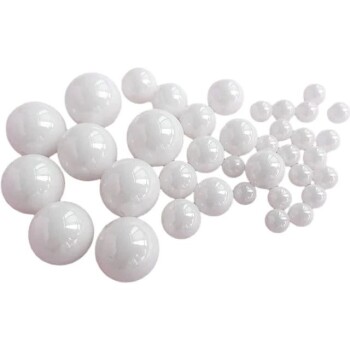
High-purity zirconia grinding balls are the definitive choice for processing Lithium Aluminum Titanium Phosphate (LATP) ceramic powders due to their superior wear resistance and chemical inertness. This selection is critical because LATP electrolytes are highly sensitive to foreign contaminants; zirconia media effectively minimizes material shedding, ensuring the chemical purity required for optimal ionic conductivity.
The Core Insight In LATP synthesis, mechanical efficiency must never compromise chemical integrity. Zirconia media solves this dual challenge by providing the high density needed to break agglomerates while possessing the extreme hardness to prevent wear-induced contamination, which is the primary antagonist to high ionic conductivity.
The Imperative of Chemical Purity
Protecting Ionic Conductivity
LATP is a solid electrolyte valued for its performance, but it is highly susceptible to degradation from impurities. The introduction of foreign elements during the grinding process can drastically reduce the material's ionic conductivity.
Eliminating Metallic Contamination
Traditional grinding media, such as steel, shed metallic particles (like iron) due to abrasive wear. Zirconia’s extreme hardness and wear resistance prevent this metallic contamination. This ensures the electrical performance of the final ceramic is not compromised after high-temperature sintering.
Inertness in Reaction
High-purity zirconia is chemically inert relative to the LATP precursor materials. By avoiding chemical reactivity during the high-energy milling process, the media preserves the stoichiometry of the mixture. This allows for the formation of a pure-phase LATP crystal structure during subsequent solid-state reactions.
Mechanical Efficiency and Particle Refinement
High-Density Impact Energy
Beyond purity, the physical properties of zirconia are essential for mechanical processing. The high density of zirconia balls provides sufficient impact energy to break down soft agglomerates found in the raw powder.
Achieving Homogeneity
The milling process, often lasting several hours, must ensure a uniform distribution of components like lithium carbonate and titanium dioxide at a microscopic scale. Zirconia media efficiently facilitates this mixing, which enhances reaction activity.
Optimizing Particle Size Distribution
For LATP, the goal is often to refine calcined coarse powder into micron-sized particles with a uniform distribution. Zirconia media effectively reduces particle size, which directly influences the density of the final ceramic pellets after molding and sintering.
Understanding the Trade-offs
The Reality of Wear
While zirconia is extremely wear-resistant, no grinding media is impervious to degradation over extended milling times (e.g., up to 50 hours). Trace amounts of zirconium dioxide (ZrO2) may eventually enter the powder mixture.
"Compatible" Contamination
The trade-off here is calculated: trace zirconium contamination is significantly less detrimental to LATP than iron or other metallic impurities. In many contexts, such as Yttria-Stabilized Zirconia (YSZ), the media is selected because its wear byproducts are chemically stable and do not catastrophically disrupt the electrochemical properties of the target material.
Making the Right Choice for Your Goal
To maximize the performance of your LATP solid electrolytes, align your grinding media selection with your specific processing targets.
- If your primary focus is Ionic Conductivity: Prioritize high-purity zirconia to eliminate metallic contamination that acts as an electron trap or impurity phase.
- If your primary focus is Sintering Density: Rely on the high density of zirconia media to achieve the fine, uniform particle size distribution necessary for dense ceramic pellets.
Success in LATP synthesis relies on balancing aggressive mechanical refinement with absolute chemical preservation.
Summary Table:
| Key Feature | Benefit for LATP Processing | Impact on Final Electrolyte |
|---|---|---|
| High Hardness | Minimizes media wear and shedding | Prevents metallic contamination |
| High Density | Provides superior impact energy | Achieves uniform micron-sized particles |
| Chemical Inertness | No reaction with precursor materials | Maintains stoichiometry and phase purity |
| Wear Resistance | Reduces byproduct introduction | Ensures high ionic conductivity |
Optimize Your Battery Research with KINTEK
Achieving the perfect LATP solid electrolyte requires more than just high-quality precursors; it demands precision processing. KINTEK specializes in advanced laboratory equipment designed for material science, including high-performance crushing and milling systems, hydraulic pellet presses, and a wide range of high-temperature furnaces (muffle, vacuum, and tube) for sintering.
From premium zirconia grinding media to specialized battery research tools and consumables, we provide the purity and efficiency your laboratory needs to push the boundaries of energy storage.
Ready to enhance your LATP synthesis? Contact KINTEK today for expert guidance and tailored equipment solutions!
Related Products
- Precision Machined Zirconia Ceramic Ball for Engineering Advanced Fine Ceramics
- High Purity Alumina Granulated Powder for Engineering Advanced Fine Ceramics
- Custom-Made Alumina Zirconia Special-Shaped Ceramic Plates for Engineering Advanced Fine Ceramics Processing
- Stainless Steel Laboratory Ball Mill for Dry Powder and Liquid with Ceramic Polyurethane Lining
- Precision Machined Yttrium Stabilized Zirconia Ceramic Rod for Engineering Advanced Fine Ceramics
People Also Ask
- What are the applications of zirconia ceramics? Unlock High-Performance Solutions for Extreme Environments
- What is the physical mechanism for selecting hard grinding media? Optimize Your ZrC-Al Matrix Composite Production
- Why are zirconia milling balls preferred for P2-type layered oxides? Ensure High Purity and Grinding Efficiency
- What is the purpose of using zirconia milling balls of different diameters? Optimize Solid Electrolyte Processing
- Why are zirconia grinding jars and balls required for solid-state electrolyte powders? Ensure High Purity & Performance