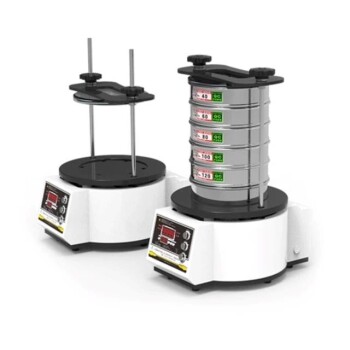
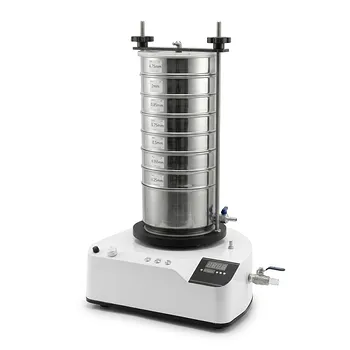
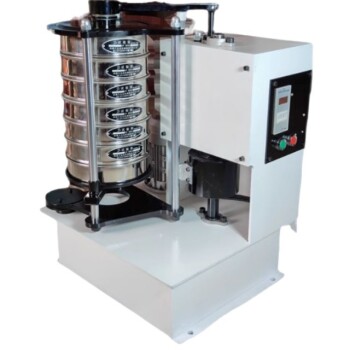
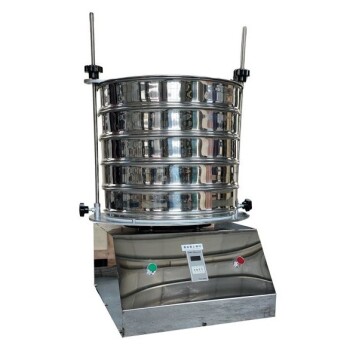
Precision vibrating sieves are used to isolate biomass particles between 60 and 90 μm to ensure they satisfy the "thermally thin" condition. By maintaining a Biot number significantly less than 0.1, internal temperature gradients become negligible, allowing researchers to isolate chemical kinetics from heat transfer effects. This specific sizing is critical for the accurate extraction and validation of kinetic models during ignition studies.
The central takeaway: Precision sieving to 60–90 μm transforms the biomass particle into a controlled laboratory specimen where ignition delay is governed by chemistry rather than physical size, ensuring that experimental data accurately reflects the fuel's intrinsic reactivity.
Achieving the Thermally Thin Condition
Eliminating Internal Temperature Gradients
In ignition studies, a particle is "thermally thin" when heat distributes through its interior much faster than it is absorbed at the surface. By using sieves to cap the size at 90 μm, the Biot number remains below 0.1, meaning the temperature remains uniform throughout the particle. This uniformity ensures that the entire mass of the particle reacts simultaneously, preventing "cold spots" that would otherwise skew data.
Simplifying Kinetic Modeling
When internal heat transfer is no longer a limiting factor, the observed ignition delay can be attributed solely to chemical kinetics. This simplification is vital for researchers because it removes the need to account for complex, three-dimensional heat conduction within the particle. It allows for the direct derivation of activation energies and reaction rates that are representative of the biomass material itself.
Ensuring Experimental Reproducibility
Reducing Heat Conduction Variations
Controlling particle size distribution is fundamental for achieving reproducible thermal analysis. If sizes vary significantly, each particle will exhibit different heat conduction behavior, leading to inconsistent ignition points. Precision sieving eliminates these variations, ensuring that every test run is representative of the batch.
Standardizing Surface-to-Volume Ratios
Small variations in particle size can lead to large differences in surface area, which dictates how the biomass interacts with oxygen and heat. By narrowing the range to 60–90 μm, researchers standardize the surface-to-volume ratio. This standardization ensures that the ignition delay measured is a result of the material’s properties rather than accidental physical dimensions.
Understanding the Trade-offs and Pitfalls
The Challenge of Representative Sampling
While a narrow 60–90 μm fraction is excellent for kinetic modeling, it may not represent the "bulk" behavior of raw pulverized biomass. Researchers must acknowledge that isolating such a specific size range potentially ignores the behavior of larger or smaller fragments found in industrial applications.
Material Loss and Processing Stress
Precision sieving requires significant mechanical energy, which can occasionally alter the physical structure of fragile biomass. Furthermore, the process of isolating a 30 μm window (60 to 90) often results in high material loss, requiring a large initial sample to yield enough material for a comprehensive study.
How to Apply These Findings to Your Research
Making the Right Choice for Your Goal
To effectively utilize precision sieving in your biomass project, consider your primary objective:
- If your primary focus is Kinetic Model Validation: Use high-precision sieves to strictly maintain a 60–90 μm range to satisfy the $Bi < 0.1$ condition and remove heat transfer variables.
- If your primary focus is Industrial Performance Simulation: Use a wider sieve aperture (e.g., < 400 μm) to better represent the "as-fired" particle distribution used in commercial boilers.
- If your primary focus is Product Quality and Energy Density: Utilize vibrating sieves to remove dust and fines (e.g., using a 2 mm or 3 mm screen) to ensure a uniform internal structure and high volumetric energy density.
By precisely controlling particle size, you move from observing unpredictable physical phenomena to measuring the fundamental chemical nature of your biomass fuel.
Summary Table:
| Key Parameter | Target Requirement | Purpose in Ignition Studies |
|---|---|---|
| Particle Size Range | 60 – 90 μm | Achieves the "thermally thin" condition |
| Biot Number (Bi) | < 0.1 | Eliminates internal temperature gradients |
| Governing Factor | Chemical Kinetics | Isolates reactivity from physical heat transfer |
| Consistency | Standardized Ratio | Ensures reproducible surface-to-volume interaction |
Elevate Your Biomass Research with KINTEK Precision
Precision is the foundation of reliable kinetic modeling. At KINTEK, we understand that isolating intrinsic reactivity requires the highest quality laboratory tools. We specialize in providing a comprehensive range of equipment designed to help you achieve the 'thermally thin' condition and ensure experimental reproducibility.
Our specialized portfolio includes:
- Sieving & Milling Systems: High-precision vibrating sieves and crushing systems for exact particle size control.
- High-Temperature Furnaces: Muffle, tube, and atmosphere furnaces for rigorous ignition and thermal analysis.
- Reactors & Autoclaves: High-temperature high-pressure systems for complex biomass conversion studies.
- Essential Consumables: Premium ceramics, crucibles, and PTFE products to maintain sample integrity.
Whether you are validating kinetic models or simulating industrial performance, KINTEK provides the reliability and technical support your research demands.
Contact KINTEK today to find the perfect equipment for your lab!
References
- Jakub Mularski, Jun Li. Development of a numerical method for the rapid prediction of ignition performance of biomass particles. DOI: 10.1016/j.fuel.2023.128520
This article is also based on technical information from Kintek Solution Knowledge Base .
Related Products
- Laboratory Test Sieves and Vibratory Sieve Shaker Machine
- Vibratory Sieve Shaker Machine Dry Three-Dimensional Vibrating Sieve
- Laboratory Vibratory Sieve Shaker Machine for Dry and Wet Three-Dimensional Sieving
- Laboratory Vibratory Sieve Shaker Machine Slap Vibrating Sieve
- Laboratory Wet Three-Dimensional Vibratory Sieve Shaker Machine
People Also Ask
- How does a laboratory vibratory sieve shaker facilitate the microstructural study of gas-atomized alloy powders?
- What role does a laboratory vibrating sieve shaker play in the LiFePO4 powder processing workflow? Ensure Batch Quality
- What is the use of vibratory sieve shaker? Achieve Precise Particle Size Analysis for Your Lab
- How is a vibratory sieve shaker used in the particle size analysis of mechanically alloyed powders? Expert Guide
- Why use a vibratory sieve shaker for PET powder? Achieve Precise Particle Size Control for Chemical Research