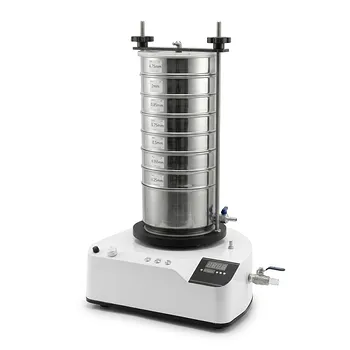
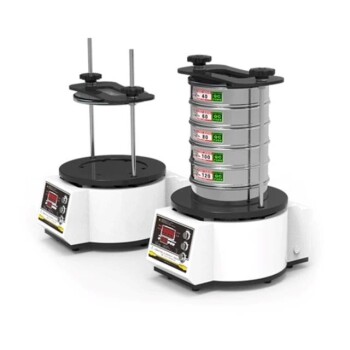
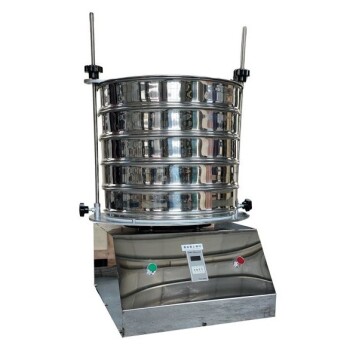
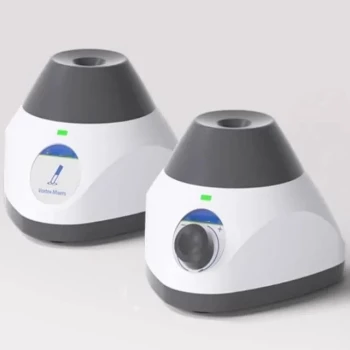
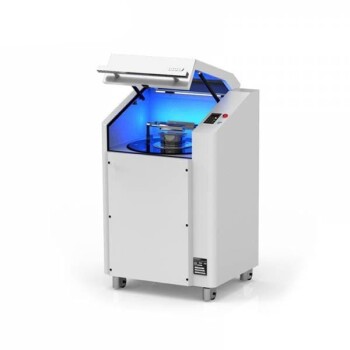
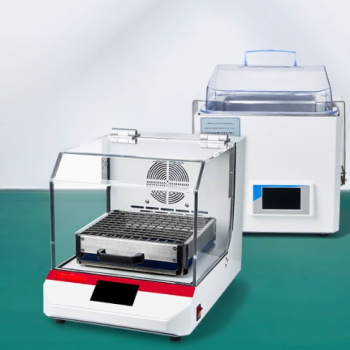
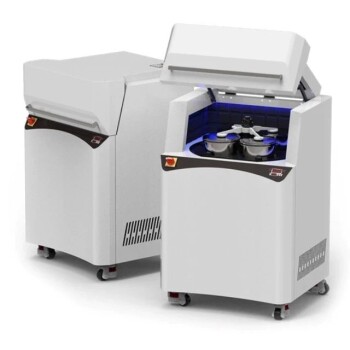
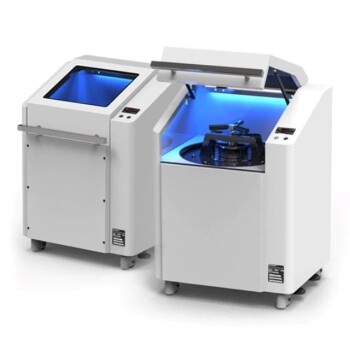
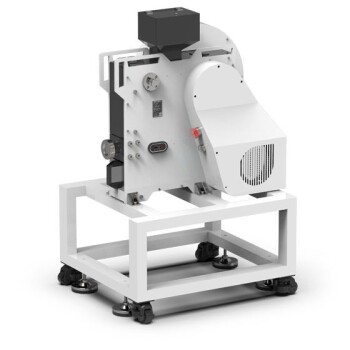
A laboratory vibrating sieve shaker acts as the primary quality control gate immediately following the ball milling stage in Lithium Iron Phosphate (LiFePO4) production. Its specific purpose is to classify both slurries and dried powders, separating the desired product from oversized contaminants to ensure material consistency.
By effectively removing large agglomerates and unground raw materials, the sieve shaker guarantees a uniform particle size distribution. This uniformity is the non-negotiable prerequisite for pressing green bodies that achieve consistent density.
The Critical Function in the Workflow
Positioning After Ball Milling
The sieve shaker is strategically placed after the ball milling process.
Ball milling is effective, but rarely perfect; it often produces a mix of properly ground particles and unintended byproducts. The sieve shaker serves as the filter to address these inconsistencies before the material moves forward.
Removing Agglomerates
One of the primary tasks of the shaker is the removal of large agglomerated particles.
Fine powders have a natural tendency to clump together during or after milling. The vibrating action breaks down loose clumps or captures hard agglomerates that would otherwise create defects in the final product.
Capturing Unground Materials
The device also acts as a safeguard against unground raw materials.
In any milling batch, some raw material may escape the grinding media without being reduced to the target size. The sieve ensures these oversized raw particles are excluded from the final powder batch.
The Impact on Product Quality
Ensuring Uniform Particle Size
The ultimate output of the vibrating sieve shaker is a uniform particle size distribution.
Uniformity is not just an aesthetic metric; it determines how the particles interact with one another. Without this step, the powder batch would contain a chaotic mix of fine dust and coarse chunks.
Criticality for Green Body Density
The primary reference explicitly links sieving to the pressing of green bodies.
A "green body" is the compacted powder form before final heat treatment. To achieve consistent density throughout this body, the particles must pack together predictably.
Preventing Density Gradients
If the particle size is inconsistent, the green body will suffer from density variations.
These variations can lead to structural weaknesses, cracking, or uneven performance in the final battery cathode. The sieve shaker eliminates the variables that cause these density issues.
Understanding the Trade-offs
Process Time vs. Purity
Introducing a vibrating sieve shaker adds a distinct step to the processing timeline.
While it increases the total processing time, skipping this step creates a high risk of batch rejection downstream. The time "lost" to sieving is an investment in reducing waste during the pressing stage.
Managing Material Loss
Using a sieve shaker inevitably results in some material loss.
The "oversize" material (agglomerates and unground particles) is removed and often discarded or sent back for re-milling. This is a necessary efficiency loss to protect the integrity of the usable yield.
Making the Right Choice for Your Goal
To optimize your LiFePO4 processing, consider how the sieve shaker aligns with your production targets:
- If your primary focus is Final Structural Integrity: Prioritize a strict sieving protocol to ensure maximum uniformity, as this directly dictates the consistent density of the green body.
- If your primary focus is Process Efficiency: Analyze the ratio of unground material caught by the sieve; a high volume of waste may indicate that your upstream ball milling parameters need adjustment.
The laboratory vibrating sieve shaker is not merely a filter; it is the essential bridge between raw milling and the creation of a high-density, high-performance battery component.
Summary Table:
| Feature | Role in LiFePO4 Processing | Impact on Final Product |
|---|---|---|
| Sieving Position | Post-ball milling stage | Acts as a critical quality control gate |
| Agglomerate Removal | Breaks down or filters powder clumps | Prevents structural defects in cathodes |
| Particle Uniformity | Ensures consistent size distribution | Essential for uniform green body density |
| Waste Management | Filters unground raw materials | Identifies inefficiencies in milling parameters |
Elevate Your Battery Material Research with KINTEK
Precision is the foundation of high-performance LiFePO4 production. At KINTEK, we specialize in the advanced laboratory equipment necessary to refine your workflow—from high-efficiency ball milling systems and vibrating sieve shakers for perfect particle distribution, to hydraulic presses for uniform green body compaction.
Whether you are optimizing battery research or scaling up production, our comprehensive range of high-temperature furnaces, crushing systems, and specialized consumables (like PTFE and ceramics) ensures your materials meet the most rigorous standards. Contact us today to find the perfect solution for your lab!
Related Products
- Laboratory Vibratory Sieve Shaker Machine for Dry and Wet Three-Dimensional Sieving
- Laboratory Vibratory Sieve Shaker Machine Slap Vibrating Sieve
- Laboratory Wet Three-Dimensional Vibratory Sieve Shaker Machine
- Vibratory Sieve Shaker Machine Dry Three-Dimensional Vibrating Sieve
- Laboratory Test Sieves and Vibratory Sieve Shaker Machine
People Also Ask
- How does a laboratory vibratory sieve shaker facilitate the microstructural study of gas-atomized alloy powders?
- Why use a vibratory sieve shaker for PET powder? Achieve Precise Particle Size Control for Chemical Research
- What is the principle of vibratory sieve shaker? Achieve Accurate Particle Size Analysis
- What is the function of a vibratory sieve shaker? Achieve Precise Particle Size Analysis
- What is the use of vibratory sieve shaker? Achieve Precise Particle Size Analysis for Your Lab