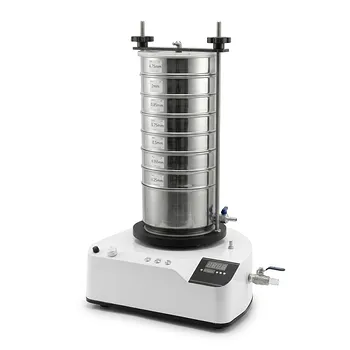
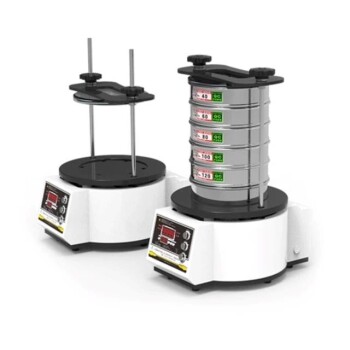
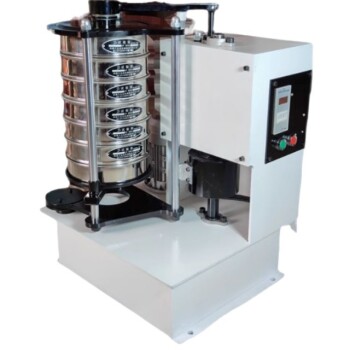
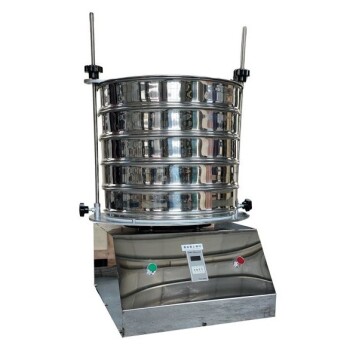
A vibrating sieve shaker classifies atomized Al-Fe-Ni powders by utilizing mechanical vibration to pass the material through a vertical stack of multi-layered screens with varying mesh sizes. This process physically separates the bulk powder into distinct particle size fractions, ensuring that only particles within specific dimensions are retained in each layer.
The core purpose of this process extends beyond simple separation; it is a critical quality control step. By isolating specific size grades, engineers can directly correlate powder characteristics with the final alloy's microstructure and its behavior during extrusion.
The Mechanics of Classification
Multi-Layered Sieve Architecture
The classification system relies on a vertical assembly of sieves. These are stacked with the largest mesh openings at the top and the finest at the bottom.
Mechanical Vibration
The shaker applies continuous mechanical vibration to the stack. This motion prevents the powder from clumping and ensures it flows effectively across the screen surface.
Sequential Separation
As the Al-Fe-Ni powder moves downward, particles pass through screens until they encounter a mesh too small to penetrate. This traps particles of specific size ranges on specific levels.
Application to Al-Fe-Ni Alloys
Defining Specific Grades
For atomized Al-Fe-Ni powders, this method allows for the isolation of precise size distributions. Commonly targeted grades include ranges such as 75-106 µm and 106-180 µm.
Ensuring Consistency
By segregating the powder into these tight bands, the variable nature of raw atomized powder is standardized. This allows for reproducible results in subsequent manufacturing steps.
The Impact on Material Performance
Influence on Microstructure
The physical size of the powder particle plays a fundamental role in determining the material's internal structure. The classification process provides the control necessary to engineer the desired microstructure in the final part.
Optimizing Extrusion
Accurate classification is essential for evaluating extrusion performance. Uniform particle sizes typically result in more predictable flow and consolidation behavior during the extrusion process.
Critical Considerations for Accuracy
The Importance of Cut Points
The value of this process lies in the precision of the "cut points" (e.g., exactly 106 µm). Inaccurate sieving can bleed sizes between grades, compromising the data regarding microstructure analysis.
Process Dependencies
It is important to recognize that the vibrating sieve is a gatekeeper. If the classification is not performed accurately, any subsequent evaluation of extrusion performance will be based on flawed input variables.
Making the Right Choice for Your Goal
To maximize the utility of Al-Fe-Ni powders, align your classification strategy with your specific engineering objectives:
- If your primary focus is Microstructure Control: Isolate tighter particle ranges (e.g., 75-106 µm) to minimize variables affecting grain growth and internal structure.
- If your primary focus is Extrusion Performance: Ensure strict adherence to size boundaries to guarantee consistent flow rates and material consolidation during processing.
By rigorously controlling particle size through vibrating sieves, you transform variable raw powder into a predictable, high-performance engineering material.
Summary Table:
| Particle Size Grade | Typical Mesh Range | Impact on Manufacturing |
|---|---|---|
| Fine Fraction | 75 - 106 µm | Enhances microstructure control and grain refinement. |
| Coarse Fraction | 106 - 180 µm | Influences material flow and consolidation during extrusion. |
| Mechanical Action | Vertical Vibration | Prevents clumping and ensures consistent particle flow. |
| Quality Goal | Precise Cut Points | Standardizes raw powder for reproducible material performance. |
Elevate Your Powder Metallurgy with KINTEK Precision
Maximize the performance of your Al-Fe-Ni alloys with KINTEK’s industry-leading crushing, milling, and sieving equipment. Whether you are refining microstructure or optimizing extrusion flow, our high-precision vibrating sieve shakers and laboratory solutions provide the consistency your research demands.
Beyond particle sizing, KINTEK specializes in a comprehensive range of lab equipment including:
- High-Temperature Furnaces (Muffle, Vacuum, Tube, and CVD) for advanced sintering.
- Hydraulic Presses (Pellet, Hot, and Isostatic) for superior material consolidation.
- Battery Research Tools and high-performance consumables like ceramics and crucibles.
Ready to transform your raw powders into high-performance engineering materials? Contact KINTEK today to discuss your laboratory requirements!
References
- Bismarck Luiz Silva, José Eduardo Spinelli. Assessing microstructures and mechanical resistances of as-atomized and as-extruded samples of Al-1wt%Fe-1wt%Ni alloy. DOI: 10.1016/j.jallcom.2016.08.243
This article is also based on technical information from Kintek Solution Knowledge Base .
Related Products
- Laboratory Vibratory Sieve Shaker Machine for Dry and Wet Three-Dimensional Sieving
- Laboratory Test Sieves and Vibratory Sieve Shaker Machine
- Vibratory Sieve Shaker Machine Dry Three-Dimensional Vibrating Sieve
- Laboratory Vibratory Sieve Shaker Machine Slap Vibrating Sieve
- Laboratory Wet Three-Dimensional Vibratory Sieve Shaker Machine
People Also Ask
- How does a laboratory vibratory sieve shaker facilitate the microstructural study of gas-atomized alloy powders?
- What role does a laboratory vibrating sieve shaker play in the LiFePO4 powder processing workflow? Ensure Batch Quality
- Why use a vibratory sieve shaker for PET powder? Achieve Precise Particle Size Control for Chemical Research
- What is the principle of vibratory sieve shaker? Achieve Accurate Particle Size Analysis
- What is the function of a vibratory sieve shaker? Achieve Precise Particle Size Analysis