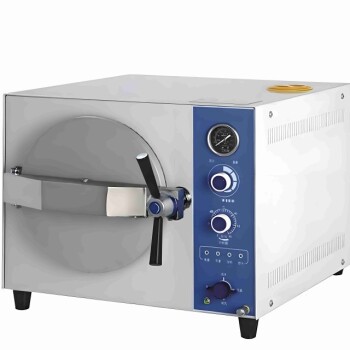
For routine sterilization, the standard autoclave temperature is 121°C (250°F). However, this is not the only temperature used. The entire effective range depends on a critical relationship between steam, pressure, and time, with some cycles running as high as 134°C (273°F) for specific applications.
The core principle of autoclaving isn't just about reaching a high temperature. It's about using pressurized saturated steam to transfer lethal heat efficiently, ensuring that the combination of temperature, pressure, and exposure time is sufficient to destroy all microorganisms.
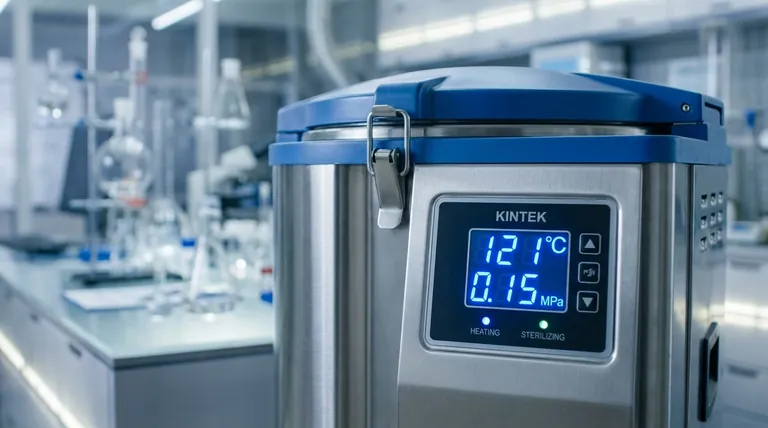
The Science Behind Autoclave Temperatures
The effectiveness of an autoclave hinges on the properties of water under pressure. Understanding this relationship is key to achieving successful sterilization.
Why 121°C is the Gold Standard
At normal atmospheric pressure, water boils at 100°C (212°F). This temperature is sufficient to kill many bacteria, but not the highly resistant spores produced by certain bacteria and fungi.
To kill these spores reliably, a higher temperature is needed. The 121°C standard was established as the minimum temperature that ensures the destruction of even the most heat-resistant organisms when held for an adequate time.
How Pressure Creates High Temperatures
An autoclave is a sealed pressure chamber. By increasing the pressure inside to approximately 15 psi (pounds per square inch) above atmospheric pressure, the boiling point of water is elevated to 121°C.
This creates an environment filled with saturated steam, where both water vapor and liquid water coexist. This wet heat is far more effective at sterilization than dry heat because it transfers energy more efficiently and rapidly denatures the essential proteins within microorganisms.
Higher Temperatures for Faster Cycles
While 121°C is the most common setting, it is not the only one. Higher temperatures can be used to achieve sterilization in a much shorter time.
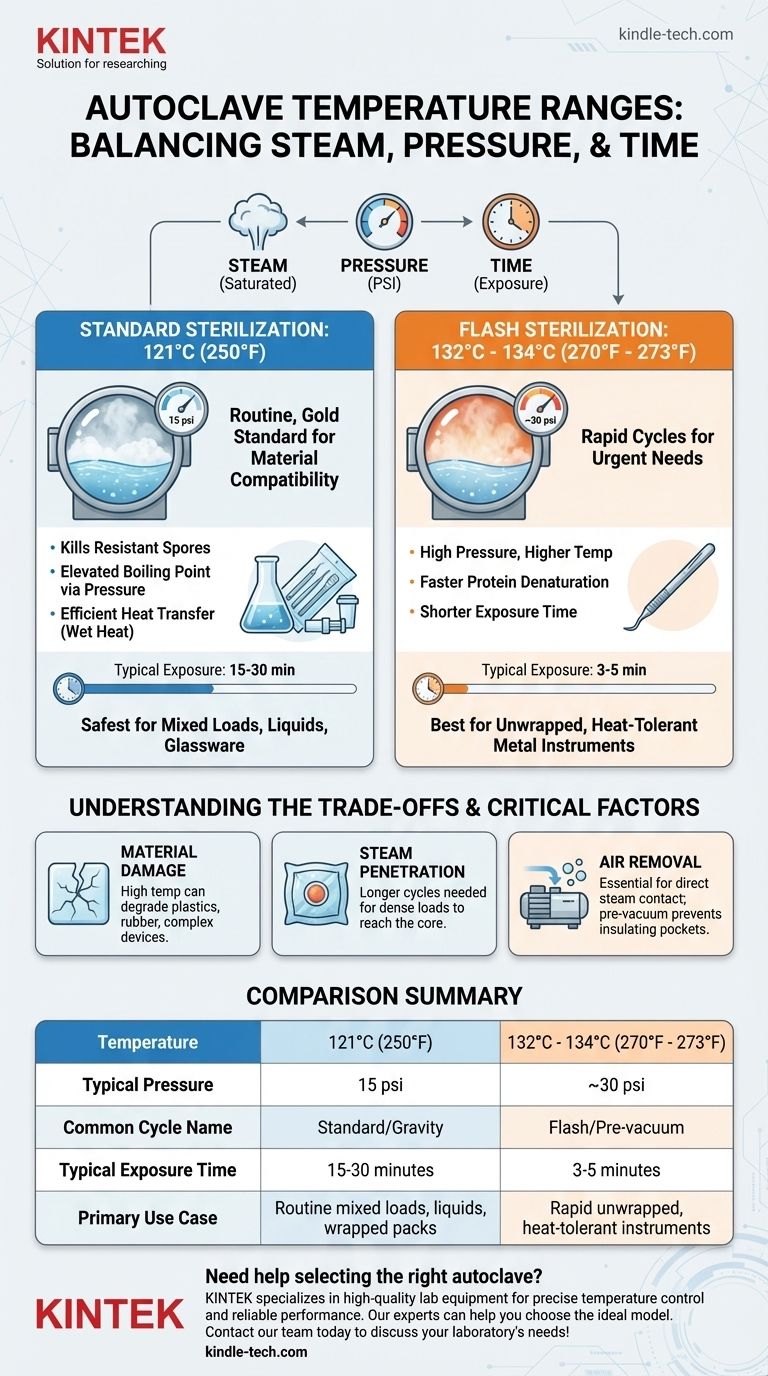
Flash Sterilization at 132°C - 134°C
Modern autoclaves often use a higher temperature of 132°C to 134°C (270°F - 273°F) at a higher pressure (around 30 psi). This is often called "flash sterilization."
At these temperatures, the required sterilization time can be reduced to as little as 3 to 5 minutes for simple, unwrapped items. This is common in operating rooms for instruments needed urgently.
The Time-Temperature Relationship
There is an inverse relationship between temperature and time. A higher temperature sterilizes faster, while a lower temperature requires a longer exposure.
- 121°C Cycle: Typically requires 15-30 minutes of exposure time (plus time for the chamber to heat up and cool down).
- 134°C Cycle: Typically requires only 3-5 minutes of exposure time.
Understanding the Trade-offs
Choosing a temperature is not just about speed; it's about balancing effectiveness with the integrity of the items being sterilized.
Risk of Material Damage
The primary reason 121°C remains a standard is material compatibility. Many plastics, rubber components, and complex medical devices can be damaged or degraded by the higher temperatures of a 134°C cycle.
The lower temperature, longer duration cycle is gentler and safer for a wider range of equipment and media.
Importance of Steam Penetration
For large, dense, or wrapped packs, a longer cycle at 121°C allows more time for steam to penetrate to the very center of the load. A short, high-temperature "flash" cycle may sterilize the outside of a wrapped kit but fail to sterilize the instruments inside.
The Critical Factor of Air Removal
Successful sterilization depends on steam making direct contact with every surface. If air is trapped in the chamber or within a package, it creates an "insulating" pocket that steam cannot penetrate.
This is why most autoclaves run a pre-vacuum phase to remove air before injecting steam. Incomplete air removal is a common cause of cycle failure, regardless of the temperature achieved.
Making the Right Choice for Your Goal
Select your autoclave cycle based on the specific load and your operational needs.
- If your primary focus is routine sterilization of mixed loads, liquids, or glassware: The standard 121°C cycle is the most reliable and safest choice for material compatibility.
- If your primary focus is rapid sterilization of an unwrapped, simple metal instrument: A 134°C "flash" cycle is effective and efficient, provided the instrument can tolerate the heat.
- If your primary focus is sterilizing dense, heavily wrapped surgical kits: Use a pre-vacuum cycle at 121°C or 134°C, ensuring the manufacturer's validated time is sufficient for steam penetration.
Mastering autoclaving means understanding it as a precise process of steam, pressure, and time, not just a matter of heat.
Summary Table:
| Temperature | Typical Pressure | Common Cycle Name | Typical Exposure Time | Primary Use Case |
|---|---|---|---|---|
| 121°C (250°F) | 15 psi | Standard/Gravity | 15-30 minutes | Routine sterilization of mixed loads, liquids, glassware, wrapped packs |
| 132°C - 134°C (270°F - 273°F) | ~30 psi | Flash/Pre-vacuum | 3-5 minutes | Rapid sterilization of unwrapped, heat-tolerant metal instruments |
Need help selecting the right autoclave for your specific sterilization requirements? KINTEK specializes in high-quality lab equipment, including autoclaves designed for precise temperature control and reliable performance. Our experts can help you choose the ideal model to ensure effective sterilization while protecting your valuable materials. Contact our team today to discuss your laboratory's needs!
Visual Guide
Related Products
- Portable High Pressure Laboratory Autoclave Steam Sterilizer for Lab Use
- Portable Digital Display Automatic Laboratory Sterilizer Lab Autoclave for Sterilization Pressure
- Desktop Fast High Pressure Laboratory Autoclave Sterilizer 16L 24L for Lab Use
- Desktop Fast Laboratory Autoclave Sterilizer 35L 50L 90L for Lab Use
- Desktop Fast Laboratory Autoclave Sterilizer 20L 24L for Lab Use
People Also Ask
- What is an autoclave laboratory equipment? The Ultimate Guide to Steam Sterilization
- What is the importance of using a laboratory autoclave in ZSM-5 synthesis? Achieve Perfect Zeolite Crystallization
- What role does a laboratory autoclave play in HEA corrosion research? Key to Validating Advanced Reactor Materials
- What is the primary function of a laboratory autoclave in the pre-treatment of medical plastic waste for liquid fuel?
- What is a laboratory autoclave? A Guide to Sterilization with Pressurized Steam