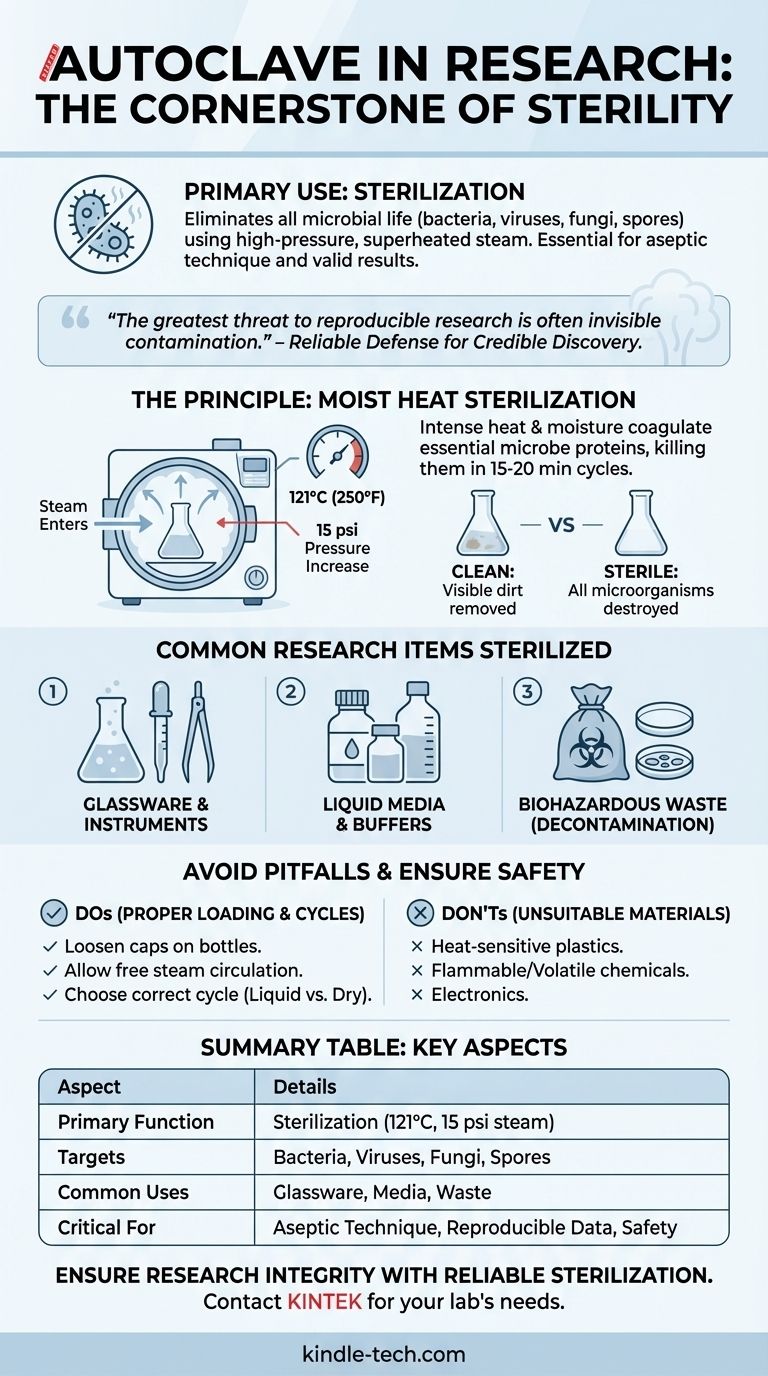
In research, the autoclave's primary use is sterilization. It is a machine that employs high-pressure, superheated steam to eliminate all forms of microbial life—including bacteria, viruses, fungi, and spores—from laboratory equipment and solutions. This process is the cornerstone of aseptic technique, ensuring that experimental results are scientifically valid and not compromised by unwanted contamination.
The greatest threat to reproducible research is often invisible contamination. The autoclave is not just a piece of equipment; it is your primary defense, providing a reliable method to create a sterile environment, which is the absolute foundation for credible scientific discovery.
The Principle of Sterilization: Why It’s Non-Negotiable
To understand the autoclave's role, one must first appreciate the constant threat of contamination in a laboratory setting.
Contamination: The Enemy of Reliable Data
Unwanted microorganisms are everywhere. If introduced into an experiment, they can outcompete the cells you are trying to study, alter chemical reactions, or produce substances that skew your results.
This invalidates the experiment, wasting time, resources, and effort. In clinical or pharmaceutical research, contamination can pose a direct safety hazard.
How an Autoclave Achieves Sterility
The autoclave works on the principle of moist heat sterilization. By increasing the pressure inside its sealed chamber, it can heat water far beyond its normal boiling point.
Typically, an autoclave reaches 121°C (250°F) at a pressure of 15 psi. This combination of intense heat and moisture is lethal to microorganisms.
The hot steam effectively transfers thermal energy, which penetrates materials and coagulates essential proteins within the microbes, killing them. A typical sterilization cycle lasts 15-20 minutes at this temperature.
The Difference Between 'Clean' and 'Sterile'
It is critical to understand that "clean" is not "sterile." Washing a flask with soap and water removes visible dirt, but it leaves behind a film of microscopic organisms.
Sterilization is an absolute term. It refers to the complete destruction of all living microorganisms, which is a requirement for most biological research.
Common Research Items Sterilized in an Autoclave
A researcher uses an autoclave daily to prepare for experiments and to safely conclude them. Its applications fall into three main categories.
Glassware and Instruments
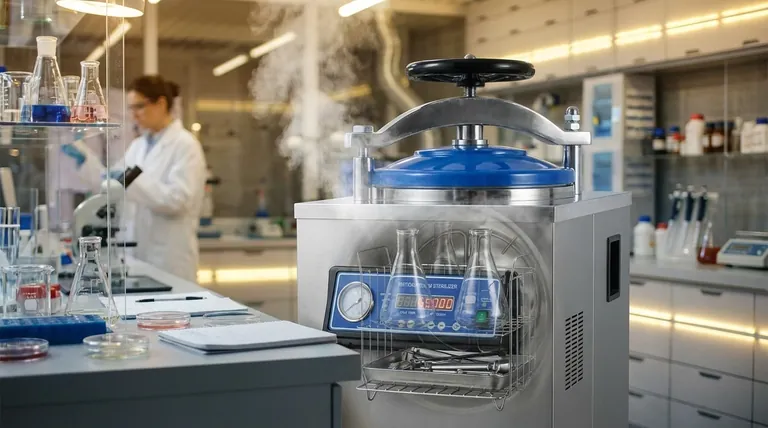
Any reusable item that will come into direct contact with your experiment must be sterilized. This includes glass flasks, beakers, pipettes, and stainless steel instruments like forceps and scalpels.
Liquid Media and Buffers
To grow cells or bacteria, you must provide them with a nutrient-rich solution called media. This media must be sterilized after preparation to kill any stray microbes that would otherwise thrive in it.
The same is true for buffers and other solutions used in molecular biology, which must be free of enzymes like DNases or RNases that could destroy DNA and RNA samples.
Biohazardous Waste
After an experiment is complete, all materials that have come into contact with microorganisms (like petri dishes or used cell culture flasks) are considered biohazardous waste.
Before disposal, this waste must be autoclaved to decontaminate it, rendering it safe and protecting lab personnel and the environment.
Understanding the Trade-offs and Common Pitfalls
While essential, an autoclave must be used correctly. Misuse can damage equipment, create safety hazards, or result in failed sterilization.
Not Everything Can Be Autoclaved
The intense heat and pressure will destroy certain materials. You should never autoclave heat-sensitive plastics, flammable or volatile chemicals (like alcohol or bleach), or items containing electronics.
The Importance of Proper Loading
Do not overpack the autoclave chamber. Steam must be able to circulate freely to reach all surfaces. When sterilizing liquids in bottles, the caps must be loosened. A sealed bottle will explode under the extreme pressure change.
Choosing the Right Cycle
Modern autoclaves have different cycles for different loads. A "liquid" cycle cools down slowly to prevent the liquids from boiling over, while a "dry" or "gravity" cycle cools down faster for sterilizing glassware and instruments. Using the wrong cycle can be dangerous and ineffective.
Making the Right Choice for Your Goal
Your specific field of research will determine how you rely on the autoclave.
- If your primary focus is cell culture or microbiology: Your top priority is the sterile preparation of media, glassware, and instruments to prevent contamination and ensure you are only growing the organism you intend to study.
- If your primary focus is molecular biology or biochemistry: You must sterilize all buffers and water to eliminate contaminant enzymes (like DNases and RNases) that will rapidly degrade your precious samples.
- If your primary focus is lab safety and disposal: The autoclave is your final, critical checkpoint for decontaminating all biological waste, ensuring it poses no threat before leaving the lab.
Ultimately, mastering the use of the autoclave is fundamental to ensuring the integrity and safety of your research.
Summary Table:
| Key Aspect | Details |
|---|---|
| Primary Function | Sterilization using high-pressure steam (121°C/250°F at 15 psi) |
| Targets | Bacteria, viruses, fungi, and spores |
| Common Uses | Glassware, instruments, liquid media, buffers, biohazardous waste |
| Critical For | Aseptic technique, reproducible data, and lab safety |
Ensure the integrity of your research with reliable sterilization.
Contamination is the enemy of reproducible science. KINTEK specializes in providing high-quality autoclaves and lab equipment designed to meet the rigorous demands of modern research. Whether you work in cell culture, microbiology, or molecular biology, our solutions help you maintain sterile conditions, protect your samples, and uphold lab safety protocols.
Contact us today to find the perfect autoclave for your laboratory's specific needs and achieve peace of mind in your research.
Visual Guide
Related Products
- Portable High Pressure Laboratory Autoclave Steam Sterilizer for Lab Use
- Laboratory Horizontal Autoclave Steam Sterilizer Lab Microcomputer Sterilizer
- Desktop Fast High Pressure Laboratory Autoclave Sterilizer 16L 24L for Lab Use
- Portable Digital Display Automatic Laboratory Sterilizer Lab Autoclave for Sterilization Pressure
- Desktop Fast Laboratory Autoclave Sterilizer 35L 50L 90L for Lab Use
People Also Ask
- What is an autoclave laboratory equipment? The Ultimate Guide to Steam Sterilization
- What role does a laboratory autoclave play in HEA corrosion research? Key to Validating Advanced Reactor Materials
- What is a laboratory autoclave? A Guide to Sterilization with Pressurized Steam
- Why is a laboratory high-pressure autoclave sterilizer necessary? Ensure Accuracy in Antibacterial Research
- What precautions should be taken during autoclave in laboratory? A Complete Safety Guide to Prevent Burns and Explosions