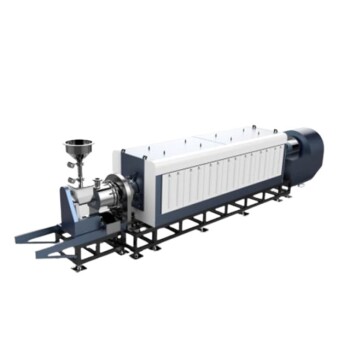
A laboratory high-pressure reactor creates a sealed, tunable environment designed to precisely regulate both temperature and pressure simultaneously. This controlled atmosphere is essential for managing the complex thermodynamic and kinetic requirements inherent in converting ethanol to acetaldehyde.
Core Takeaway Ethanol dehydrogenation is an endothermic process that expands volume, creating a natural conflict between reaction speed and maximum yield. A high-pressure reactor resolves this by allowing you to fine-tune the pressure to find the exact "sweet spot" between kinetic acceleration and thermodynamic constraints, while safely containing hydrogen byproducts.
Optimizing Reaction Dynamics
Managing Endothermic Requirements
Ethanol dehydrogenation is an endothermic process, meaning it absorbs heat to proceed.
To drive this reaction forward, the system requires significant thermal energy. The reactor provides a stable thermal environment to maintain these elevated temperatures consistently.
The Kinetic vs. Thermodynamic Balance
The reaction increases the number of molecules (one ethanol molecule yields one acetaldehyde and one hydrogen molecule).
Thermodynamically, lower pressure favors this expansion. However, higher pressures can often accelerate reaction kinetics (speed). The high-pressure reactor allows you to adjust the pressure precisely to balance these opposing forces.
Overcoming Equilibrium Limitations
By fine-tuning the pressure, you can prevent the reaction from stalling.
The reactor enables you to operate at a pressure that is high enough to maintain desired reaction rates, but not so high that it pushes the chemical equilibrium back toward the reactants.
Gas Management and containment
A Sealed Reaction Ecosystem
The reactor provides a strictly sealed environment.
Because the process generates hydrogen gas, a sealed system is critical for preventing leaks and maintaining an accurate mass balance.
Efficient Hydrogen Handling
The high-pressure capability ensures that the hydrogen produced is effectively collected.
This sealed nature also allows for in-situ utilization, where the generated hydrogen can be immediately used for subsequent hydrogenation steps within the same experimental setup.
Understanding the Trade-offs
The Pressure Penalty
It is vital to remember that pressure is a double-edged sword in dehydrogenation.
According to Le Chatelier's principle, increasing pressure on a reaction that produces gas will shift the equilibrium away from the products. Using this reactor requires careful calculation; simply maximizing pressure will reduce your conversion of ethanol to acetaldehyde.
Thermal Stress
High-pressure reactors are robust, but combining high pressure with the high temperatures required for endothermic reactions creates significant material stress.
You must ensure the reactor's metallurgy is rated for the specific combination of thermal and barometric loads you intend to apply.
Making the Right Choice for Your Goal
To maximize the utility of a high-pressure reactor for this specific process, consider your primary objective:
- If your primary focus is Kinetic Study: Use the pressure controls to map reaction rates at different elevated pressures to understand the activation energy barriers.
- If your primary focus is Hydrogen Utilization: Leverage the sealed environment to capture the hydrogen byproduct for immediate use in downstream chemical synthesis.
The high-pressure reactor is not just a vessel; it is a precision instrument for navigating the conflict between reaction speed and product yield.
Summary Table:
| Parameter | Influence on Ethanol Dehydrogenation | Reactor Benefit |
|---|---|---|
| Temperature | Endothermic; requires constant heat input | Stable thermal environment for high-temp stability |
| Pressure | High pressure boosts kinetics; low pressure favors yield | Precise tuning to find the optimal 'sweet spot' |
| Containment | Produces hydrogen gas as a byproduct | Sealed ecosystem for leak prevention and H2 collection |
| Equilibrium | Volume expansion (1 molecule to 2) | Controlled pressure to prevent back-reaction to ethanol |
Elevate Your Chemical Research with KINTEK Precision
Unlock the full potential of your ethanol dehydrogenation studies with KINTEK’s industry-leading high-temperature high-pressure reactors and autoclaves. Our reactors are engineered to handle the intense material stress of endothermic reactions, providing the precise pressure tuning and thermal stability required to balance reaction speed and yield.
Whether you are focusing on kinetic studies or hydrogen utilization, KINTEK offers a comprehensive range of laboratory solutions—from crushing systems and PTFE consumables to high-performance cooling solutions—designed to streamline your workflow and ensure repeatable, high-accuracy results.
Ready to optimize your lab's performance? Contact us today to find the perfect reactor for your application!
References
- Kai Wang, Adelina Voutchkova‐Kostal. Homogeneous <i>vs.</i> heterogeneous catalysts for acceptorless dehydrogenation of biomass-derived glycerol and ethanol towards circular chemistry. DOI: 10.1039/d3gc04378a
This article is also based on technical information from Kintek Solution Knowledge Base .
Related Products
- Stainless High Pressure Autoclave Reactor Laboratory Pressure Reactor
- Customizable Laboratory High Temperature High Pressure Reactors for Diverse Scientific Applications
- Mini SS High Pressure Autoclave Reactor for Laboratory Use
- Customizable High Pressure Reactors for Advanced Scientific and Industrial Applications
- High Pressure Laboratory Autoclave Reactor for Hydrothermal Synthesis
People Also Ask
- Why is a laboratory high-pressure reactor necessary for synthesizing fly ash-based zeolite? Achieve Pure Crystallization
- Why is a laboratory high-pressure reactor used in the hydrothermal synthesis of hydroxyapatite catalysts?
- What role does a laboratory high-pressure reactor play in the leaching process of spent cathode materials? Optimize Recovery
- What conditions do laboratory high-pressure reactors provide for HTC? Optimize Your Biochar Production Processes
- How are high-pressure reactors used to prepare metaphosphate electrocatalysts? Master In-Situ Precursor Growth