The primary role of metal nickel particles is to act as a flow regulator for lithium atoms. By applying a nickel functional layer to the surface of aluminum anodes, researchers utilize the specific chemical incompatibility between nickel and lithium to fundamentally alter how the battery charges. This layer forces lithium to distribute evenly across the surface rather than penetrating the anode unevenly.
The introduction of nickel exploits its "lithium-phobic" nature to force horizontal atomic diffusion. This mechanism uniformizes lithium flux and prevents the localized stress buildup that causes aluminum anodes to crumble and fail in solid-state systems.
The Mechanics of the Nickel Layer
The Lithium-Phobic Principle
The effectiveness of this functional layer relies on a specific material property: insolubility.
Nickel does not form a solid solution with lithium at temperatures below 800°C. In the context of battery research, this makes the nickel layer "lithium-phobic." It physically resists the immediate assimilation of lithium atoms.
Redirecting Atomic Flow
When lithium ions arrive at a standard aluminum anode, they tend to stack vertically at the point of contact. This creates uneven assimilation.
The nickel layer acts as a barrier to this vertical entry. Because the lithium cannot immediately dissolve into the nickel, it is forced to spread horizontally across the electrode surface first. It only enters the aluminum matrix after it has distributed itself over a wider area.
Solving Aluminum Anode Failures
Uniformizing Lithium Flux
The shift from vertical stacking to horizontal spreading ensures a consistent flow of ions.
Rather than having high concentrations of lithium entering specific points of the anode, the nickel layer ensures a uniform lithium flux. This homogeneity is critical for the structural integrity of the battery.
Suppressing Stress Concentration
Aluminum anodes are notorious for significant volume expansion during cycling.
When lithium flux is uneven, it creates localized stress concentrations. These stress points lead to electrode powdering—where the material essentially crumbles—and interface failure. By distributing the lithium evenly, the nickel layer mitigates these localized stresses, preserving the physical structure of the anode.
Understanding the Operational Limits
Temperature Dependence
It is critical to note the thermal constraints of this mechanism.
The protection offered by the nickel layer is chemically dependent on temperature. The lithium-phobic characteristic—and therefore the horizontal spreading mechanism—holds true because the operational temperature remains below 800°C. Above this threshold, the solubility dynamics would change, potentially nullifying the protective benefit.
Making the Right Choice for Your Goal
To apply this to your specific battery architecture, consider your primary failure mode:
- If your primary focus is preventing material disintegration: Utilize the nickel layer to stop electrode powdering by eliminating the localized stress points caused by uneven lithium entry.
- If your primary focus is stabilizing the electrolyte interface: Leverage nickel's lithium-phobic properties to ensure uniform lithium distribution, preventing the interface failure common in aluminum-based solid-state systems.
By controlling the direction of atomic diffusion, you convert a chaotic charging process into a uniform, sustainable operation.
Summary Table:
| Feature | Impact of Nickel Layer on Aluminum Anodes |
|---|---|
| Material Property | Lithium-phobic (insoluble with Li below 800°C) |
| Diffusion Direction | Redirects vertical stacking to horizontal spreading |
| Lithium Flux | Ensures uniform distribution across the electrode surface |
| Structural Integrity | Prevents electrode powdering and localized stress |
| Failure Mitigation | Suppresses interface failure and volume expansion issues |
Elevate Your Battery Research with KINTEK Precision
Are you looking to overcome the challenges of anode disintegration and interface failure in your solid-state battery development? KINTEK specializes in high-performance laboratory equipment and consumables designed for cutting-edge energy research.
Whether you need precision battery research tools, high-temperature furnaces for material processing, or high-quality PTFE and ceramic consumables, our comprehensive portfolio supports every stage of your workflow. From crushing and milling systems to isostatic presses, we provide the tools you need to achieve uniform material distribution and structural integrity in your energy storage solutions.
Ready to optimize your lab's performance? Contact us today to discover how KINTEK can provide the advanced tools and expertise required for your next breakthrough.
Related Products
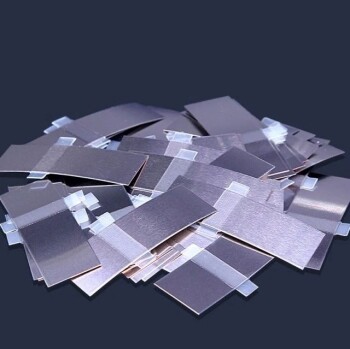
- Nickel Aluminum Tabs for Soft Pack Lithium Batteries
- Aluminum Foil Current Collector for Lithium Battery
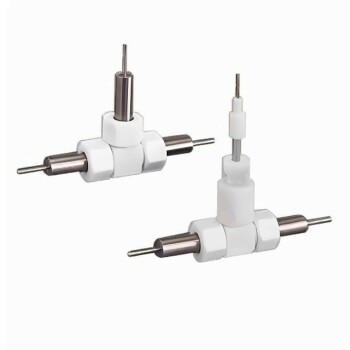
- Customizable Swagelok Type Test Cells for Advanced Battery Research Electrochemical Analysis
- Battery Lab Equipment 304 Stainless Steel Strip Foil 20um Thick for Battery Test
- High Purity Zinc Foil for Battery Lab Applications
People Also Ask
- Is there a way to test lithium batteries? Understand Voltage vs. True Health
- How to check if a lithium battery is good? Safely Test Voltage, Capacity & Internal Resistance
- What are the advantages of aluminum electrodes in microplastic electrocoagulation? Enhance Treatment and Durability
- Why are nickel-based materials preferred for electrodes in alkaline water electrolyzers? The Economic & Technical Edge
- How to tell if a lithium-ion battery is bad? Spot the critical signs of failure before it's too late.