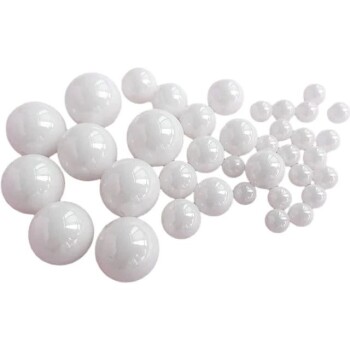
Zirconia grinding balls are the preferred choice for Ni-SmDC catalyst production primarily to guarantee chemical purity. Their exceptional hardness and superior wear resistance minimize media degradation during high-energy milling, effectively preventing the introduction of contaminants that would compromise the catalyst's performance in dry reforming reactions.
Core Takeaway Ideally, milling media should pulverize material without becoming part of it. Zirconia’s combination of extreme hardness and chemical inertness ensures that the Ni-SmDC powder remains pure, preserving the delicate catalytic activity required for subsequent chemical processes.
The Imperative of Purity in Catalyst Synthesis
Eliminating Media Wear
In high-speed milling, the friction between balls and powder inevitably stresses the grinding media. Zirconia possesses an extremely low wear rate, meaning it resists shedding microscopic debris into the mixture even during long processing periods.
Protecting Reaction Integrity
For Ni-SmDC powders, purity is a functional requirement, not just a specification. The introduction of foreign material from lesser grinding media can cause impurity interference, which directly degrades the catalyst's activity during subsequent dry reforming reactions.
Chemical Inertness
Beyond physical durability, the grinding media must remain chemically neutral relative to the powder. Zirconia maintains chemical inertness, ensuring that the stoichiometry of the Ni-SmDC catalyst remains unaltered during the rigorous mixing process.
Mechanical Efficiency and Particle Refinement
Withstanding High-Energy Forces
The preparation of these powders often involves planetary ball mills that utilize powerful impact and shear forces. Zirconia's extreme hardness allows it to deliver these forces effectively without fracturing or degrading under the stress.
Enhancing Surface Area
The goal of milling Ni-SmDC is to pulverize calcined bulk solids to increase their specific surface area and reactivity. Zirconia media effectively reduces particle size, creating a high-performance raw material essential for coating slurry preparation.
Delivering Kinetic Energy
High-density media is required to crush hard particles effectively. Zirconia balls provide substantial impact kinetic energy, which is critical for refining powders to the nanometer or micrometer scale and ensuring a uniform distribution.
Common Pitfalls to Avoid
Overlooking Cross-Contamination
A critical error in catalyst preparation is using media that is not hard enough for the target material. If the media wears down, it introduces metal impurities that are virtually impossible to separate from the final powder.
Ignoring Media Density
Choosing low-density media can result in inefficient milling times and poor particle reduction. Zirconia provides the necessary density to ensure thorough mixing and effective crushing, avoiding the pitfalls of inconsistent microstructures in the final product.
Making the Right Choice for Your Goal
When selecting grinding media for advanced material synthesis, align your choice with your specific performance metrics.
- If your primary focus is Chemical Purity: Prioritize Zirconia to prevent wear debris from interfering with sensitive catalytic reactions.
- If your primary focus is Particle Refinement: Rely on Zirconia’s high density and hardness to generate the kinetic energy needed to maximize specific surface area.
Zirconia represents the optimal balance of mechanical strength and chemical stability, ensuring your process refines the material without compromising its composition.
Summary Table:
| Feature | Zirconia Grinding Media Benefit | Impact on Ni-SmDC Catalyst |
|---|---|---|
| Wear Resistance | Extremely low degradation rate | Prevents contamination from media debris |
| Chemical Inertness | Non-reactive material | Preserves delicate catalytic activity and stoichiometry |
| Hardness/Density | High impact kinetic energy | Achieves uniform particle size and high surface area |
| Durability | Resists fracturing under high stress | Ensures consistent performance in planetary ball mills |
Elevate Your Catalyst Synthesis with KINTEK Precision
Don't let media wear compromise your research outcomes. KINTEK specializes in high-performance laboratory solutions designed for the most demanding material science applications. Whether you are refining Ni-SmDC catalyst powders or developing next-generation energy materials, our premium crushing and milling systems and high-purity zirconia consumables ensure your samples remain free from contaminants.
From high-temperature furnaces and vacuum reactors to precision hydraulic presses and milling media, KINTEK provides the comprehensive tools needed for advanced powder processing and battery research.
Ready to optimize your particle refinement process? Contact our technical experts today to find the perfect grinding solution for your laboratory’s unique requirements.
References
- Mariarita Santoro, Elisabetta Di Bartolomeo. Nickel-Based Structured Catalysts for Indirect Internal Reforming of Methane. DOI: 10.3390/app10093083
This article is also based on technical information from Kintek Solution Knowledge Base .
Related Products
- Precision Machined Zirconia Ceramic Ball for Engineering Advanced Fine Ceramics
- Laboratory Jar Mill with Agate Grinding Jar and Balls
People Also Ask
- What are the applications of zirconia ceramics? Unlock High-Performance Solutions for Extreme Environments
- What is the physical mechanism for selecting hard grinding media? Optimize Your ZrC-Al Matrix Composite Production
- Why are zirconia milling balls preferred for P2-type layered oxides? Ensure High Purity and Grinding Efficiency
- What is the purpose of using zirconia milling balls of different diameters? Optimize Solid Electrolyte Processing
- Why are zirconia grinding jars and balls required for solid-state electrolyte powders? Ensure High Purity & Performance