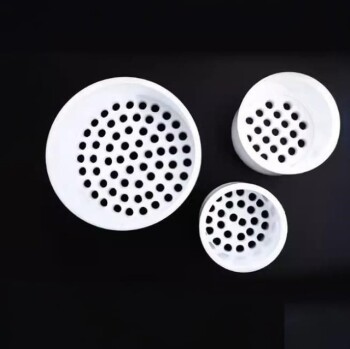
The use of a 60-mesh standard sieve is a critical calibration step in biomass pretreatment. It ensures that pomelo peel powder achieves high particle size uniformity, which is essential for facilitating even heat distribution during pyrolysis and providing a standardized surface area for the subsequent loading of chemical modifiers like Magnesium-Iron Layered Double Hydroxides (MgFe-LDH).
Using a specific 60-mesh sieve transforms raw, irregular biomass into a standardized technical feedstock. This uniformity is the foundation for predictable thermal decomposition and optimal chemical bonding in the production of high-quality biochar composites.
Ensuring Thermal Homogeneity during Pyrolysis
Preventing Temperature Gradients in the Tube Furnace
During the pyrolysis process in a tube furnace, heat must penetrate the biomass evenly to ensure complete carbonization. If particles vary significantly in size, larger pieces may retain a raw core while smaller particles over-process or "ash."
Optimizing Heat Transfer Efficiency
Uniformly fine particles created by a 60-mesh sieve maximize the contact surface between the heat source and the biomass. This ensures that the thermal energy is distributed rapidly and consistently across the entire sample, leading to a more stable biochar structure.
Creating a Standardized Skeleton for Chemical Loading
Providing a Consistent Surface Area for MgFe-LDH
The primary goal of using pomelo peel in this context is often to serve as a carbon skeleton for MgFe-LDH loading. A 60-mesh sieve ensures that the total available surface area is consistent across different batches, allowing for a predictable and uniform distribution of these hydroxides.
Enhancing Coating and Reaction Uniformity
Uniform particle sizes prevent the uneven "clumping" of chemical agents during the modification phase. This allows ionic liquids or metal salts to penetrate the biomass interior evenly, ensuring that the final biochar composite has high structural density and consistent chemical properties.
Improving Material Flow and Process Stability
Removing Agglomerates and Large Impurities
Sieving effectively removes large fibers or agglomerates formed during the grinding or storage of dried pomelo peels. Eliminating these outliers prevents clogging in experimental equipment and ensures that the raw material behaves predictably during processing.
Enhancing Mixing Uniformity
When pomelo peel powder is mixed with binders or other precursors, size consistency is paramount. A narrow particle size distribution ensures that every grain of powder is equally exposed to the reaction environment, which is vital for the reproducibility of leaching and passivation experiments.
Understanding the Trade-offs
The Risk of Sieve Blinding and Material Loss
Using a fine mesh like 60-mesh can lead to "blinding," where oily or slightly damp pomelo peel particles clog the screen apertures. This requires frequent cleaning and may result in the loss of valuable material in the form of ultra-fine dust that passes through or remains trapped.
Energy Demands of Fine Grinding
Achieving a 60-mesh consistency requires more intensive mechanical grinding compared to coarser distributions. This increased energy consumption must be balanced against the performance benefits of the resulting biochar to ensure the process remains economically and environmentally viable.
How to Apply This to Your Project
Recommendations Based on Your Objectives
- If your primary focus is maximizing chemical loading (e.g., MgFe-LDH): Adhere strictly to the 60-mesh standard to ensure a high specific surface area and uniform active site distribution.
- If your primary focus is high-throughput pyrolysis: Ensure the biomass is thoroughly dried before sieving to prevent mesh clogging and maintain a steady flow of feedstock into the furnace.
- If your primary focus is structural strength in molded products: Combine the 60-mesh powder with controlled amounts of binders, as the uniform fineness will enhance the internal structural density of the final briquette.
Standardizing your particle size via a 60-mesh sieve is the most effective way to guarantee that your pomelo-derived biochar remains chemically consistent and thermally stable.
Summary Table:
| Feature | Technical Benefit | Impact on Biochar Quality |
|---|---|---|
| Particle Uniformity | Eliminates temperature gradients in furnaces | Prevents over-processing or raw cores |
| Surface Area | Standardized skeleton for MgFe-LDH | Ensures predictable and even chemical loading |
| Material Flow | Removes large fibers and agglomerates | Prevents equipment clogging and ensures stability |
| Heat Transfer | Maximizes contact between heat and biomass | Leads to a more stable and dense carbon structure |
Optimize Your Biomass Research with KINTEK Precision
Achieving the perfect 60-mesh consistency is only the first step toward high-quality biochar. At KINTEK, we provide the specialized tools necessary for every stage of your material science workflow.
From high-performance sieving equipment and crushing systems to achieve precise particle sizes, to advanced tube furnaces and high-temperature reactors for controlled pyrolysis, our laboratory solutions ensure maximum reproducibility and efficiency. Whether you are loading chemical modifiers or pressing biochar composites using our hydraulic pellet presses, KINTEK delivers the durability and precision your research demands.
Ready to elevate your lab's performance? Contact our technical experts today to find the ideal equipment for your specific biomass and biochar applications.
References
- Yongxiang Huang, Youkuan Yu. Efficient Adsorption Capacity of MgFe-Layered Double Hydroxide Loaded on Pomelo Peel Biochar for Cd (II) from Aqueous Solutions: Adsorption Behaviour and Mechanism. DOI: 10.3390/molecules28114538
This article is also based on technical information from Kintek Solution Knowledge Base .
Related Products
- Custom PTFE Teflon Parts Manufacturer for PTFE Mesh F4 Sieve
- Three-dimensional electromagnetic sieving instrument
- Laboratory Test Sieves and Sieving Machines
People Also Ask
- What are the primary reasons for selecting PTFE as a matrix? Enhance Composites with Carbon Nanotube Reinforcement
- How is PTFE utilized for insulation in Alloy 22 corrosion setups? Ensure Signal Purity & Accuracy
- Is PTFE corrosion resistant? Discover the Ultimate Chemical Resistance for Your Lab
- What are the specific applications of PTFE in micro-batch slug flow systems? Enhance Your Microfluidic Reaction Purity
- What is the mesh size of a sieve? A Guide to Particle Size and Sieve Selection