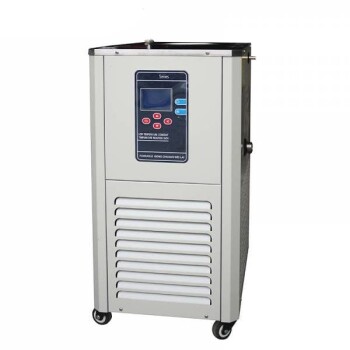
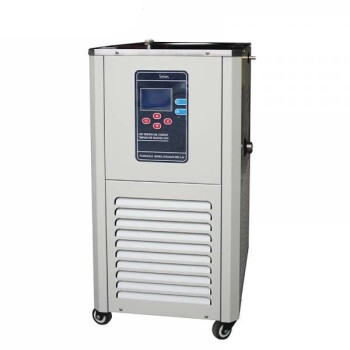
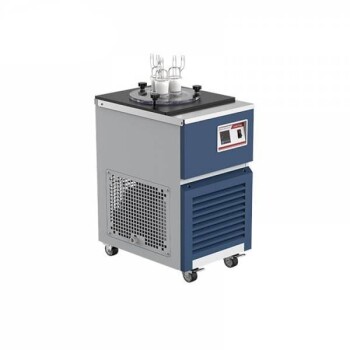
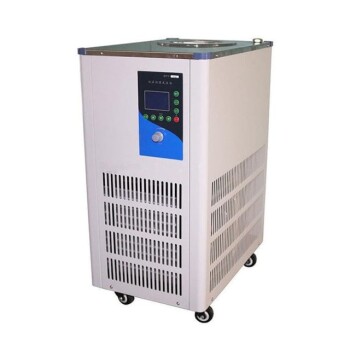
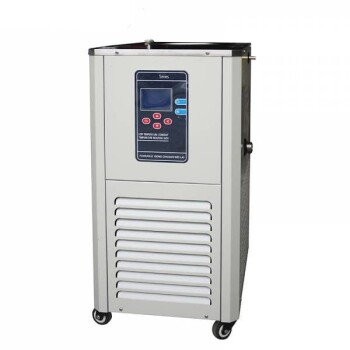
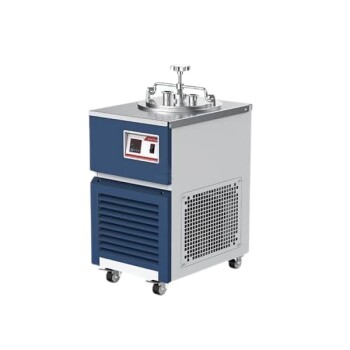
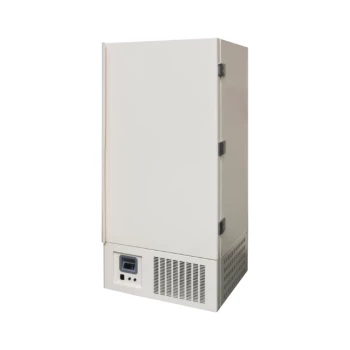
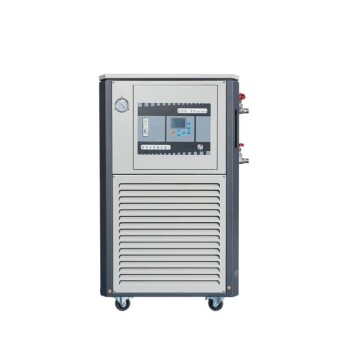
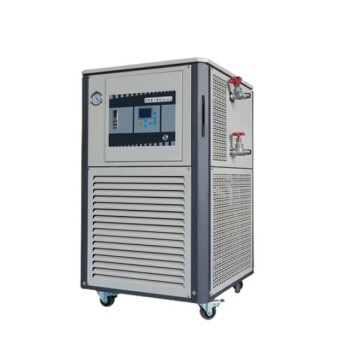
A high-performance cooling circulator is the engine that drives mass transfer in silica membrane desalination. While its most visible function is to rapidly condense water vapor into liquid for collection, its operational necessity is rooted in thermodynamics. By enforcing a phase change, the chiller significantly reduces the partial pressure of water vapor on the permeate side, creating the essential driving force required to pull water molecules through the membrane.
The chiller acts as a vacuum pump for vapor. Its primary role is not just water collection, but the maintenance of a steep pressure gradient. Without the rapid reduction of permeate pressure caused by condensation, the mass transfer of water across the membrane would slow down or stall completely.
The Dual Role of Cooling in Pervaporation
Rapid Condensation for Collection
In a pervaporation setup, water passes through the silica membrane as a vapor. To quantify performance, this vapor must be converted back into a liquid state immediately.
Enabling Measurement
A high-performance chiller ensures that 100% of the permeate is captured. This allows for accurate measurement of water flux and salt rejection rates, which are the key metrics for evaluating membrane efficiency.
The Thermodynamic Driving Force
Reducing Partial Pressure
The core function of the chiller is to manipulate the partial pressure on the permeate (downstream) side of the membrane. When water vapor contacts the cold surface of the condenser, it changes phase to liquid, occupying significantly less volume.
Creating the Gradient
This phase change creates a localized drop in pressure. This maintains a low partial pressure on the permeate side compared to the high vapor pressure on the feed side.
Sustaining Mass Transfer
The difference in pressure between the feed and permeate sides is the driving force of the process. By keeping the permeate pressure low, the chiller ensures a continuous, high-speed flow of water molecules through the silica structure.
Operational Stability
Constant Temperature Control
High-performance units are necessary because they offer precise temperature stability. Fluctuations in cooling temperature can lead to fluctuations in permeate pressure.
Ensuring Steady State
Variable pressure disrupts the mass transfer rate. A stable chiller ensures the experiment operates under steady-state conditions, providing reliable and reproducible data.
Understanding the Trade-offs
Energy Consumption
High-performance chillers can be energy-intensive. While lower temperatures generate a stronger driving force (and higher flux), they significantly increase the energy cost per liter of water produced.
Diminishing Returns
There is a thermodynamic limit to how much cooling improves flux. Once the permeate pressure is sufficiently close to zero (vacuum), further cooling offers negligible gains in driving force while still consuming maximum power.
Sizing Mismatches
If the chiller is undersized compared to the membrane surface area, it cannot condense vapor fast enough. This leads to vapor accumulation, which raises back-pressure and immediately throttles the membrane's performance.
Making the Right Choice for Your Setup
To ensure your silica membrane setup delivers accurate results, align your cooling strategy with your specific experimental goals:
- If your primary focus is Maximum Flux: Prioritize a chiller capable of reaching the lowest possible temperatures to maximize the transmembrane pressure gradient.
- If your primary focus is Energy Efficiency: Select a chiller that maintains stability at moderate temperatures (e.g., 10-20°C) to balance condensation rates with power consumption.
Ultimately, the chiller is not just a collection vessel; it is the active component that sustains the pressure differential required for desalination.
Summary Table:
| Feature | Function in Desalination | Impact on Performance |
|---|---|---|
| Rapid Condensation | Converts vapor to liquid for collection | Enables accurate measurement of flux and salt rejection |
| Pressure Gradient | Lowers partial pressure on the permeate side | Creates the thermodynamic driving force for water movement |
| Temperature Stability | Maintains constant cooling conditions | Ensures steady-state operation and reproducible research data |
| Capacity Matching | Prevents vapor accumulation back-pressure | Protects against membrane throttling and flux decline |
Precision Cooling Solutions for Advanced Desalination Research
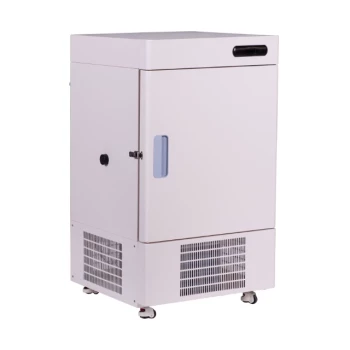
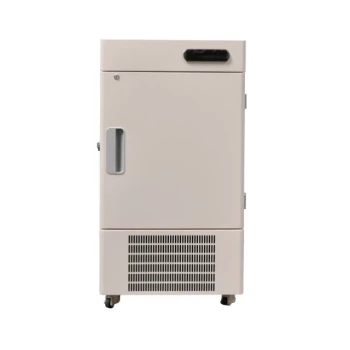
At KINTEK, we understand that in silica membrane desalination, your chiller is more than just a cooler—it's the engine of your mass transfer. Our high-performance cooling solutions, including ULT freezers and precision chillers, provide the rock-solid temperature stability required to maintain steep pressure gradients and ensure accurate experimental data.
Whether you are scaling up high-temperature high-pressure reactors or optimizing silica membrane pervaporation, KINTEK offers a comprehensive range of laboratory equipment including high-temperature furnaces, hydraulic presses, and specialized ceramics.
Ready to optimize your experimental driving force? Contact us today to find the perfect cooling circulator tailored to your flux requirements and energy efficiency goals.
References
- Muthia Elma, João C. Diniz da Costa. Microporous Silica Based Membranes for Desalination. DOI: 10.3390/w4030629
This article is also based on technical information from Kintek Solution Knowledge Base .
Related Products
- 30L Chiller Water Bath Cooling Circulator Low Temperature Constant Temperature Reaction Bath
- 20L Chiller Water Bath Cooling Circulator Low Temperature Constant Temperature Reaction Bath
- 40L Chiller Water Bath Cooling Circulator Low Temperature Constant Temperature Reaction Bath
- 50L Chiller Water Bath Cooling Circulator Low Temperature Constant Temperature Reaction Bath
- 80L Chilling Circulator Cooling Water Circulator for Water Bath Cooling and Low Temperature Constant Temperature Reaction Bath
People Also Ask
- What is the necessity of a circulating water bath in chlorate production? Optimize Yield & Purity with Precision
- What function does a circulating cooling chiller perform during the gas adsorption isotherm testing of nanoporous carbon?
- What is the role of low-temperature cooling baths in bio-oil collection? Maximize Yield Through Rapid Quenching
- For which types of substances are water baths and chillers considered ideal? Essential Care for Sensitive Samples
- Why is a circulating water chiller required for Prussian Blue nanoparticles? Ensure Stability & Batch Reproducibility