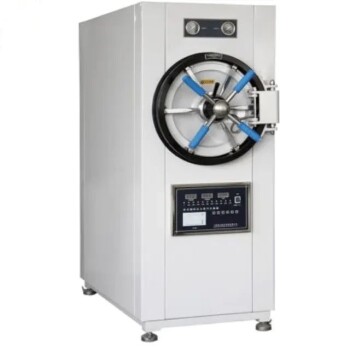
A high-pressure reactor, or autoclave, is the fundamental enabler for lignin solvolysis because it permits reaction conditions to safely exceed the boiling points of solvents. By containing the pressure generated at temperatures above 200°C, the vessel allows solvents to transition into supercritical or near-critical states. This state is chemically necessary to penetrate lignin's stubborn structure and prevent the solvent from simply evaporating before the reaction occurs.
By forcing solvents like water or ethanol into a supercritical state, the autoclave transforms them into highly penetrating fluids that can break the complex cross-linked bonds of lignin, a feat impossible at atmospheric pressure.
Overcoming Lignin’s Structural Defenses
The Necessity of Extreme Heat
Lignin is a biopolymer characterized by a rigid, complex structure.
To break this structure down into useful components, the reaction environment typically requires temperatures exceeding 200°C.
Standard vessels cannot sustain these temperatures with liquid solvents, as the solvent would boil off immediately.
Containing the Resulting Pressure
When you heat a solvent like water or ethanol to these temperatures in a closed system, the internal pressure rises dramatically.
The autoclave is specifically engineered to withstand this intense pressure without rupturing.
This containment keeps the solvent in contact with the lignin biomass rather than allowing it to escape as steam or vapor.
The Mechanism of Depolymerization
Achieving the Supercritical State
The core function of the autoclave is to push the solvent into a supercritical or near-critical state.
In this state, the solvent exhibits properties of both a liquid and a gas.
This duality allows the solvent to diffuse through solids like a gas while dissolving materials like a liquid.
Penetrating the Matrix
Lignin possesses a dense, cross-linked network that resists standard chemical attacks.
Supercritical solvents formed within the autoclave can penetrate deep into this cross-linked matrix.
Once inside, the high-energy solvent efficiently cleaves the bonds holding the lignin together.
Yielding High-Quality Precursors
The ultimate goal of this process is the acquisition of phenolic monomer precursors.
The autoclave ensures the reaction is efficient enough to maximize the yield of these high-value monomers.
Without the high-pressure environment, the depolymerization would be incomplete, resulting in low-quality outputs.
Understanding the Trade-offs
Operational Complexity and Safety
While essential for chemistry, high-pressure reactors introduce significant safety risks compared to atmospheric vessels.
Operators must strictly monitor pressure limits, requiring robust safety valves and burst discs.
The potential for catastrophic failure demands rigorous training and safety protocols.
Equipment Cost and Maintenance
Autoclaves are precision-engineered heavy equipment, leading to high initial capital costs.
They require specialized seals and locking mechanisms to maintain integrity at $>200°C$.
Maintenance is frequent and critical; a minor seal failure can abort an experiment or damage the hardware.
Making the Right Choice for Your Project
High-pressure processing is a balance between yield requirements and operational capabilities.
- If your primary focus is maximizing monomer yield: Ensure your reactor is rated for pressures well above the critical point of your chosen solvent (e.g., ethanol or water) to ensure complete depolymerization.
- If your primary focus is process safety and simplicity: You may be forced to operate at lower temperatures, but you must accept that solvent penetration will be lower and reaction times significantly longer.
The autoclave acts not just as a vessel, but as a thermodynamic tool that unlocks the chemical potential of the solvent.
Summary Table:
| Feature | Atmospheric Pressure | High-Pressure Reactor (Autoclave) |
|---|---|---|
| Temperature Limit | Limited by solvent boiling point | Exceeds 200°C safely |
| Solvent State | Liquid or Vapor | Supercritical or Near-critical |
| Penetration Power | Low (surface only) | High (diffuses like gas, dissolves like liquid) |
| Bond Cleaving | Inefficient/Incomplete | Rapid & effective breaking of cross-links |
| Monomer Yield | Low quality/Low volume | High-quality phenolic precursors |
Maximize Your Lignin Research Efficiency with KINTEK
Unlock the full potential of your chemical processing with KINTEK’s precision-engineered high-temperature high-pressure reactors and autoclaves. Specifically designed for demanding applications like lignin solvolysis and hydroprocessing, our equipment ensures safety and reliability at temperatures exceeding 200°C.
Whether you are producing phenolic monomer precursors or exploring battery research and advanced materials, KINTEK provides a comprehensive range of laboratory solutions, including:
- High-Pressure Reactors & Autoclaves for supercritical fluid processing.
- Muffle & Tube Furnaces for precise thermal treatment.
- Crushing & Milling Systems for biomass preparation.
- Essential Consumables like PTFE products, ceramics, and crucibles.
Don't let equipment limitations stall your innovation. Contact KINTEK today to find the perfect reactor for your lab!
References
- Weijun Yang, P. J. Lemstra. Bio‐renewable polymers based on lignin‐derived phenol monomers: Synthesis, applications, and perspectives. DOI: 10.1002/sus2.87
This article is also based on technical information from Kintek Solution Knowledge Base .
Related Products
- Stainless High Pressure Autoclave Reactor Laboratory Pressure Reactor
- Mini SS High Pressure Autoclave Reactor for Laboratory Use
- High Pressure Laboratory Autoclave Reactor for Hydrothermal Synthesis
- Customizable High Pressure Reactors for Advanced Scientific and Industrial Applications
- Laboratory High Pressure Horizontal Autoclave Steam Sterilizer for Lab Use
People Also Ask
- Why is a laboratory high-pressure reactor necessary for synthesizing fly ash-based zeolite? Achieve Pure Crystallization
- Why is a laboratory high-pressure reactor used in the hydrothermal synthesis of hydroxyapatite catalysts?
- What role does a laboratory high-pressure reactor play in the leaching process of spent cathode materials? Optimize Recovery
- What conditions do laboratory high-pressure reactors provide for HTC? Optimize Your Biochar Production Processes
- How are high-pressure reactors used to prepare metaphosphate electrocatalysts? Master In-Situ Precursor Growth