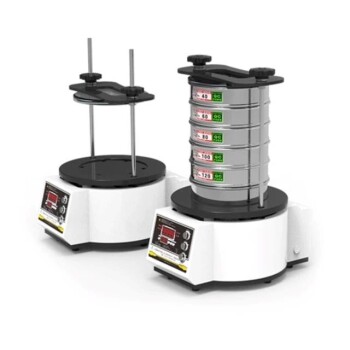
High-precision standard sieves are critical tools for controlling particle size distribution to ensure analytical accuracy. By strictly filtering ground powder to a predefined fineness—often 200 mesh—these sieves eliminate X-ray scattering deviations caused by uneven grain sizes. This process is a fundamental prerequisite for building reliable quantitative models and achieving reproducible results in both portable and benchtop X-ray fluorescence (XRF) analysis.
High-precision sieving acts as a vital quality control stage that transforms heterogeneous geological material into a homogeneous powder. This uniformity is the cornerstone of accurate chemical analysis, as it minimizes physical interference and ensures the sample is truly representative of the bulk material.
Optimizing Particle Size for X-Ray Interaction
Eliminating X-Ray Scattering Deviations
When an XRF spectrometer scans a sample, the physical texture of the surface significantly impacts how X-rays are reflected and absorbed. Uneven grain sizes create micro-shadows and irregular paths for secondary X-rays, leading to scattering deviations that distort the data.
Sieving ensures that the sample surface is mechanically consistent, allowing for a predictable interaction between the X-ray beam and the atoms in the powder.
Achieving Predefined Fineness Standards
Geological samples must reach a specific level of fineness, typically around 200 mesh (75 microns), to be considered suitable for high-quality XRF work. High-precision sieves provide a definitive physical boundary that guarantees no oversized particles remain in the final sample.
This strict control allows technicians to meet the standardized protocols required for calibrated analytical models.
Ensuring Representative and Homogeneous Samples
Transitioning from Bulk to Homogenized Powder
A geological sample is often a small fragment taken from a much larger bulk product. To ensure that the small volume measured by the XRF spectrometer represents the entire deposit, the material must be crushed, ground, and homogenized.
Sieving facilitates this by ensuring only the most finely ground, thoroughly mixed particles proceed to the final analysis stage, effectively averaging the chemical composition across the sample.
Impact on Quantitative Modeling
Reliable quantitative evaluation depends on the ability to compare unknown samples against known calibration curves. If the grain size varies between the calibration standards and the unknown samples, the analytical models will fail.
High-precision sieves ensure that all samples processed in a laboratory share the same physical characteristics, allowing for mathematical consistency in the data.
Understanding the Trade-offs and Limitations
Balance of Effort and Accuracy
While sieving significantly increases the accuracy of results, it introduces additional steps in terms of labor, equipment costs, and time. Laboratory managers must decide if the required level of precision justifies the extra handling required to achieve a perfectly sieved powder.
In some rapid field assessments using pXRF, technicians may accept a lower degree of preparation, though this always comes at the cost of increased measurement uncertainty.
Risks of Contamination and Material Loss
Every piece of equipment that touches a sample introduces a risk of cross-contamination. Sieves must be meticulously cleaned between samples to prevent "carryover" from one geological site to another.
Furthermore, excessive sieving of very small samples can lead to material loss, which may be problematic if the initial sample volume was already limited.
How to Optimize Your Sample Preparation Workflow
Choosing the right preparation strategy depends on your specific analytical goals and the nature of your geological material.
- If your primary focus is high-precision quantitative research: You must utilize high-precision sieves to reach a 200-mesh standard before pressing the powder into pellets or creating fused beads.
- If your primary focus is rapid field screening with pXRF: Focus on achieving a basic level of homogenization and use sieving primarily to remove large debris that would cause significant scattering.
- If your primary focus is cost-effective routine monitoring: Implement an automated grinding and sieving workflow to reduce labor costs while maintaining a baseline of sample uniformity.
By integrating high-precision sieving into your preparation protocol, you ensure that your XRF data is a true reflection of chemical composition rather than a byproduct of physical inconsistency.
Summary Table:
| Key Feature | Benefit for XRF Analysis | Analytical Impact |
|---|---|---|
| Particle Size Control | Achieves strict 200-mesh (75μm) fineness | Ensures standardized, calibrated results |
| Surface Uniformity | Eliminates micro-shadows and irregular paths | Minimizes secondary X-ray scattering |
| Homogenization | Averages chemical composition across sample | Ensures the sample represents the bulk deposit |
| Consistency | Aligns unknown samples with calibration curves | Provides mathematical reliability in modeling |
Elevate Your Geological Analysis with KINTEK Precision
Achieving the perfect 200-mesh consistency is non-negotiable for reliable X-ray fluorescence results. KINTEK specializes in high-performance laboratory solutions designed to streamline your sample preparation workflow. From high-precision sieving equipment and crushing and milling systems to hydraulic presses for high-quality pellet preparation, we provide the tools you need to eliminate measurement uncertainty.
Whether you are performing high-precision quantitative research or rapid field screening, our comprehensive range of laboratory equipment and consumables—including ceramics, crucibles, and grinding media—ensures your lab maintains the highest standards of accuracy and efficiency.
Ready to optimize your lab's performance? Contact our experts today to find the ideal equipment for your geological sampling needs!
References
- Shuguang Zhou, Shibin Liao. Evaluation of Portable X-ray Fluorescence Analysis and Its Applicability As a Tool in Geochemical Exploration. DOI: 10.3390/min13020166
This article is also based on technical information from Kintek Solution Knowledge Base .
Related Products
- Vibratory Sieve Shaker Machine Dry Three-Dimensional Vibrating Sieve
- Laboratory Vibratory Sieve Shaker Machine Slap Vibrating Sieve
- Custom PTFE Teflon Parts Manufacturer for PTFE Mesh F4 Sieve
- Three-dimensional electromagnetic sieving instrument
- Laboratory Test Sieves and Sieving Machines
People Also Ask
- How is a vibratory sieve shaker used in the particle size analysis of mechanically alloyed powders? Expert Guide
- Why use a vibratory sieve shaker for PET powder? Achieve Precise Particle Size Control for Chemical Research
- What is the principle of vibratory sieve shaker? Achieve Accurate Particle Size Analysis
- What is the function of a vibratory sieve shaker? Achieve Precise Particle Size Analysis
- What is the use of vibratory sieve shaker? Achieve Precise Particle Size Analysis for Your Lab