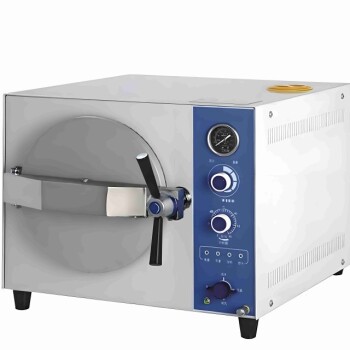
Using a drying dish to spread tungstic acid into a thin layer creates a controlled environment that fundamentally changes how water leaves the material. By combining this geometry with temperature control, you force moisture to escape the crystal lattice slowly rather than rapidly. This specific physical arrangement is the key to manipulating the final particle structure.
By shifting from bulk drying to thin-layer controlled dehydration, you utilize "dehydration stress" as a tool. This process actively fractures particles to increase surface area while simultaneously preventing them from clumping together.
The Mechanics of Thin-Layer Dehydration
Controlling Moisture Release
When tungstic acid is piled in bulk, moisture creates humidity micro-climates that lead to uneven drying.
Spreading the material in a thin layer within a drying dish ensures that each particle has direct exposure to the drying environment.
This allows water molecules to escape the crystal lattice at a slow, consistent rate.
Preventing Particle Aggregation
One of the primary risks during dehydration is that particles will bind together as water evaporates, forming hard clumps.
The thin-layer technique minimizes the contact points between wet particles.
By allowing moisture to escape slowly and evenly, you significantly reduce the tendency for particle aggregation, resulting in a looser, more uniform powder.
Enhancing Material Properties via Dehydration Stress
Inducing Physical Splitting
The most critical mechanism at play here is dehydration stress.
As water slowly exits the crystal lattice, the internal structure undergoes physical tension.
Because the material is in a thin layer, this tension does not result in clumping; instead, it causes the particles to physically split or crack on a microscopic level.
Increasing Specific Surface Area
The microscopic cracking effect is not a defect; it is a desirable outcome for high-performance applications.
These micro-cracks expose the inner material of the particle, effectively increasing the total surface area.
Consequently, the resulting tungsten trioxide possesses a significantly enhanced specific surface area compared to material dried in bulk.
Understanding the Trade-offs
Process Time vs. Material Quality
The primary reference highlights that this process allows moisture to escape slowly.
While this improves the physical properties of the tungsten trioxide, it inherently requires a longer processing time than rapid, high-heat drying methods.
You are effectively trading production speed for superior particle morphology and surface area.
Scalability Constraints
This method relies on spreading material thinly in dishes.
This introduces a spatial constraint, as you require significantly more surface area in your equipment to process the same volume of material compared to a bulk method.
Making the Right Choice for Your Goal
This technique is not just about drying; it is about engineering the physical characteristics of your final product.
- If your primary focus is maximizing catalytic activity: Adopt the thin-layer method to induce micro-cracking and maximize the specific surface area of the tungsten trioxide.
- If your primary focus is particle uniformity: Use this technique to prevent the formation of hard aggregates and ensure a consistent particle size distribution.
Control the geometry of your drying process, and you control the performance of your material.
Summary Table:
| Feature | Bulk Dehydration | Thin-Layer Dehydration |
|---|---|---|
| Moisture Release | Rapid & uneven; micro-climates form | Slow, consistent, and controlled |
| Particle Structure | High risk of hard aggregation/clumping | Induced micro-cracking for higher surface area |
| Material Quality | Lower specific surface area | Enhanced catalytic activity & uniformity |
| Process Efficiency | Faster production speed | Improved morphology (requires more time/space) |
Elevate Your Material Engineering with KINTEK Precision
Achieving the perfect particle morphology for tungsten trioxide requires more than just heat—it requires precise control over the drying environment. KINTEK specializes in high-performance laboratory equipment designed to meet the rigorous demands of material science.
Whether you are scaling your research with our advanced muffle and vacuum furnaces, refining powders with our crushing and milling systems, or requiring high-purity ceramic crucibles and PTFE products, KINTEK provides the tools to ensure your materials reach their maximum potential. Our solutions are tailored for researchers and manufacturers who cannot compromise on surface area or particle uniformity.
Ready to optimize your dehydration process? Contact KINTEK today to discover how our comprehensive range of laboratory equipment and consumables can enhance your lab's efficiency and product quality.
References
- E. A. Mazulevsky, N. M. Seidakhmetova. Production of fine-dispersed tungstic acid. DOI: 10.17580/nfm.2022.02.06
This article is also based on technical information from Kintek Solution Knowledge Base .
Related Products
- Laboratory Scientific Electric Heating Blast Drying Oven
- 56L Vertical Laboratory Vacuum Drying Oven
- 23L Laboratory Vacuum Drying Oven
- Tungsten Evaporation Boat for Thin Film Deposition
- Three-dimensional electromagnetic sieving instrument
People Also Ask
- How does a laboratory electric drying oven contribute to the formation of the initial coating? Expert Insights
- What role does a precision laboratory drying oven play in the synthesis of GO-PANI nanocomposites? Protect Material Integrity
- What role does a laboratory drying oven play in the preparation of zinc oxide nanoparticle precursors?
- What is the necessity of using a laboratory drying oven when processing MoO3/GO composite nanopowders? Find out here.
- What is the role of a laboratory drying oven in cellulose citrate production? Ensure Material Stability & Purity