In essence, pyrolysis transforms waste into value. The primary advantage of the pyrolysis process is its ability to thermally decompose organic materials—such as biomass, plastics, and tires—in an oxygen-free environment. This converts low-value or waste feedstocks into high-value products like bio-oil, bio-char, and syngas, simultaneously reducing landfill burden and creating alternatives to fossil fuels.
Pyrolysis is more than just a waste disposal method; it is a transformative technology that reclaims the chemical and energy value locked inside organic materials, turning a linear waste stream into a circular value chain.
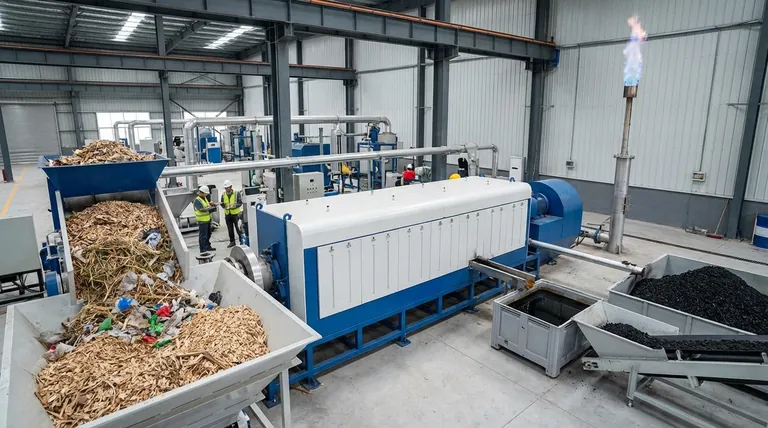
From Waste Stream to Value Stream
The core function of pyrolysis is chemical conversion. By applying intense heat without oxygen, it breaks down complex organic polymers into simpler, more useful molecules, preventing the combustion that would simply release their energy as heat and CO2.
Converting Organic Waste into Valuable Products
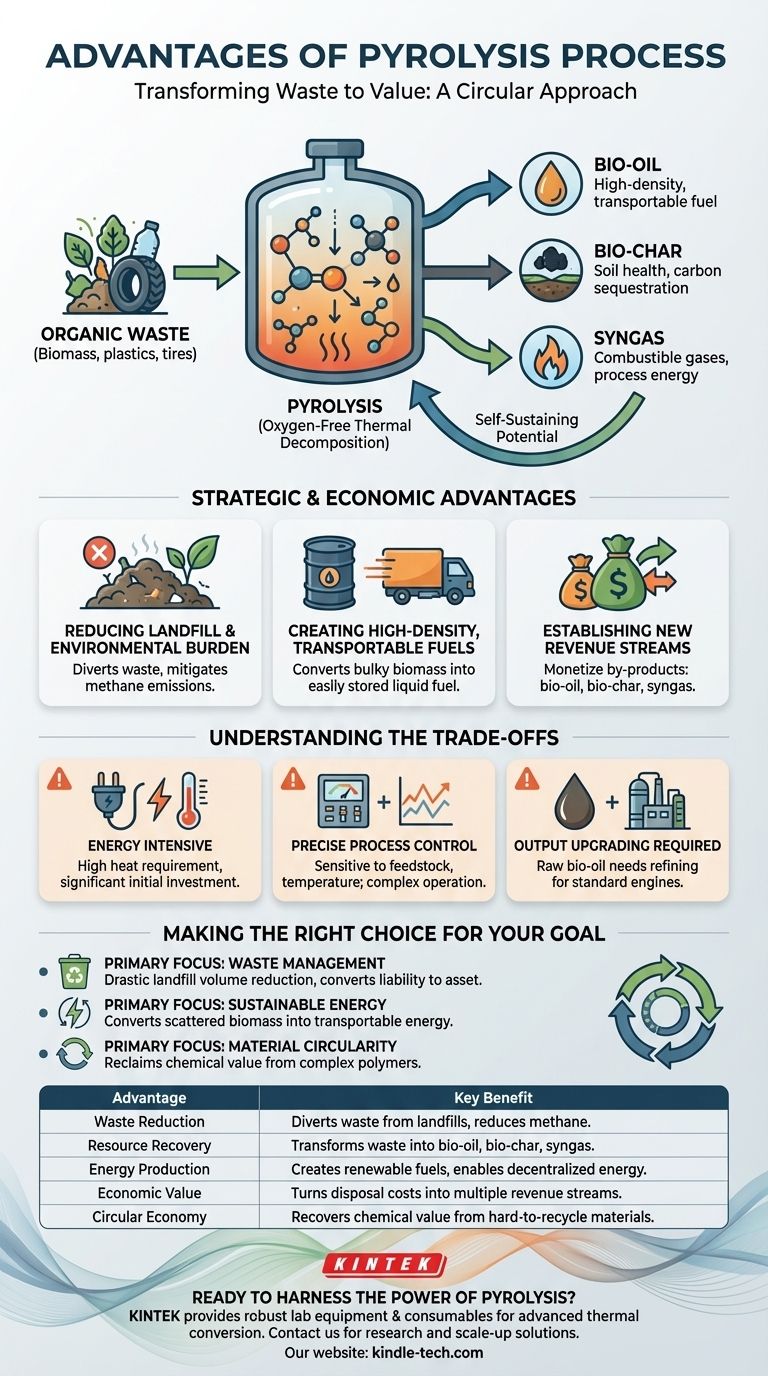
Pyrolysis separates a single input material into three distinct and valuable output streams.
- Bio-oil: A liquid, sometimes called pyrolysis oil, that can be refined into transportation fuels or used for generating heat and power.
- Bio-char: A stable, carbon-rich solid that can be used to improve soil health, sequester carbon, or serve as an activated carbon precursor.
- Syngas: A mixture of combustible gases (primarily hydrogen and carbon monoxide) that can be used to power the pyrolysis process itself, making it partially self-sustaining.
Reducing Landfill and Environmental Burden
By diverting organic waste from landfills, pyrolysis directly addresses a major environmental challenge. This significantly reduces the volume of waste requiring disposal and mitigates the release of methane, a potent greenhouse gas produced by decomposing organic matter in landfills.
Recovering Value from Post-Consumer Materials
The process is highly effective for materials that are difficult to recycle mechanically, such as mixed plastics or vehicle tires. Pyrolysis can break these materials down to their constituent chemical components, enabling the recovery of valuable hydrocarbons that can be used to create new products.
The Strategic and Economic Advantages
Beyond its environmental benefits, pyrolysis offers compelling economic and logistical advantages, particularly in the fields of energy and resource management.
Creating High-Density, Transportable Fuels
One of the most significant advantages is the conversion of low-energy-density biomass, like wood chips or agricultural residue, into high-energy-density liquid bio-oil. This "energy densification" makes the resulting fuel far cheaper and easier to store and transport than the original bulky feedstock.
Enabling Decentralized Energy Production
Pyrolysis plants can be built at various scales, including smaller, modular units. This flexibility allows them to be deployed in remote locations close to the source of biomass, reducing transportation costs and enabling localized energy production for rural communities or industrial sites.
Establishing New Revenue from By-products
The sale of bio-oil, bio-char, and excess syngas creates multiple revenue streams from what was once a waste product with disposal costs. This economic incentive drives the adoption of more sustainable waste management practices.
Understanding the Trade-offs and Realities
While powerful, pyrolysis is not a perfect solution and requires a clear understanding of its operational demands. Its efficiency and viability are dependent on managing several key factors.
The Energy Input Requirement
The process is energy-intensive, as it requires maintaining high temperatures in a controlled, oxygen-free environment. While the syngas produced can offset a portion of this energy demand, the initial setup and sustained operation require a significant energy investment.
The Need for Precise Process Control
The final output—the ratio and quality of oil, char, and gas—is highly sensitive to the feedstock material, temperature, and heating rate. Achieving a consistent, desirable product mix demands sophisticated monitoring and process control, which adds to operational complexity.
The Requirement for Output Upgrading
The raw bio-oil produced by pyrolysis is not a "drop-in" replacement for conventional diesel or gasoline. It is typically acidic, unstable, and contains water and solids, requiring further refining or upgrading before it can be used in standard engines or industrial processes.
Making the Right Choice for Your Goal
To determine if pyrolysis is the appropriate technology, you must align its strengths with your primary objective.
- If your primary focus is waste management: Pyrolysis offers a superior method for drastically reducing landfill volume and converting a disposal liability into a valuable asset.
- If your primary focus is sustainable energy: This process is an excellent tool for converting scattered, low-value biomass into a storable and transportable liquid energy carrier.
- If your primary focus is material circularity: Pyrolysis is uniquely capable of reclaiming the chemical value from complex polymer waste like plastics and tires, closing the loop on material lifecycles.
By understanding its core advantages and operational requirements, you can effectively leverage pyrolysis to achieve both environmental and economic objectives.
Summary Table:
| Advantage | Key Benefit |
|---|---|
| Waste Reduction | Diverts organic waste from landfills, reducing methane emissions. |
| Resource Recovery | Transforms waste into valuable products: bio-oil, bio-char, and syngas. |
| Energy Production | Creates renewable fuels and enables decentralized energy generation. |
| Economic Value | Turns disposal costs into multiple revenue streams from by-products. |
| Circular Economy | Recovers chemical value from hard-to-recycle materials like mixed plastics and tires. |
Ready to harness the power of pyrolysis for your laboratory or waste management operation? KINTEK specializes in providing robust lab equipment and consumables tailored for advanced thermal conversion processes like pyrolysis. Whether you're researching feedstock efficiency, optimizing product yields, or scaling up your process, our solutions deliver the precision, control, and reliability you need to succeed. Contact our experts today to discuss how we can support your specific laboratory needs and help you achieve your environmental and economic goals.
Visual Guide
Related Products
- Electric Rotary Kiln Small Rotary Furnace Biomass Pyrolysis Plant
- Electric Rotary Kiln Continuous Working Small Rotary Furnace Heating Pyrolysis Plant
- Electric Rotary Kiln Pyrolysis Furnace Plant Machine Calciner Small Rotary Kiln Rotating Furnace
- Customizable Laboratory High Temperature High Pressure Reactors for Diverse Scientific Applications
- High Pressure Laboratory Autoclave Reactor for Hydrothermal Synthesis
People Also Ask
- What are the reactions involved in pyrolysis of biomass? Unlock the Chemistry for Tailored Bio-Products
- Is rotary kiln a furnace? Discover the Key Differences for Industrial Processing
- What are the reactors for fast pyrolysis? Choosing the Right System for Maximum Bio-Oil Yield
- What are the characteristics of the slipping, slumping, and rolling modes of bed motion? Optimize Your Rotary Process
- What are the main parts of a rotary kiln? A Guide to Its Core Components and Functions