
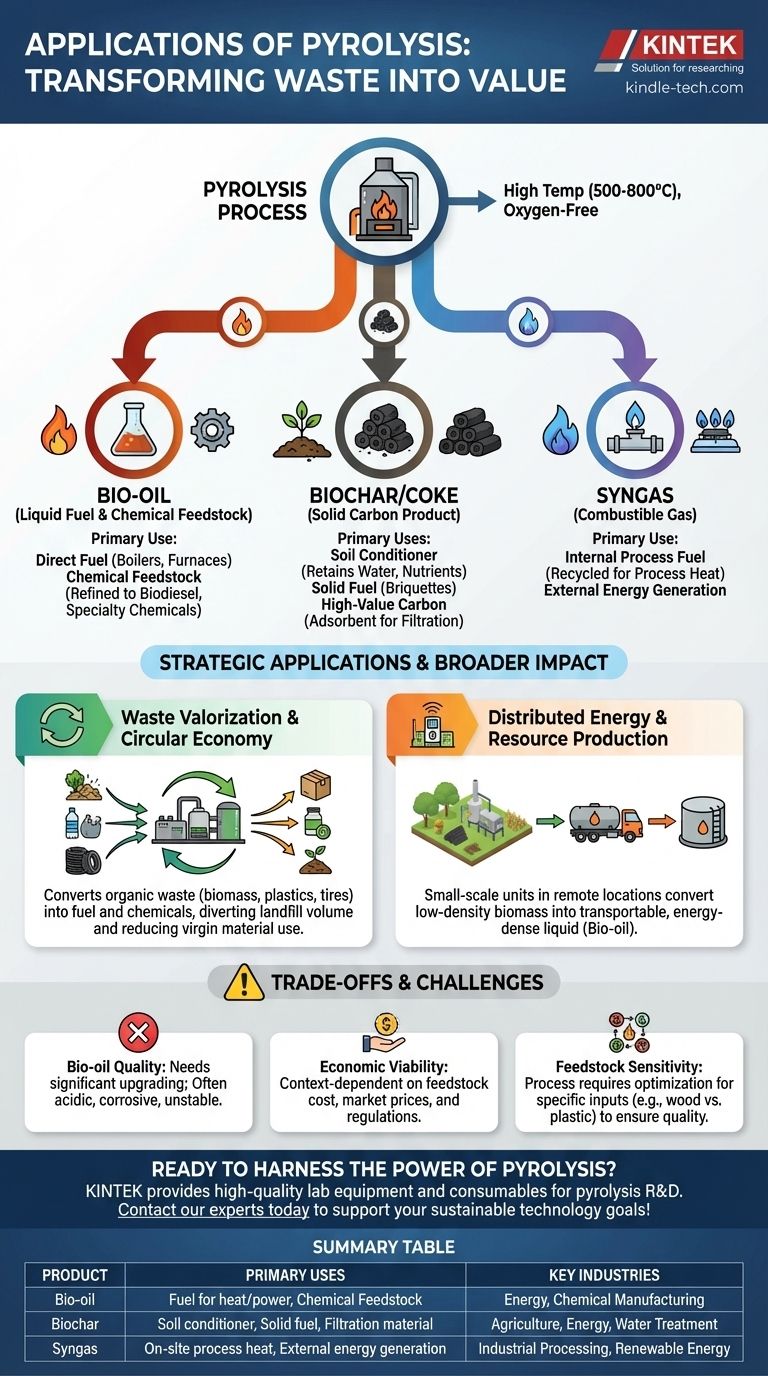
At its core, pyrolysis is a powerful transformation process. It uses high temperatures in an oxygen-free environment to chemically decompose organic materials, converting what is often considered waste into valuable products. The primary applications are the creation of liquid fuel (bio-oil), a solid carbon-rich product (biochar or coke), and a combustible gas (syngas), which are used for energy, agriculture, and chemical production.
Pyrolysis should not be viewed merely as a waste disposal method, but as a strategic value-creation technology. It unlocks the chemical and energy potential stored in low-value materials like biomass or plastic waste, converting them into stable, transportable, and useful commodities.
The Three Primary Products and Their Uses
Pyrolysis is best understood through its three main outputs. The specific yield and quality of each product depend heavily on the input material (feedstock) and process conditions like temperature and heating rate.
Bio-oil: The Liquid Fuel and Chemical Feedstock
Bio-oil, also known as pyrolysis oil, is a dark, dense liquid. It is the most versatile of the outputs.
Its primary use is as a direct fuel source. It can be burned in industrial boilers and furnaces to generate heat and electricity, serving as an alternative to conventional fuel oil.
Bio-oil also serves as a feedstock for advanced products. It can be refined and upgraded to produce transportation fuels like biodiesel or to extract specialty chemicals, a practice that reduces our reliance on fossil fuels for chemical manufacturing.
Historically, this liquid fraction has been valued for centuries. Ancient Egyptians used the tars and acids from wood pyrolysis for embalming and to caulk boats.
Biochar (or Coke): The Solid Carbon Product
Biochar is the stable, carbon-rich solid that remains after pyrolysis. Its applications are diverse and growing.
In agriculture, biochar is highly valued as a soil conditioner. Its porous structure helps retain water and nutrients, improving soil health and crop yields while sequestering carbon in the ground for long periods.
It is also used as a solid fuel. In the 1800s, charcoal produced from wood pyrolysis was the primary fuel of the Industrial Revolution before being replaced by coal. Today, it can be formed into briquettes for energy.
More advanced applications use biochar as a high-value carbon material, such as an adsorbent for filtration systems or as a carrier for industrial catalysts.
Syngas: The Internal Process Fuel
Syngas, or synthesis gas, is the non-condensable gas mixture produced during pyrolysis. It contains components like hydrogen, carbon monoxide, and methane.
While it can be used for external energy generation, its most common application is to be recycled back into the pyrolysis plant. It is burned on-site to provide the heat required for the pyrolysis reaction itself, making the entire process more energy-efficient and self-sustaining.
Strategic Applications Beyond the Products
The true power of pyrolysis lies in how it solves broader industrial and environmental problems. It is not just about what it makes, but what problems it solves.
Waste Valorization and The Circular Economy
Pyrolysis provides a powerful method for waste valorization—turning a liability into an asset. It can process a wide range of organic waste, including agricultural residues, forestry waste, food scraps, and even difficult materials like plastics and old tires.
By converting this waste into fuel and chemicals, pyrolysis diverts significant volume from landfills and reduces the need to extract virgin raw materials, a core principle of the circular economy.
Distributed Energy and Resource Production
Unlike massive, centralized refineries, pyrolysis units can be built at a relatively small scale and deployed in remote locations.
This is especially valuable for biomass, which is often spread out and has a low energy density, making it expensive to transport. Pyrolysis converts this bulky solid biomass into an energy-dense, easily stored, and transportable liquid (bio-oil), effectively creating a mobile and flexible energy supply chain.
Understanding the Trade-offs and Challenges
While powerful, pyrolysis is not a universal solution. A clear-eyed assessment requires acknowledging its practical limitations.
Bio-oil Quality and Stability
Raw bio-oil is not a direct replacement for gasoline or diesel. It is often acidic, corrosive to standard pipes and engines, and can be chemically unstable over time. It typically requires significant upgrading and refining before it can be used as a high-grade transportation fuel, which adds cost and complexity.
Economic Viability is Context-Dependent
The profitability of a pyrolysis operation is highly dependent on external factors. These include the cost and availability of the feedstock, local market prices for the end products (fuel, char), and government regulations or incentives related to waste disposal and renewable energy.
Feedstock Determines the Output
The process is highly sensitive to the input material. The chemical composition of wood, plastic, or manure is vastly different, and this directly impacts the yield and quality of the oil, char, and gas produced. A plant optimized for wood chips may not perform well with plastic waste without significant adjustments.
Making the Right Choice for Your Goal
To apply pyrolysis effectively, you must first define your primary objective. The technology is a flexible tool, and its value is realized differently depending on the goal.
- If your primary focus is energy production: View pyrolysis as a way to convert inconsistent solid biomass into a storable and transportable liquid or solid fuel for generating heat and power.
- If your primary focus is waste management: Frame pyrolysis as a powerful instrument for waste valorization that reduces landfill burden and creates revenue streams from materials previously considered worthless.
- If your primary focus is sustainable materials: See pyrolysis as a production method for valuable carbon-based products, from agricultural biochar that enhances soil to industrial-grade carbon for specialty applications.
Ultimately, pyrolysis offers a flexible pathway to convert low-value organic matter into higher-value products, playing a key role in a more sustainable and circular economy.
Summary Table:
| Product | Primary Uses | Key Industries |
|---|---|---|
| Bio-oil | Fuel for heat/power, chemical feedstock | Energy, Chemical Manufacturing |
| Biochar | Soil conditioner, solid fuel, filtration material | Agriculture, Energy, Water Treatment |
| Syngas | On-site process heat, external energy generation | Industrial Processing, Renewable Energy |
Ready to harness the power of pyrolysis for your lab or operation? KINTEK specializes in high-quality lab equipment and consumables for pyrolysis research and development. Whether you're exploring bio-oil refining, biochar applications, or syngas utilization, our solutions help you achieve precise, reliable results. Contact our experts today to discuss how we can support your sustainable technology goals!
Visual Guide
Related Products
- Electric Rotary Kiln Small Rotary Furnace Biomass Pyrolysis Plant
- Electric Rotary Kiln Continuous Working Small Rotary Furnace Heating Pyrolysis Plant
- Electric Rotary Kiln Pyrolysis Furnace Plant Machine Calciner Small Rotary Kiln Rotating Furnace
- Customizable Laboratory High Temperature High Pressure Reactors for Diverse Scientific Applications
- High Pressure Laboratory Autoclave Reactor for Hydrothermal Synthesis
People Also Ask
- What are the characteristics of the slipping, slumping, and rolling modes of bed motion? Optimize Your Rotary Process
- What are the reactors for fast pyrolysis? Choosing the Right System for Maximum Bio-Oil Yield
- What is the temperature of a rotating kiln? It Depends on Your Material and Process Goal
- What are the main parts of a rotary kiln? A Guide to Its Core Components and Functions
- What is a rotary kiln reactor? A Guide to Industrial Thermal Processing










