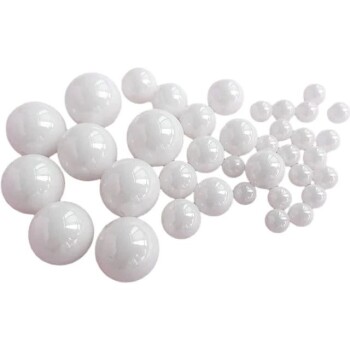
The selection of ceramic grinding ball diameters is a critical lever for balancing pulverization energy with dispersion quality.
For Carbon Nanotube (CNT)/Alumina fillers, utilizing a range of diameters—typically between 40 and 100 mm—ensures there is sufficient kinetic energy to break down large particle agglomerates. This specific size range, combined with the chemical stability of ceramic material, prevents metallic contamination and creates the complex motion trajectories required for a uniform composite mixture.
The core objective in selecting media diameter is to achieve a "proper gradation" where larger balls provide the initial impact force to crush brittle alumina structures, while smaller balls provide the surface area and collision frequency needed to refine the powder to a sub-micron scale.
The Role of Ball Diameter in Energy Distribution
Impact Energy of Large Diameters
Larger ceramic balls (towards the 100 mm range) generate the high impact kinetic energy necessary to pulverize large agglomerates of rice husk ash or ceramic waste. This energy is essential for inducing the initial chemical reactions and physical breakdown of the raw alumina feedstock.
Refinement and Frequency of Small Diameters
Smaller diameter balls increase the total surface area and the frequency of collisions within the mill jar. This higher collision density is what allows the mixture to reach the nanometer scale, ensuring that CNTs are distributed evenly throughout the alumina matrix.
Creating Complex Motion Trajectories
Using a variety of diameters prevents the media from moving in a simple, uniform pattern, which can lead to "dead zones" in the mill. Instead, gradated sizes create complex motion trajectories that improve the overall reaction kinetics and mixing uniformity.
Optimizing the Grinding Media Material
Preventing Metallic Contamination
Ceramic media is selected specifically for its high hardness and chemical stability compared to industrial-grade stainless steel. This ensures that the grinding process does not introduce metallic impurities, which would otherwise compromise the phase purity and electrical properties of the CNT/Alumina composite.
Material Compatibility and Self-Matching
Using high-purity alumina balls for alumina-rich fillers is a strategic choice to minimize "heterogeneous impurities." If the grinding media wears slightly, the debris is chemically identical to the filler itself, preserving the optical and chemical integrity of the final material.
Leveraging High-Density Media
Materials like Zirconia or Tungsten Carbide (WC) are occasionally used when extreme density is required to refine hard particles like Silicon Carbide. Their high mass increases the physical friction and impact forces, which is vital for increasing the contact density between the carbon nanotubes and the alumina particles.
Understanding the Trade-offs
Grinding Efficiency vs. Impurity Introduction
While Zirconia balls offer exceptional wear resistance and density, high-energy milling can still result in trace material loss. Technical analysis (such as OES-ICP) shows that this can introduce minute zirconium impurities, requiring a careful balance between the need for speed and the need for absolute powder purity.
Hardness vs. Media Longevity
Extremely hard media, such as Tungsten Carbide, effectively refines brittle microstructures but can be more expensive or sensitive to specific chemical environments. However, its high melting point and corrosion resistance generally ensure that any wear debris does not negatively impact the mechanical properties of the resulting composite.
Kinetic Energy vs. Material Sensitivity
Providing too much kinetic energy through excessively large balls can potentially damage the aspect ratio of the Carbon Nanotubes. The goal is to provide just enough force to break the alumina agglomerates without over-processing the sensitive carbon structures.
Applying Media Selection to Your Project
When configuring your ball mill for CNT/Alumina filler production, your choice should be dictated by the specific requirements of your final application.
- If your primary focus is Maximum Chemical Purity: Use high-purity alumina grinding balls to ensure that any media wear is chemically "self-matching" with your filler material.
- If your primary focus is Achieving Sub-Micron Particle Size: Prioritize a mixture of zirconia balls with a focus on smaller diameters to maximize collision frequency and friction.
- If your primary focus is Processing Large, Hard Raw Agglomerates: Utilize a larger diameter range (up to 100 mm) to provide the high-impact kinetic energy required for initial breakdown.
- If your primary focus is Uniform CNT Dispersion: Implement a gradated approach using multiple ball sizes to create complex motion trajectories and prevent powder dead zones.
The right combination of ceramic diameter and material properties ensures a high-performance filler that maintains its structural and chemical integrity throughout the milling process.
Summary Table:
| Selection Factor | Recommended Approach | Key Benefit |
|---|---|---|
| Diameter Range | 40 mm to 100 mm | High impact energy for initial agglomerate breakdown. |
| Media Gradation | Mixture of large & small sizes | Creates complex trajectories and prevents "dead zones." |
| Small Diameters | Increased surface area | Higher collision frequency for sub-micron refinement. |
| Material Choice | Alumina or Zirconia | Prevents metallic contamination; ensures chemical purity. |
| Energy Control | Balanced kinetic force | Protects the aspect ratio of sensitive Carbon Nanotubes. |
Elevate Your Material Synthesis with KINTEK’s Precision Milling Solutions
Achieving the perfect dispersion of Carbon Nanotubes in Alumina requires more than just high-quality raw materials—it demands the right grinding environment. KINTEK specializes in high-performance crushing and milling systems, alongside premium consumables like high-purity alumina and zirconia grinding balls, crucibles, and PTFE products.
Whether you are a researcher refining sub-micron powders or a distributor seeking a reliable partner for laboratory equipment, we provide the technical expertise and robust supply chain you need to succeed. Our comprehensive portfolio—from hydraulic presses for pelletizing to high-temperature furnaces and reactors—ensures your lab is equipped for excellence.
Contact KINTEK today for a customized consultation and expert support!
References
- Siti Shuhadah Md Saleh, Norlin Nosbi. Preparation of Carbon Nanotubes/Alumina Hybrid-Filled Phenolic Composite with Enhanced Wear Resistance. DOI: 10.3390/ma16072772
This article is also based on technical information from Kintek Solution Knowledge Base .
Related Products
- Precision Machined Zirconia Ceramic Ball for Engineering Advanced Fine Ceramics
- Stainless Steel Laboratory Ball Mill for Dry Powder and Liquid with Ceramic Polyurethane Lining
- Laboratory Jar Ball Mill with Alumina Zirconia Grinding Jar and Balls
- Laboratory Jar Mill with Agate Grinding Jar and Balls
- Laboratory Micro Tissue Grinding Mill Grinder
People Also Ask
- What are the applications of zirconia ceramics? Unlock High-Performance Solutions for Extreme Environments
- What is the physical mechanism for selecting hard grinding media? Optimize Your ZrC-Al Matrix Composite Production
- Why are zirconia milling balls preferred for P2-type layered oxides? Ensure High Purity and Grinding Efficiency
- What is the purpose of using zirconia milling balls of different diameters? Optimize Solid Electrolyte Processing
- Why are zirconia grinding jars and balls required for solid-state electrolyte powders? Ensure High Purity & Performance