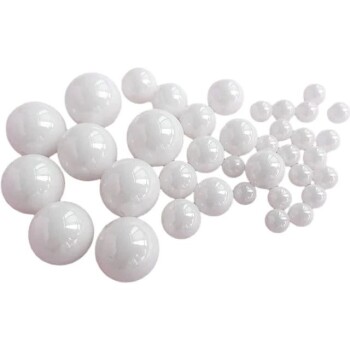
Zirconia grinding balls are the critical standard for milling NaSICON precursors because they offer a precise balance between mechanical force and material preservation. They provide the necessary high density to fracture hard ceramic structures while maintaining the chemical inertness required to prevent contamination in sensitive solid electrolytes.
The core value of zirconia lies in its ability to deliver high-impact kinetic energy without degrading the product. By minimizing wear and chemical reactivity, it ensures the final NaSICON powder retains the high purity essential for optimal electrical performance.
The Mechanics of Effective Refining
To achieve the correct particle size for NaSICON synthesis, the milling media must overcome the physical resistance of the precursor materials.
High Density Generates Kinetic Energy
The primary mechanical advantage of zirconia is its high density. In a milling environment, the impact energy delivered to the powder is directly related to the mass of the grinding media.
Because zirconia is dense, it carries sufficient kinetic energy during the milling process to effectively shatter and refine hard ceramic powders. Lighter media would lack the force required to break down these precursors efficiently.
Hardness to Overcome Resistance
NaSICON precursors and synthesized powders are often hard ceramic materials. To refine them, the grinding media must be significantly harder than the target material.
Zirconia possesses extreme hardness, allowing it to crush components like silicon carbide (SiC) or other hard precursors. This ensures a thorough size reduction and mixing process, which is fundamental to the consistency of the final synthesized powder.
Preserving Material Purity
In solid electrolyte production, purity is paramount. Even trace impurities can impede ionic conductivity or alter the electrochemical stability of the material.
Chemical Inertness
Zirconia exhibits excellent chemical stability, meaning it does not react with the precursor powders during the high-energy milling process.
This inertness prevents the chemical composition of the NaSICON from being altered by the grinding media itself. This is critical for maintaining the stoichiometry required for the material's specific electrical properties.
Wear Resistance and Contamination Control
All grinding media experience some level of abrasion, but zirconia is characterized by extremely low wear rates.
This durability minimizes the amount of media residue introduced into the powder mixture. By preventing the introduction of "wear byproducts," zirconia ensures the high purity of the solid electrolyte, avoiding defects that would otherwise degrade performance.
Critical Considerations: System Compatibility
While zirconia balls are highly effective, they must be used within a compatible milling system to maximize their benefits.
Preventing Metallic Impurities
The hardness of zirconia can be aggressive on milling jars. To fully eliminate contamination, specifically metallic impurities, the high-hardness balls are often paired with Nylon jars or similarly wear-resistant, non-metallic containers.
Using zirconia balls in a standard metallic jar could result in the hard balls abrading the jar walls, introducing metal contaminants that negate the purity benefits of the zirconia media. The combination of zirconia media and inert jars is essential for preventing impurities from interfering with subsequent material property evaluations.
Making the Right Choice for Your Goal
When setting up your milling process for NaSICON or similar advanced ceramics, consider your primary objective.
- If your primary focus is Purity: Pair zirconia balls with Nylon jars to ensure zero metallic contamination and preserve the electrochemical integrity of the electrolyte.
- If your primary focus is Particle Refinement: Rely on the high density of zirconia to provide the impact energy necessary to pulverize hard ceramic precursors that lighter media cannot fracture.
By leveraging the density and stability of zirconia, you ensure your milling process yields a powder that is both physically refined and chemically pure.
Summary Table:
| Feature | Benefit for NaSICON Processing | Impact on Final Product |
|---|---|---|
| High Density | Delivers maximum kinetic energy | Efficient particle size reduction |
| Extreme Hardness | Overcomes ceramic resistance | Uniformly refined powder structure |
| Chemical Inertness | Prevents reactive contamination | Maintains stoichiometry and stability |
| Low Wear Rate | Minimizes media residue | Ensures ultra-high purity levels |
| System Synergy | Works with Nylon/Polymer jars | Eliminates metallic impurity ingress |
Elevate Your Advanced Material Synthesis with KINTEK
Precision milling is the foundation of high-performance solid electrolytes. KINTEK specializes in providing the high-tier laboratory equipment and consumables required for advanced ceramic research. From our high-density zirconia grinding media to specialized crushing and milling systems, we ensure your NaSICON precursors achieve the perfect balance of refinement and purity.
Beyond milling, our comprehensive portfolio supports your entire workflow with:
- High-Temperature Furnaces: Muffle, vacuum, and atmosphere furnaces for precise sintering.
- Sample Preparation: Hydraulic pellet presses (manual and isostatic) for electrolyte disc formation.
- Specialized Labware: High-purity ceramics, crucibles, and PTFE products to prevent contamination.
Ready to optimize your NaSICON production? Contact KINTEK experts today to discover how our high-performance tools can enhance your research outcomes.
Related Products
- Laboratory Jar Ball Mill with Alumina Zirconia Grinding Jar and Balls
- Precision Machined Zirconia Ceramic Ball for Engineering Advanced Fine Ceramics
- Laboratory Jar Mill with Agate Grinding Jar and Balls
- Laboratory Ball Mill Jar Mill with Metal Alloy Grinding Jar and Balls
- High Energy Planetary Ball Mill Milling Machine for Laboratory
People Also Ask
- What are the primary functions of using a ball mill for BZCY72 powder? Achieve High Purity and Enhanced Sintering
- In what way does a laboratory ball mill affect material properties when modifying PHBV/pulp fiber composites?
- Why is a laboratory ball mill required for ultra-fine fly ash? Unlock Nano-Scale Adsorption Power
- What is the function of a laboratory ball mill in the preparation of AMMCs? Optimize Dispersion & Grain Refinement
- What is the function of a laboratory ball mill in the pretreatment of waste tire char (WTC)? Optimize Material Reactivity