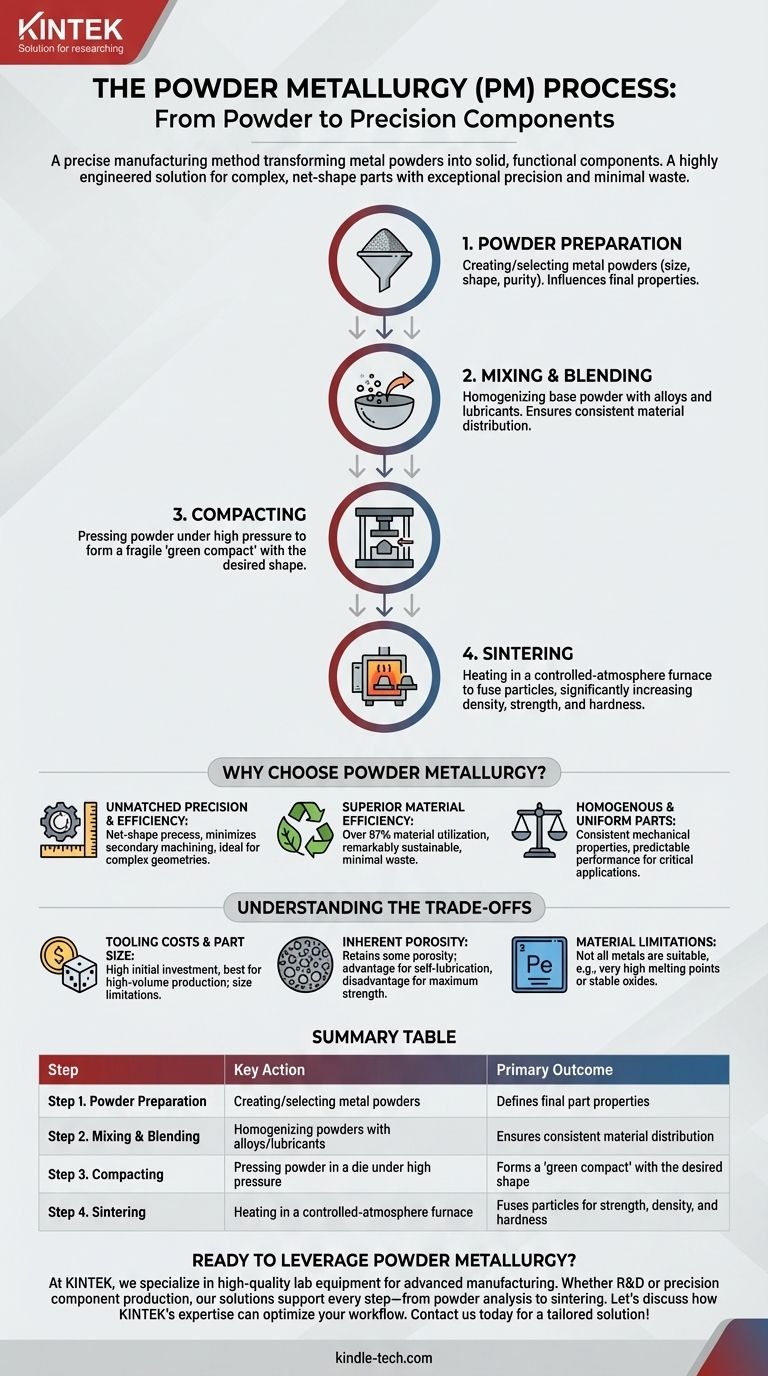
The powder metallurgy (PM) process is a precise manufacturing method that transforms metal powders into solid, functional components. At its core, the process consists of four fundamental steps: preparing the metal powder, mixing or blending it to ensure uniformity, compacting the powder into a desired shape under high pressure, and finally, sintering the compacted part at high temperature to bond the particles and create a strong, finished product.
Powder metallurgy is not just an alternative to casting or forging; it is a highly engineered solution for producing complex, net-shape metal parts with exceptional precision and minimal waste. It excels by building components from the ground up, atom by atom, rather than carving them from a larger block.
The Four Pillars of Powder Metallurgy
The PM process is a sequence of carefully controlled stages. Each step builds upon the last, contributing specific properties to the final component, from its chemical composition to its final density and strength.
Step 1: Powder Preparation
This foundational step involves the creation or selection of metal powders. The characteristics of this powder—such as particle size, shape, and purity—are critical as they directly influence the properties of the final part. Powders can be pure metals, like iron or copper, or pre-alloyed materials.
Step 2: Mixing and Blending
To achieve a homogenous final product, the base metal powder is precisely mixed. During this stage, different metal powders can be blended to create specific alloys, or lubricants can be added to improve the compaction process. This step ensures that every part produced has a consistent material distribution.
Step 3: Compacting
The blended powder is fed into a rigid die and compressed under extreme pressure, typically at room temperature. This pressure forces the powder particles into intimate contact, forming a fragile part known as a "green compact." This component has the desired shape and dimensions but lacks the strength for most applications.
Step 4: Sintering
Sintering is the critical thermal treatment that transforms the fragile green compact into a robust metal part. The component is heated in a controlled-atmosphere furnace to a temperature just below the metal's melting point. This heat causes the individual powder particles to fuse together, significantly increasing the part's density, strength, and hardness.
Why Choose Powder Metallurgy?
Beyond the technical process, the true value of PM lies in its unique benefits, making it the preferred choice for manufacturing countless components in the automotive, aerospace, and industrial sectors.
Unmatched Precision and Efficiency
PM is a net-shape or near-net-shape process, meaning the parts are formed with exceptional accuracy right out of the die. This minimizes or eliminates the need for secondary machining, saving time and reducing cost. It is ideal for producing complex geometries like gears, bushings, and structural components.
Superior Material Efficiency
The process is remarkably sustainable. Because parts are built up from powder, there is virtually no scrap material. Over 97% of the raw powder becomes part of the final product, a stark contrast to traditional subtractive manufacturing where significant material is cut away and wasted.
Homogenous and Uniform Parts
The controlled mixing and blending of powders ensure that the final component has a highly uniform and homogenous structure. This leads to consistent and predictable mechanical properties across the entire part, which is essential for high-performance applications like bearings and structural supports.
Understanding the Trade-offs
While powerful, powder metallurgy is not a universal solution. An objective evaluation requires acknowledging its limitations.
Tooling Costs and Part Size
The rigid dies and tooling required for compaction can be complex and expensive to produce. This initial investment makes PM most cost-effective for high-volume production runs where the tooling cost can be amortized over many thousands of parts. Furthermore, producing very large components can be challenging due to the immense press sizes required.
Inherent Porosity
Sintered parts almost always retain a small amount of residual porosity compared to parts made by melting (casting) or deformation (forging). While this can be an advantage for self-lubricating bearings (the pores hold oil), it can be a disadvantage for applications requiring maximum tensile strength or fatigue resistance.
Material Limitations
While a wide range of metals and alloys can be used, not all materials are suitable for powder metallurgy. Metals with very high melting points or those that readily form stable oxides can be difficult to process effectively.
Is Powder Metallurgy Right for Your Project?
Choosing the right manufacturing process depends entirely on your project's specific goals for performance, volume, and cost.
- If your primary focus is high-volume production of small, complex parts: PM is an exceptional choice due to its ability to produce net-shape components with high material efficiency and minimal secondary operations.
- If your primary focus is maximum material strength and zero porosity: You should carefully evaluate PM, as traditional forging or casting may offer superior density and fatigue properties for certain critical applications.
- If your primary focus is cost reduction and sustainability: PM's minimal waste (over 97% material utilization) and high-speed production make it a leading sustainable and cost-effective manufacturing process.
Ultimately, understanding the complete powder metallurgy process empowers you to make an informed decision that aligns with your specific engineering and business requirements.
Summary Table:
| Step | Key Action | Primary Outcome |
|---|---|---|
| 1. Powder Preparation | Creating/selecting metal powders | Defines final part properties (size, shape, purity) |
| 2. Mixing & Blending | Homogenizing powders with alloys/lubricants | Ensures consistent material distribution |
| 3. Compacting | Pressing powder in a die under high pressure | Forms a 'green compact' with the desired shape |
| 4. Sintering | Heating in a controlled-atmosphere furnace | Fuses particles for strength, density, and hardness |
Ready to leverage powder metallurgy for your lab's component needs?
At KINTEK, we specialize in providing the high-quality lab equipment and consumables essential for advanced manufacturing processes like powder metallurgy. Whether you're involved in R&D, material testing, or producing precision components, our solutions support every step—from powder analysis to sintering.
We help you achieve:
- Precision and Efficiency: Net-shape manufacturing for complex parts like gears and bushings.
- Material Sustainability: Over 97% material utilization, minimizing waste.
- Consistent Quality: Homogenous parts with predictable mechanical properties.
Let’s discuss how KINTEK’s expertise in lab equipment can optimize your powder metallurgy workflow. Contact us today for a tailored solution!
Visual Guide
Related Products
- Advanced Engineering Fine Ceramics Low Temperature Alumina Granulation Powder
- XRF & KBR steel ring lab Powder Pellet Pressing Mold for FTIR
- XRF & KBR plastic ring lab Powder Pellet Pressing Mold for FTIR
- Round Bidirectional Press Mold for Lab
- Folding Molybdenum Tantalum Boat With or Without Cover
People Also Ask
- Why is it necessary to apply alumina powder to graphite molds for TiC10/Cu-Al2O3? Ensure Smooth Release.
- What are the examples of ceramic powder? A Guide to Oxide and Non-Oxide Materials
- What is the most common industrial ceramic? Discover Why Alumina Dominates Countless Applications
- How is alumina ceramic made? A Guide to Manufacturing Methods and Material Properties
- What measures should be taken to prevent cross-contamination when using different sizes of alumina powder?