In short, heat-treated aluminum alloys are essential in high-performance applications where strength, durability, and low weight are critical. You will find them in the aerospace industry for structural components like fuselage frames and wing skins, in the automotive sector for engine blocks and suspension parts, and in demanding industrial equipment where materials must withstand significant stress.
Heat treating is not a single process but a strategic tool used to unlock specific, enhanced mechanical properties in certain aluminum alloys. It transforms a standard material into a specialized one, tailoring its strength, hardness, and internal stability for a specific engineering challenge.
The Core Purpose of Heat Treating Aluminum
Understanding why aluminum is heat-treated is more important than memorizing a list of applications. The goal is to deliberately manipulate the alloy's internal microstructure to achieve a desired performance outcome that the base material cannot provide on its own.
To Unlock Latent Strength
Many high-performance aluminum alloys, particularly in the 2xxx, 6xxx, and 7xxx series, derive their exceptional strength from a process called precipitation hardening.
Heat treatment allows microscopic alloying elements to first dissolve into the aluminum and then precipitate out as fine, dispersed particles during a controlled aging process. These particles act as obstacles that impede internal dislocations, dramatically increasing the material's strength and hardness.
To Relieve Internal Stresses
Manufacturing processes like casting, forging, extrusion, and even aggressive machining introduce significant internal stresses into a part.
A specific heat treatment cycle, often called stress relieving or annealing, gently heats the material to a uniform temperature. This allows the internal atomic structure to relax and realign, reducing the risk of warping after machining or premature failure under fatigue.
To Improve Durability and Hardness
By increasing an alloy's tensile strength, heat treatment also inherently increases its hardness and resistance to wear and deformation.
This is critical for components that experience contact, friction, or high cyclical loads, such as gears, pistons, or structural fasteners. The hardened surface better resists indentation and abrasion, extending the part's service life.
Key Applications by Industry
The benefits of heat treatment directly translate to its use in some of the most demanding engineering fields.
In Aerospace and Defense
This is the quintessential application for heat-treated aluminum. The industry's relentless demand for the highest possible strength-to-weight ratio makes it a perfect fit.
Common uses include aircraft fuselage frames, wing skins and spars, landing gear components, and structural castings for missiles and spacecraft. Alloys from the 7xxx series (e.g., 7075) are frequently used here.
In Automotive and Transportation
While steel is still prevalent, heat-treated aluminum is critical for lightweighting vehicles to improve fuel efficiency and performance.
You will find it in cast engine blocks, cylinder heads, suspension knuckles, control arms, and high-performance forged wheels. The ability to manage heat and resist fatigue makes it ideal for engine and chassis components.
In High-Performance Industrial and Consumer Goods
The principles extend to any application where performance outweighs cost.
This includes high-end bicycle frames, structural components for high-speed industrial machinery, and precision castings like turbine blades or vanes in smaller power generation systems.
Understanding the Trade-offs
Specifying heat treatment is not without its considerations. It is an engineering decision that involves balancing competing properties.
Reduced Ductility
A fundamental trade-off in metallurgy is that as you increase strength and hardness, you typically decrease ductility.
A heat-treated, high-strength aluminum part will be more brittle than its non-treated counterpart. It will withstand a higher load, but it will fracture with less warning or "plastic" deformation.
Potential for Distortion
The very act of heating and rapidly cooling a part can introduce thermal stresses that cause it to warp or change shape.
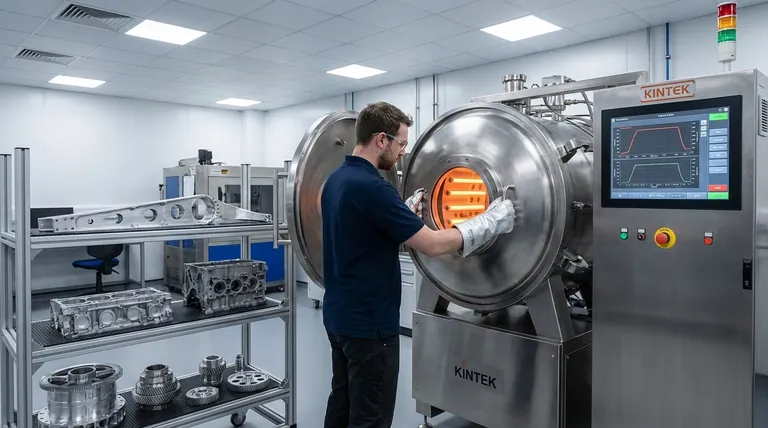
Properly supporting (fixturing) parts in the furnace and precisely controlling heating and quenching rates, as is done in vacuum furnace processes, are critical to maintaining dimensional accuracy.
Not All Alloys are Treatable
It is a common mistake to assume any aluminum alloy can be strengthened with heat. Only alloys with the right alloying elements (like copper, magnesium, silicon, and zinc) can be precipitation hardened.
The wrought 1xxx, 3xxx, and 5xxx series and the cast 4xx.x series are non-heat-treatable. Their strength is primarily achieved through work hardening or solid-solution strengthening.
Making the Right Choice for Your Goal
Your decision to use a heat-treated alloy should be driven by the primary requirement of your component.
- If your primary focus is maximum strength and structural integrity: Select a heat-treatable alloy from the 2xxx or 7xxx series and specify a full solution treatment and artificial aging (e.g., a T6 temper).
- If your primary focus is dimensional stability after machining: Incorporate a stress-relief cycle on your material before final machining to prevent warping in complex or high-precision parts.
- If your primary focus is formability followed by good strength: Use a 6xxx series alloy, which can be formed in a softer state and then aged to achieve a significant increase in strength for applications like automotive panels or extrusions.
Ultimately, heat treating transforms aluminum from a common material into a high-performance engineering solution tailored to a specific purpose.
Summary Table:
| Industry | Common Applications | Key Benefits |
|---|---|---|
| Aerospace & Defense | Fuselage frames, wing skins, landing gear | Highest strength-to-weight ratio, fatigue resistance |
| Automotive | Engine blocks, suspension parts, wheels | Lightweight for fuel efficiency, manages heat and stress |
| Industrial & Consumer Goods | Bicycle frames, machinery components, turbine blades | Enhanced durability, wear resistance, precision performance |
Ready to leverage heat-treated aluminum for your high-performance components?
At KINTEK, we specialize in providing the advanced lab equipment and consumables needed for precise thermal processing. Whether you're developing aerospace components, automotive parts, or industrial machinery, our solutions help you achieve the exact material properties your projects demand.
Contact us today to discuss how we can support your laboratory's specific needs and help you unlock the full potential of your materials.
Visual Guide

Related Products
- Engineering Advanced Fine Ceramics Aluminum Oxide Al2O3 Heat Sink for Insulation
- High Temperature Aluminum Oxide (Al2O3) Protective Tube for Engineering Advanced Fine Ceramics
- High Temperature Wear-Resistant Alumina Al2O3 Plate for Engineering Advanced Fine Ceramics
- Advanced Engineering Fine Ceramics Low Temperature Alumina Granulation Powder
- Engineering Advanced Fine Ceramics Alumina Crucibles (Al2O3) for Thermal Analysis TGA DTA
People Also Ask
- How is alumina ceramic made? A Guide to Manufacturing Methods and Material Properties
- How is a ceramic heater different? Discover the Self-Regulating Safety and Efficiency
- Why are porous ceramic filters utilized in methane pyrolysis? Protect Your Assets with High-Precision Filtration
- Can ceramic withstand high temperatures? Discover the Superior Materials for Extreme Heat
- What happens when ceramic is heated? A Deep Dive into Radiant Heat & Thermal Stability