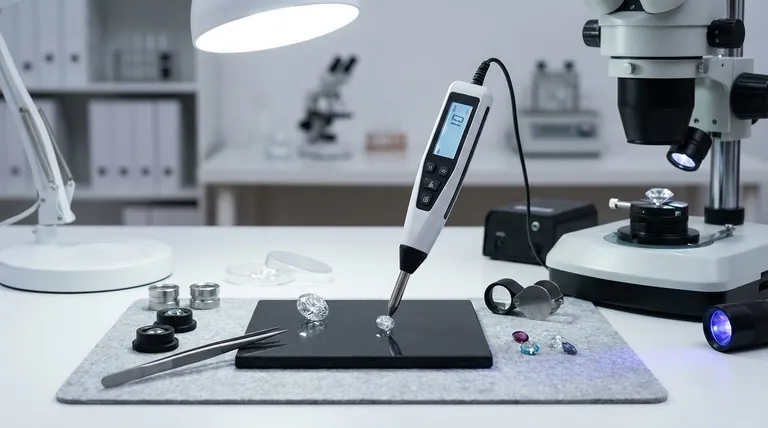
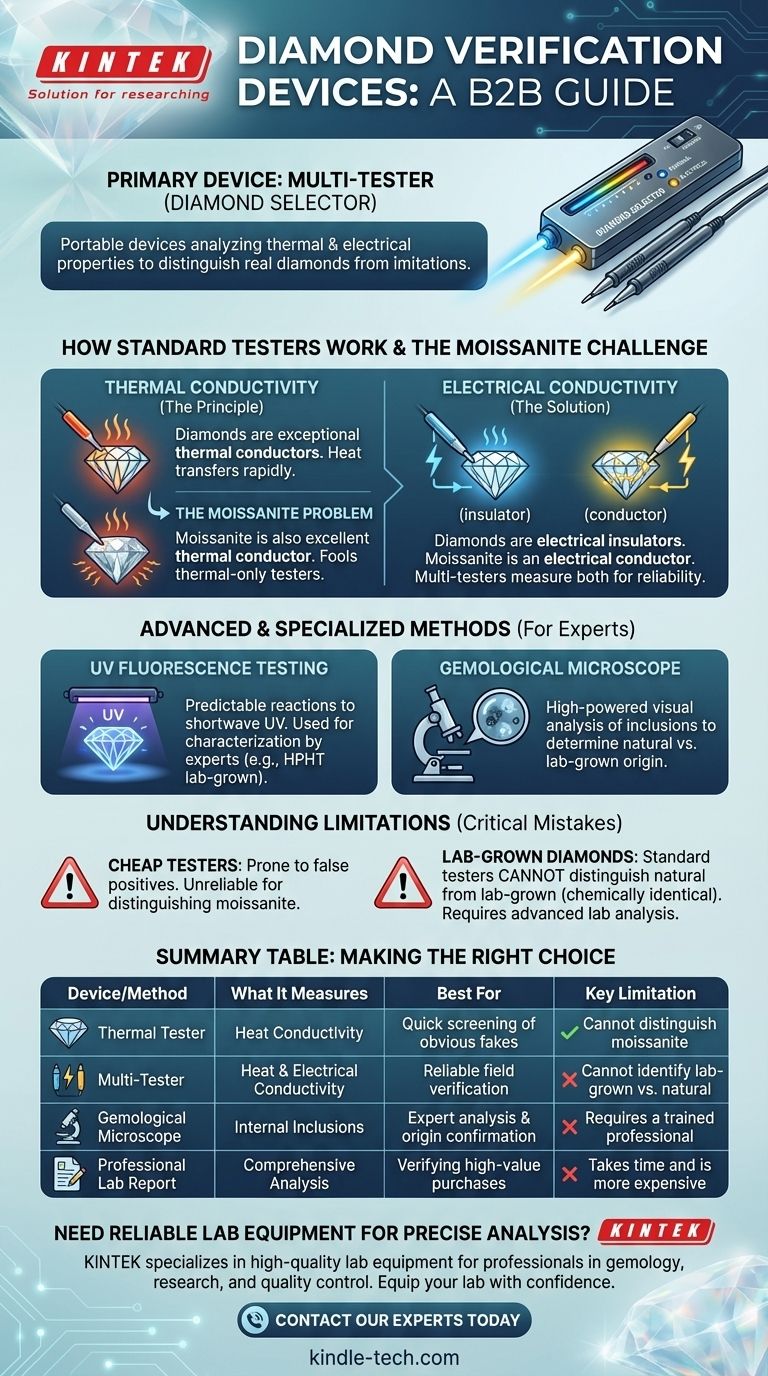
The primary device used to test for real diamonds is commonly called a diamond tester, a diamond selector, or a multi-tester. These portable electronic devices work by analyzing how a gemstone responds to heat and electricity, as diamonds have unique thermal and electrical properties that distinguish them from common imitations.
The core challenge in diamond testing isn't just identifying a diamond, but distinguishing it from convincing fakes like moissanite. For this reason, modern testers measure both thermal and electrical conductivity, as this dual-test approach provides the most reliable field verification.
How Standard Diamond Testers Work
The most common and accessible diamond testers are electronic probes that measure specific physical properties. They provide a quick, non-destructive way to separate diamonds from the vast majority of simulants.
The Principle of Thermal Conductivity
Diamonds are exceptional thermal conductors. They transfer heat more efficiently than almost any other material, including all common gemstones.
A basic diamond tester has a metal tip that heats up. When this tip touches the surface of a diamond, the heat is rapidly pulled away from the probe. The device measures this rate of heat transfer to make its determination.
The Problem with Moissanite
The most common and convincing diamond simulant is moissanite. Critically, moissanite is also an excellent thermal conductor, meaning it can easily fool a tester that only measures heat.
This shared property is why older, thermal-only testers are now considered unreliable for definitive testing.
The Solution: Electrical Conductivity
To solve the moissanite problem, modern devices—often called multi-testers—also measure electrical conductivity. This is the key differentiator.
Diamonds are electrical insulators (they do not conduct electricity). In contrast, moissanite is an electrical conductor. A multi-tester that detects both high thermal conductivity and no electrical conductivity will reliably identify a stone as a diamond.
Advanced and Specialized Testing Methods
While electronic testers are the standard for quick verification, gemologists use a wider array of tools for a complete analysis, especially for distinguishing natural diamonds from synthetic ones.
UV Fluorescence Testing
Some advanced screeners use shortwave ultra-violet (UV) light. Diamonds can fluoresce in predictable ways under UV light, and specific reactions can sometimes indicate a synthetic origin (like an HPHT lab-grown diamond) or certain treatments.
This method is more for characterization by an expert rather than a simple "yes/no" test for authenticity.
The Gemological Microscope
A trained gemologist's most powerful tool is often a high-powered microscope. It allows them to look for inclusions—tiny internal characteristics that formed when the diamond grew deep within the Earth.
The type, shape, and nature of these inclusions are often definitive proof of a diamond's natural origin. Lab-grown diamonds have different, more uniform growth characteristics.
Understanding the Limitations
No single field device is perfect. Understanding their limitations is critical to avoid costly mistakes.
Inaccuracy of Cheap Testers
Inexpensive testers that only measure thermal conductivity are prone to false positives. They cannot be trusted to distinguish a diamond from moissanite and should be considered unreliable for any serious purpose.
The Challenge of Lab-Grown Diamonds
Standard electronic diamond testers cannot distinguish between a natural diamond and a lab-grown diamond. This is because a lab-grown diamond is chemically, physically, and optically identical to a natural one.
Both are real diamonds and will pass a test for thermal and electrical conductivity. Differentiating them requires specialized laboratory equipment that can analyze growth patterns and trace elements.
The Importance of a Professional
For any stone of significant value, the only truly reliable method of verification is an assessment by a certified gemologist. They use a combination of tools and expertise to provide a definitive identification and grading report.
Making the Right Verification Choice
Your choice of testing method should align directly with your goal and the value of the stone in question.
- If your primary focus is quick screening: A quality multi-tester that measures both thermal and electrical conductivity is the best portable tool to separate diamonds from common fakes like moissanite or cubic zirconia.
- If your primary focus is verifying a high-value purchase: The only definitive approach is to submit the stone to a reputable gemological laboratory (like the GIA) for a full grading report.
- If your primary focus is determining origin (natural vs. lab-grown): You must consult a gemologist with access to advanced screening equipment, as standard testers are incapable of making this distinction.
Ultimately, choosing the right tool is about matching the level of certainty required for the situation.
Summary Table:
| Device/Method | What It Measures | Best For | Key Limitation |
|---|---|---|---|
| Thermal Tester | Heat Conductivity | Quick screening of obvious fakes | Cannot distinguish moissanite |
| Multi-Tester | Heat & Electrical Conductivity | Reliable field verification | Cannot identify lab-grown vs. natural diamonds |
| Gemological Microscope | Internal Inclusions | Expert analysis & origin confirmation | Requires a trained professional |
| Professional Lab Report | Comprehensive Analysis | Verifying high-value purchases | Takes time and is more expensive |
Need Reliable Lab Equipment for Precise Analysis?
Whether you're a gemologist verifying precious stones or a researcher requiring exacting measurements, the right equipment is fundamental to your results. KINTEK specializes in high-quality lab equipment and consumables, serving the precise needs of professionals in gemology, research, and quality control.
Let us help you equip your lab with confidence. Contact our experts today to discuss your specific requirements and discover the KINTEK difference in performance and reliability.
Visual Guide
Related Products
- CVD Diamond Dressing Tools for Precision Applications
- High Precision Diamond Wire Cutting Machine Laboratory Saw Precision Wire EDM Cutting Machine
- CVD Diamond Cutting Tool Blanks for Precision Machining
- 12 Inch 24 Inch High Precision Automatic Diamond Wire Cutting Machine Laboratory Saw Precision Wire EDM Cutting Machine
- Precision Wire Saw Laboratory Cutting Machine with 800mm x 800mm Workbench for Diamond Single Wire Circular Small Cutting
People Also Ask
- What is chemical vapor deposition of diamond? Grow High-Purity Diamonds Atom-by-Atom
- How do CVD diamonds grow? A Step-by-Step Guide to Lab-Grown Diamond Creation
- How do you identify a CVD diamond? The Definitive Guide to Lab-Grown Diamond Verification
- What color diamonds are CVD? Understanding the Process from Brown Tint to Colorless Beauty
- Does the chemical vapor deposition be used for diamonds? Yes, for Growing High-Purity Lab Diamonds