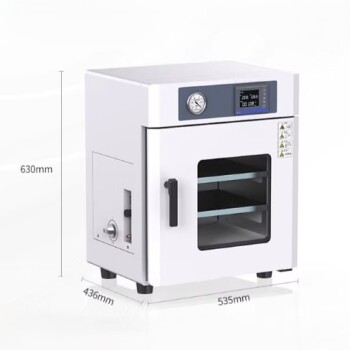
At its core, a heat treat oven is a highly controlled furnace designed to alter the fundamental physical properties of a material—most often a metal—through a precise cycle of heating and cooling. Unlike a regular furnace, its purpose is not to melt or change the shape of a part, but to purposefully manipulate its internal microstructure to achieve specific engineering goals like increasing hardness, softness, or durability.
The true function of a heat treat oven isn't simply heating metal; it's the precise execution of a thermal recipe. This control allows manufacturers to transform a standard material into a high-performance component engineered for a specific purpose, from a cutting tool to an aerospace gear.

The Goal: Manipulating a Material's Microstructure
To understand a heat treat oven, you must think of materials like metals not as solid, inert blocks, but as having a complex internal crystal structure. The oven's job is to rearrange that structure.
Beyond Simple Heating
A heat treat oven operates on a thermal cycle—a pre-programmed recipe of heating rates, soak times at specific temperatures, and controlled cooling rates. This is far more sophisticated than a blacksmith's forge; it is a process of scientific precision.
The Crystalline Structure of Metals
Metals are composed of microscopic crystals, or grains. The size, shape, and arrangement of these grains dictate the metal's properties. Heat provides the energy needed to dissolve and reform these grain structures into a more desirable configuration.
The Key Variables: Time, Temperature, and Atmosphere
Every heat treating process is defined by three critical variables:
- Temperature: The specific temperatures the part is heated to.
- Time: How long the part is held (or "soaked") at that temperature.
- Atmosphere & Cooling Rate: The environment inside the oven (e.g., air, inert gas, vacuum) and how quickly the part is cooled.
Manipulating these three levers allows an operator to produce a wide range of material properties from the exact same starting metal.
Common Heat Treating Processes and Their Outcomes
Different thermal cycles achieve different results. The most common processes are designed to solve specific engineering challenges.
Annealing: For Softness and Machinability
Annealing involves heating a metal and then cooling it very slowly. This process relieves internal stresses, refines the grain structure, and makes the metal softer and more ductile. This is often done to make a part easier to machine or form.
Hardening (Quenching): For Strength and Wear Resistance
Hardening requires heating a metal like steel above a critical temperature and then rapidly cooling it by submerging it in a medium like water, oil, or air. This process, known as quenching, traps the crystalline structure in a very hard but brittle state called martensite.
Tempering: For Toughness and Durability
A hardened part is often too brittle for practical use. Tempering is a secondary, lower-temperature heating process performed after hardening. It reduces some of the hardness and brittleness, exchanging it for a significant increase in toughness—the material's ability to absorb impact without fracturing.
Case Hardening: The Best of Both Worlds
For parts like gears or bearings, you need a surface that is extremely hard and wear-resistant, but a core that is softer and able to absorb shock. Case hardening (or surface hardening) achieves this by diffusing elements like carbon or nitrogen into only the surface layer of the steel part, allowing just the "case" to be hardened while the core remains tough.
Understanding the Trade-offs
Heat treating is not without its risks. The immense energy involved creates critical trade-offs that must be managed.
The Hardness vs. Toughness Dilemma
This is the most fundamental trade-off in metallurgy. As you increase a material's hardness (its resistance to scratching and wear), you almost always decrease its toughness, making it more brittle and prone to shattering. The balance between these two is the primary goal of most heat treatment plans.
Risk of Distortion or Cracking
The rapid temperature changes involved in processes like quenching induce massive internal stresses. If not managed properly, these stresses can cause the part to warp, distort, or even crack. This risk is why precise control of the heating and cooling cycles is paramount.
The Importance of Atmosphere Control
At high temperatures, the oxygen in the air can react with the surface of a steel part, causing scale and removing carbon from the surface (decarburization), which compromises its properties. Modern heat treat ovens use controlled atmospheres—such as nitrogen, argon, or a vacuum—to prevent these unwanted chemical reactions.
Matching the Process to Your Engineering Goal
The choice of heat treatment process is dictated entirely by the final application of the component.
- If your primary focus is preparing a material for manufacturing: Annealing is your key process to improve machinability and formability.
- If your primary focus is creating a final part with maximum wear resistance: A combination of hardening and tempering is necessary to achieve high strength without critical brittleness.
- If your primary focus is a component that needs a durable surface but a shock-absorbent core: Case hardening is the ideal solution, commonly used for gears and bearings.
- If your primary focus is refining a material's structure after forging or rolling: Normalizing will create a more uniform and reliable internal grain structure.
Ultimately, a heat treat oven transforms a simple piece of metal into a high-performance component engineered for a specific task.
Summary Table:
| Process | Primary Goal | Key Outcome |
|---|---|---|
| Annealing | Improve Machinability | Softer, more ductile metal |
| Hardening & Tempering | Increase Wear Resistance | Strong, tough, and durable part |
| Case Hardening | Create a Hard Surface/Tough Core | Excellent surface wear resistance with a shock-absorbent core |
Ready to Engineer Superior Metal Components?
Unlock the full potential of your materials with a precision heat treat oven from KINTEK. Whether your goal is to improve machinability, achieve maximum wear resistance, or create complex surface-hardened parts, our lab equipment delivers the exact control over time, temperature, and atmosphere that your process demands.
Contact our experts today to discuss how KINTEK's solutions can enhance your laboratory's capabilities and help you produce high-performance, reliable components.
Visual Guide

Related Products
- 2200 ℃ Graphite Vacuum Heat Treat Furnace
- Vacuum Heat Treat Furnace with Ceramic Fiber Liner
- Laboratory Scientific Electric Heating Blast Drying Oven
- 600T Vacuum Induction Hot Press Furnace for Heat Treat and Sintering
- Vacuum Heat Treat and Pressure Sintering Furnace for High Temperature Applications
People Also Ask
- What features must a vacuum furnace have for Cr2AlC MAX phase coatings? Precision Controls for High-Purity Synthesis
- What are the three primary cooling methods for a vacuum heat treatment furnace? Optimize Hardness & Surface Finish
- Why is high-temperature vacuum heat treatment critical for Cr-Ni steel? Optimize Strength & Surface Integrity
- Why do you heat treat in a vacuum? Achieve Perfect Surface Finish and Material Integrity
- What is graphite heating? A Guide to Durable, High-Temp Industrial Furnace Solutions