In essence, sintered glass is a solid, porous material created by heating glass powder to a temperature where the particles fuse together without completely melting. This process, known as sintering, transforms loose powder into a rigid, interconnected structure, much like welding countless tiny beads into a single, cohesive piece.
The critical distinction is that sintered glass is made from powder fused below its melting point, resulting in a strong but porous material, unlike traditional glass which is melted into a non-porous liquid and then cooled.
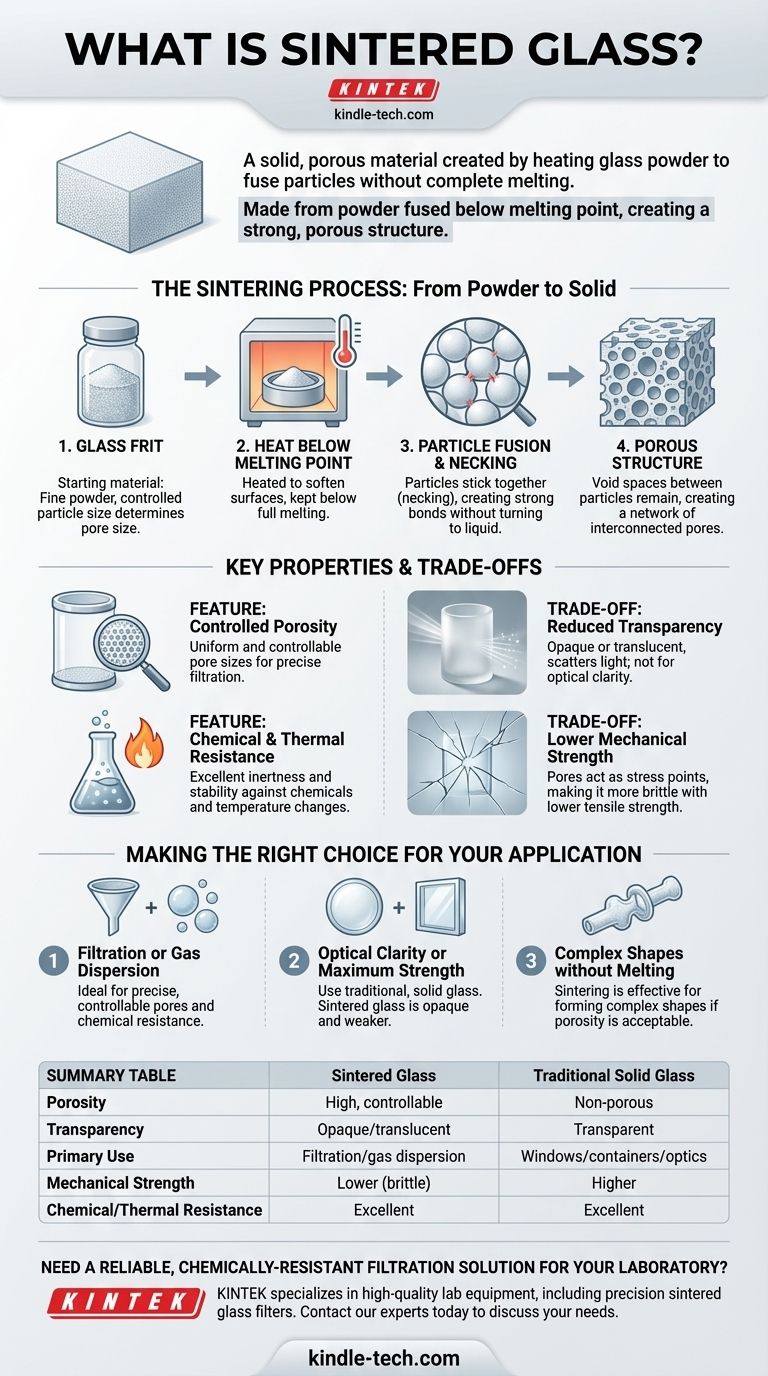
The Sintering Process: From Powder to Solid
Understanding how sintered glass is made is key to understanding its unique properties. It is a fundamentally different manufacturing path than that used for windows or bottles.
The Starting Material: Glass Frit
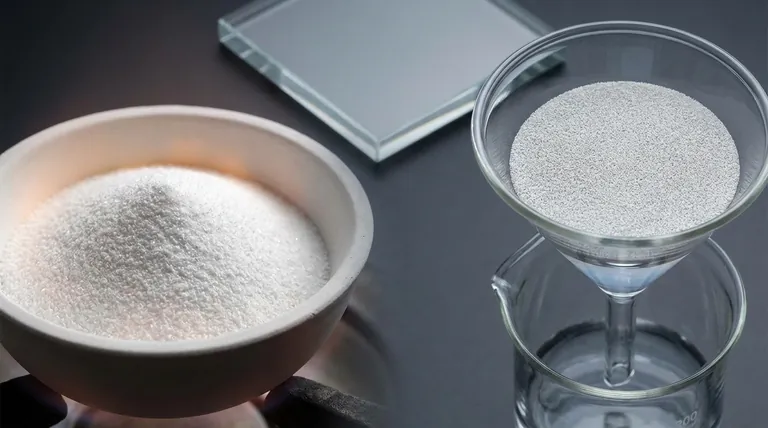
The process begins not with a sheet or a molten blob of glass, but with a fine powder known as glass frit.
The particle size of this frit is carefully controlled, as it will directly determine the pore size of the final product.
Applying Heat Below the Melting Point
This powder is placed in a mold and heated in a furnace. Critically, the temperature is raised high enough to soften the surfaces of the glass particles but kept below the glass's full melting point.
Particle Fusion and Necking
As the particles soften, they stick together at their points of contact. This localized fusion is called "necking," where small bridges or "necks" form between adjacent particles, creating a strong bond.
This is the core of the sintering process: welding particles together without turning the entire mass into a liquid.
The Result: A Porous Structure
Because the glass never fully melts and flows, the spaces between the original powder particles remain. These voids become a network of interconnected pores throughout the final solid material.
The result is a single, rigid piece of glass with a sponge-like internal structure.
Key Properties and Trade-offs
The unique manufacturing process of sintered glass gives it distinct advantages and disadvantages compared to its solid, non-porous counterpart.
Feature: Controlled Porosity
The primary benefit of sintered glass is its uniform and controllable porosity. By selecting the initial size of the glass frit, manufacturers can produce filters with very specific pore sizes, from very fine to coarse.
This property makes it invaluable for scientific and industrial filtration.
Feature: Chemical and Thermal Resistance
Sintered glass retains the excellent chemical inertness and thermal stability of the base glass it was made from (e.g., borosilicate). It can withstand corrosive chemicals and significant temperature changes without degrading.
Trade-off: Reduced Transparency
The internal porous structure scatters light extensively. Consequently, sintered glass is typically translucent or opaque, not transparent. It cannot be used for applications requiring optical clarity, like lenses or windows.
Trade-off: Lower Mechanical Strength
The pores within the structure act as microscopic stress concentration points. This means sintered glass is generally more brittle and has lower tensile strength than a solid piece of the same glass.
Making the Right Choice for Your Application
Choosing between sintered and traditional glass depends entirely on whether porosity is a required feature or a critical flaw for your goal.
- If your primary focus is filtration or gas dispersion: Sintered glass is the ideal choice due to its precise, controllable network of pores and chemical resistance.
- If your primary focus is optical clarity or maximum strength: You must use traditional, solid glass, as the porous nature of sintered glass makes it opaque and mechanically weaker.
- If your primary focus is creating a complex shape without melting: Sintering can be an effective method to form intricate glass components, provided that the resulting porosity is acceptable for the application.
Ultimately, sintered glass is an engineered material designed specifically for tasks where a durable, porous filter is essential.
Summary Table:
| Property | Sintered Glass | Traditional Solid Glass |
|---|---|---|
| Porosity | High, controllable pores | Non-porous |
| Transparency | Opaque or translucent | Transparent |
| Primary Use | Filtration, gas dispersion | Windows, containers, optics |
| Mechanical Strength | Lower (brittle) | Higher |
| Chemical/Thermal Resistance | Excellent (depends on base glass) | Excellent |
Need a reliable, chemically-resistant filtration solution for your laboratory?
At KINTEK, we specialize in high-quality lab equipment, including sintered glass filters designed for precision and durability. Our products are crafted to meet the rigorous demands of scientific filtration, ensuring consistent performance and chemical inertness.
Let us help you select the perfect porous glass for your application. Contact our experts today to discuss your specific needs and discover how KINTEK can enhance your lab's capabilities.
Visual Guide
Related Products
- Silicon Carbide (SIC) Ceramic Sheet Wear-Resistant Engineering Advanced Fine Ceramics
- Float Soda-Lime Optical Glass for Laboratory Use
- High Temperature Resistant Optical Quartz Glass Sheet
- KF Ultra-High Vacuum Observation Window Stainless Steel Flange Sapphire Glass Sight Glass
- Optical Window Glass Substrate Wafer Single Double Sided Coated K9 Quartz Sheet
People Also Ask
- Does silicon carbide dissolve in water? Discover Its Unmatched Chemical Stability
- What is the strongest ceramics? Silicon Carbide Leads in Hardness & Thermal Strength
- What are the properties and applications of silicon carbide ceramics? Solve Extreme Engineering Challenges
- What are the common uses of silicon carbide? Unlock Extreme Performance in Harsh Environments
- What are the uses of silicon carbide ceramics in different industries? Master Extreme Performance in Aerospace, Semiconductors & More