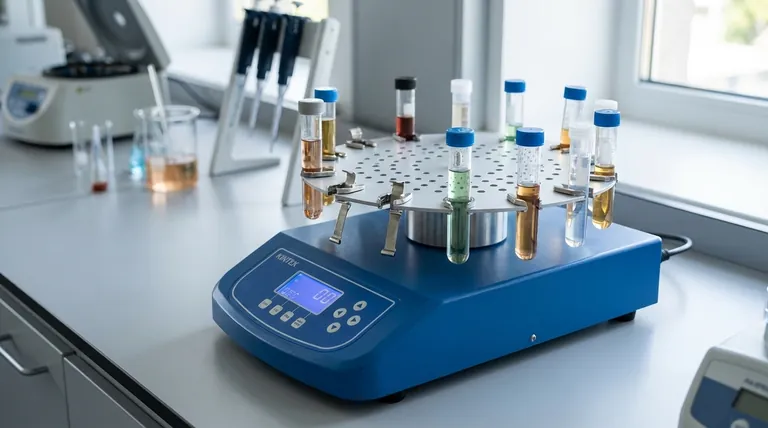
In a biological context, a mixer is a laboratory device designed to agitate and blend liquid samples, ensuring they become a uniform, or homogenous, mixture. The most common type is the vortex mixer, a compact instrument that uses high-speed orbital motion to rapidly mix small vials of liquid, which is essential for countless experimental procedures in bioscience, microbiology, and biochemistry.
The core purpose of a mixer in biology is to eliminate variability within a sample. By creating a homogenous solution, it ensures that every drop of liquid is identical, which is a fundamental requirement for producing accurate, reliable, and repeatable experimental results.
The Core Function: Creating Homogeneity
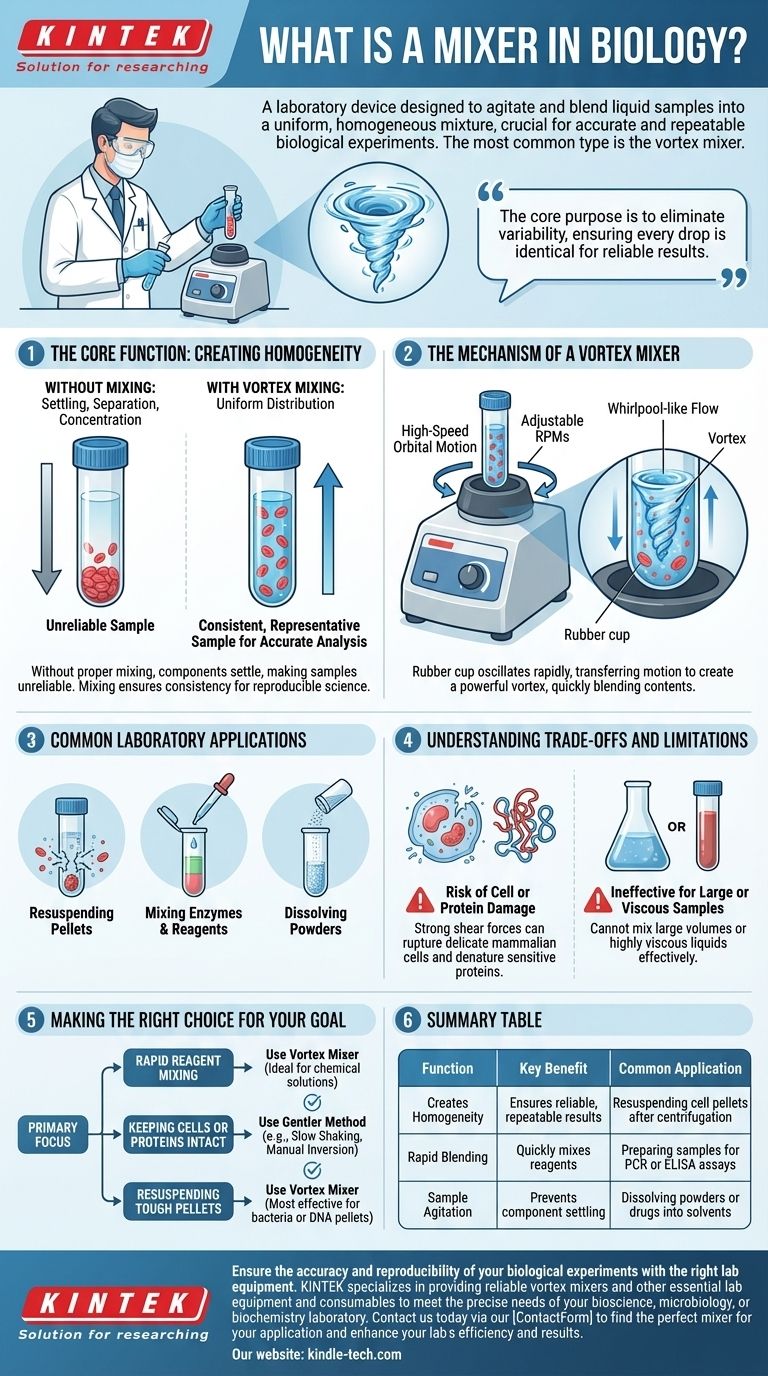
In many biological experiments, components in a liquid solution can settle, separate, or concentrate in one area. A mixer's job is to counteract this by creating a uniform distribution of all components, from cells and proteins to chemical reagents.
Why Uniformity is Critical
Without proper mixing, a sample is unreliable. For instance, cells in a culture tube will settle to the bottom over time. Taking a sample from the top would yield mostly liquid media, while a sample from the bottom would be overly concentrated with cells, invalidating any subsequent analysis.
Thorough mixing ensures that any subsample taken for an experiment is truly representative of the entire mixture. This consistency is the bedrock of reproducible science.
The Mechanism of a Vortex Mixer
A vortex mixer operates on a simple but effective principle. The device has a small rubber cup that oscillates in a circular motion at a very high speed, often with adjustable RPMs (revolutions per minute).
When an operator presses a test tube or other small vial onto the cup, this rapid orbital motion is transferred to the liquid inside. This action creates a powerful vortex, a whirlpool-like flow that aggressively and quickly blends the contents.
Common Laboratory Applications
The vortex mixer is a ubiquitous tool used in a wide range of tasks.
It is essential for resuspending pellets of cells or nucleic acids after centrifugation. It is also used for mixing enzymes and reagents for assays like PCR or ELISA, and for dissolving powdered chemicals or drugs into a solvent.
Understanding the Trade-offs and Limitations
While powerful, a vortex mixer is not the universal solution for every mixing task. Its aggressive action comes with specific limitations that every researcher must understand to avoid compromising their experiment.
The Risk of Cell or Protein Damage
The strong mechanical shear forces that create the vortex can be destructive. These forces can easily rupture or lyse delicate mammalian cells, which may be undesirable if the goal is to study living, intact cells.
Similarly, these forces can cause sensitive proteins to denature, or unfold, rendering them inactive and ruining an experiment.
Ineffective for Large or Viscous Samples
Vortex mixers are specifically designed for small volumes contained in vessels like test tubes and microcentrifuge tubes. They cannot generate a sufficient vortex to mix larger volumes found in beakers or flasks.
They also struggle with highly viscous (thick) liquids, which resist the formation of a vortex and will not mix properly.
Making the Right Choice for Your Goal
Selecting the correct mixing technique is a critical decision that directly impacts the quality of your results. Your experimental goal should dictate your approach.
- If your primary focus is rapid reagent mixing: The high speed of a vortex mixer is the ideal and standard method for quickly preparing uniform chemical solutions.
- If your primary focus is keeping cells or proteins intact: A gentler method, such as slow orbital shaking or manually inverting the tube by hand, is necessary to avoid damaging shear forces.
- If your primary focus is resuspending a tough pellet: A vortex mixer is the most effective tool to break up and evenly distribute a compacted pellet of bacteria or DNA.
Ultimately, proper mixing is a foundational lab skill that underpins the accuracy and integrity of countless biological experiments.
Summary Table:
| Function | Key Benefit | Common Application |
|---|---|---|
| Creates Homogeneity | Ensures reliable, repeatable results | Resuspending cell pellets after centrifugation |
| Rapid Blending | Quickly mixes reagents | Preparing samples for PCR or ELISA assays |
| Sample Agitation | Prevents component settling | Dissolving powders or drugs into solvents |
Ensure the accuracy and reproducibility of your biological experiments with the right lab equipment. KINTEK specializes in providing reliable vortex mixers and other essential lab equipment and consumables to meet the precise needs of your bioscience, microbiology, or biochemistry laboratory. Contact us today via our [#ContactForm] to find the perfect mixer for your application and enhance your lab's efficiency and results.
Visual Guide
Related Products
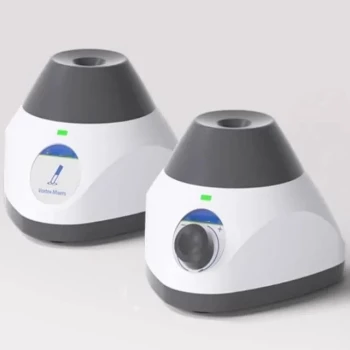
- Laboratory Vortex Mixer Orbital Shaker Multifunctional Rotation Oscillation Mixer
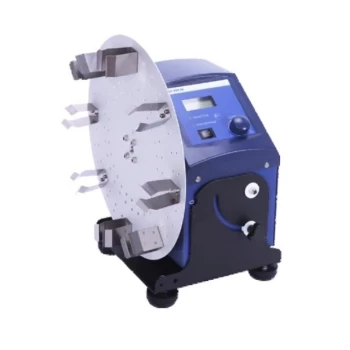
- Laboratory Disc Rotary Mixer for Efficient Sample Mixing and Homogenization
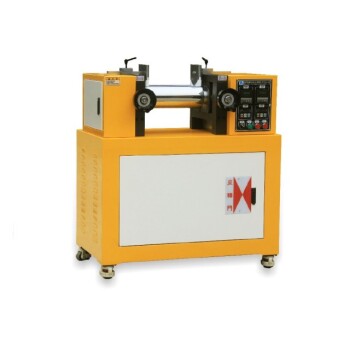
- Open Type Two Roll Mixing Mill Machine for Rubber Crusher
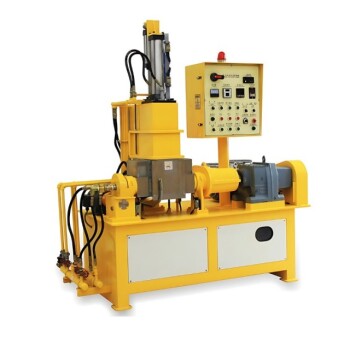
- Lab Internal Rubber Mixer Rubber Kneader Machine for Mixing and Kneading
- High Performance Lab Homogenizer for Pharma Cosmetics and Food R&D
People Also Ask
- What are the primary functions of a laboratory orbital shaker during BMP testing? Maximize Methane Yield Accuracy
- How do static culture and shaking culture affect the morphology of BC? Optimize Lab Shaker Results
- What is the function of a laboratory orbital shaker in methylene blue adsorption kinetics? Optimize Your Research
- What is the role of a laboratory shaker in silane sol preparation? Master Uniform Aramid Fabric Coating
- What role does a laboratory orbital shaker play in silane coupling? Enhance Self-Assembled Monolayer Uniformity