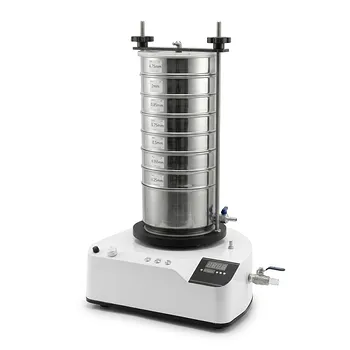
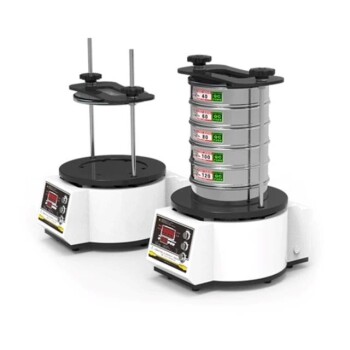
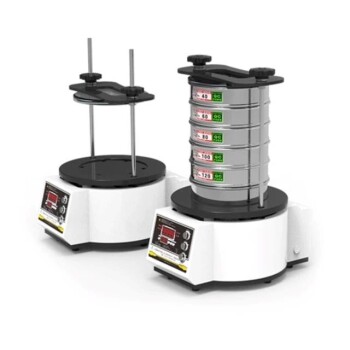
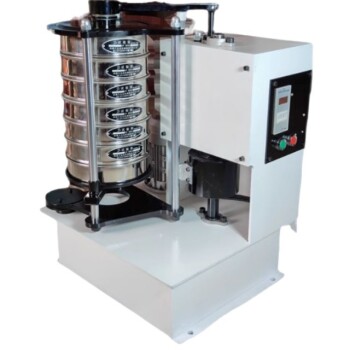
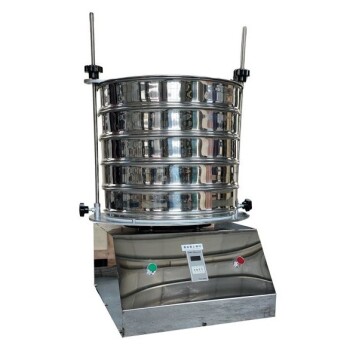
Crucially, the sieve shaker itself does not have an aperture; it is the machine that provides the motion. The interchangeable test sieves, which are placed inside the shaker, are the components with specific aperture sizes. These opening sizes can range from as large as 5 inches (125 mm) down to as fine as 20 microns (635 mesh).
The essential takeaway is that a sieve shaker is a system. The shaker provides the consistent, mechanical action, while the user-selected stack of test sieves, each with a precise aperture size, performs the actual particle separation. The system's versatility comes from the ability to choose and combine different sieve apertures to match the material being analyzed.
The Core Components of Particle Analysis
To understand the system, we must distinguish between the machine and the tools it uses. The precision of your analysis depends entirely on selecting the correct tools for the job.
The Sieve Shaker: The Machine Itself
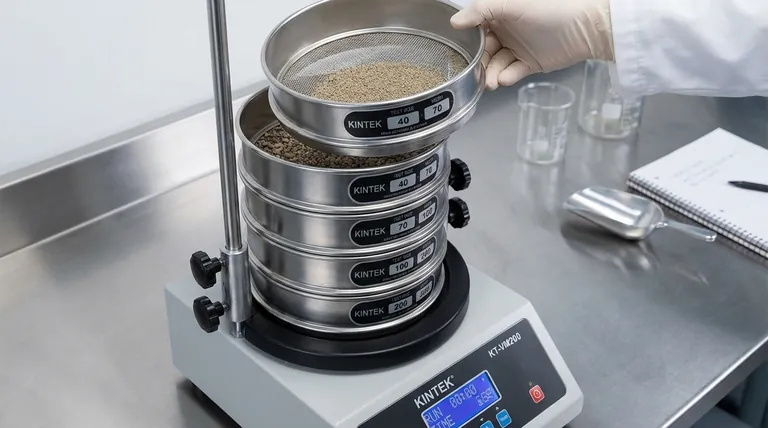
A sieve shaker is simply the motorized unit that holds a stack of test sieves. Its purpose is to impart a specific, repeatable motion—such as tapping, vibrating, or orbital shaking—to the sieve stack. This controlled agitation ensures that particles have the opportunity to pass through apertures until they are retained by a sieve they cannot fit through.
The Test Sieve: Where Separation Happens
The test sieve is the critical component for measurement. It consists of a screen frame, typically made of brass or stainless steel, holding a woven wire mesh or perforated plate with openings of a uniform size. The size of these openings is the aperture size.
Defining Aperture Size: From Inches to Microns
The range of available aperture sizes is vast to accommodate countless materials. Sieves are commonly available with openings from 5 inches (125 mm) for very coarse materials down to 20 microns (0.02 mm) for fine powders.
The term "mesh" refers to the number of openings per linear inch of the screen. A higher mesh number indicates more openings per inch and therefore a smaller aperture size (e.g., 635 mesh is a very fine screen).
How Sieves are Stacked for Analysis
For a particle size distribution analysis, multiple sieves are stacked together. They are always arranged in order of descending aperture size, with the largest openings at the top and the smallest at the bottom. A solid collection pan is placed at the very base of the stack to collect the finest particles that pass through all the sieves.
Understanding the Trade-offs and Limitations
While powerful, sieve analysis is not without its challenges. The physical nature of the process introduces variables that you must consider for accurate results.
Particle Shape and Clogging
The woven wire mesh of a test sieve assumes particles are roughly spherical. Elongated or irregular particles may pass through an aperture end-on but be retained if they hit it sideways, potentially skewing results. Additionally, sticky or wet materials can clog the apertures, a phenomenon known as "blinding," which prevents other particles from passing through.
The Lower Limit of Sieving
Mechanical sieving has a practical lower limit. As aperture sizes decrease below 20 microns, forces like static electricity and moisture can cause particles to clump together, making accurate separation with a wire mesh nearly impossible. For sub-micron particle analysis, alternative methods like laser diffraction are required.
Accuracy and Repeatability
The primary advantage of a mechanical sieve shaker over manual hand sieving is repeatability. The machine provides the exact same motion for the same duration every time, eliminating human variability and ensuring that results from different tests are comparable and reliable.
Making the Right Choice for Your Goal
Selecting the correct sieve apertures is determined entirely by the material you are analyzing and the data you need to collect.
- If your primary focus is coarse materials (e.g., construction aggregates, soil): You will use a set of sieves with larger apertures measured in inches or millimeters.
- If your primary focus is fine powders (e.g., pharmaceuticals, pigments, flour): You will need a series of sieves defined by high mesh counts, extending down into the micron range.
- If your primary focus is a full particle size distribution: You must use a carefully selected stack of sieves that covers the entire expected size range of your sample material.
Ultimately, mastering particle analysis begins with understanding that the shaker provides the force, but the precisely engineered apertures of the test sieves deliver the results.
Summary Table:
| Component | Role | Key Specification |
|---|---|---|
| Sieve Shaker | Provides mechanical motion | No aperture; imparts shaking/tapping action |
| Test Sieve | Performs particle separation | Specific aperture size (5 in to 20 µm) |
| Sieve Stack | Enables size distribution analysis | Arranged from largest to smallest aperture |
Ready to achieve precise and repeatable particle analysis in your lab?
At KINTEK, we specialize in high-quality lab equipment, including reliable sieve shakers and a full range of precision test sieves. Whether you're working with coarse aggregates or fine powders, our solutions ensure accurate particle size distribution results.
Contact us today to discuss your specific laboratory needs and let our experts help you select the perfect system for your materials.
Get in touch with our team now →
Visual Guide

Related Products
- Laboratory Vibratory Sieve Shaker Machine for Dry and Wet Three-Dimensional Sieving
- Laboratory Test Sieves and Vibratory Sieve Shaker Machine
- Laboratory Wet Three-Dimensional Vibratory Sieve Shaker Machine
- Vibratory Sieve Shaker Machine Dry Three-Dimensional Vibrating Sieve
- Laboratory Vibratory Sieve Shaker Machine Slap Vibrating Sieve
People Also Ask
- How are vibratory sieve shakers and standard sieves utilized to analyze the effects of biomass torrefaction? Optimize Grindability
- What is the use of vibratory sieve shaker? Achieve Precise Particle Size Analysis for Your Lab
- What is the principle of vibratory sieve shaker? Achieve Accurate Particle Size Analysis
- How does a laboratory vibratory sieve shaker facilitate the microstructural study of gas-atomized alloy powders?
- Why is a sieve shaker important? Automate Particle Analysis for Accurate, Repeatable Results