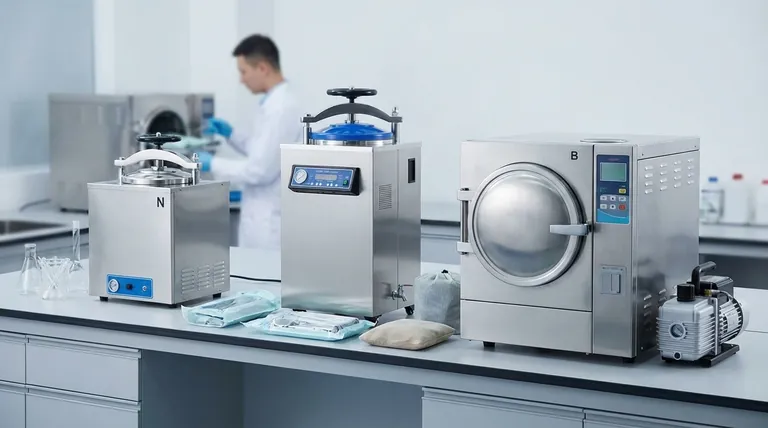
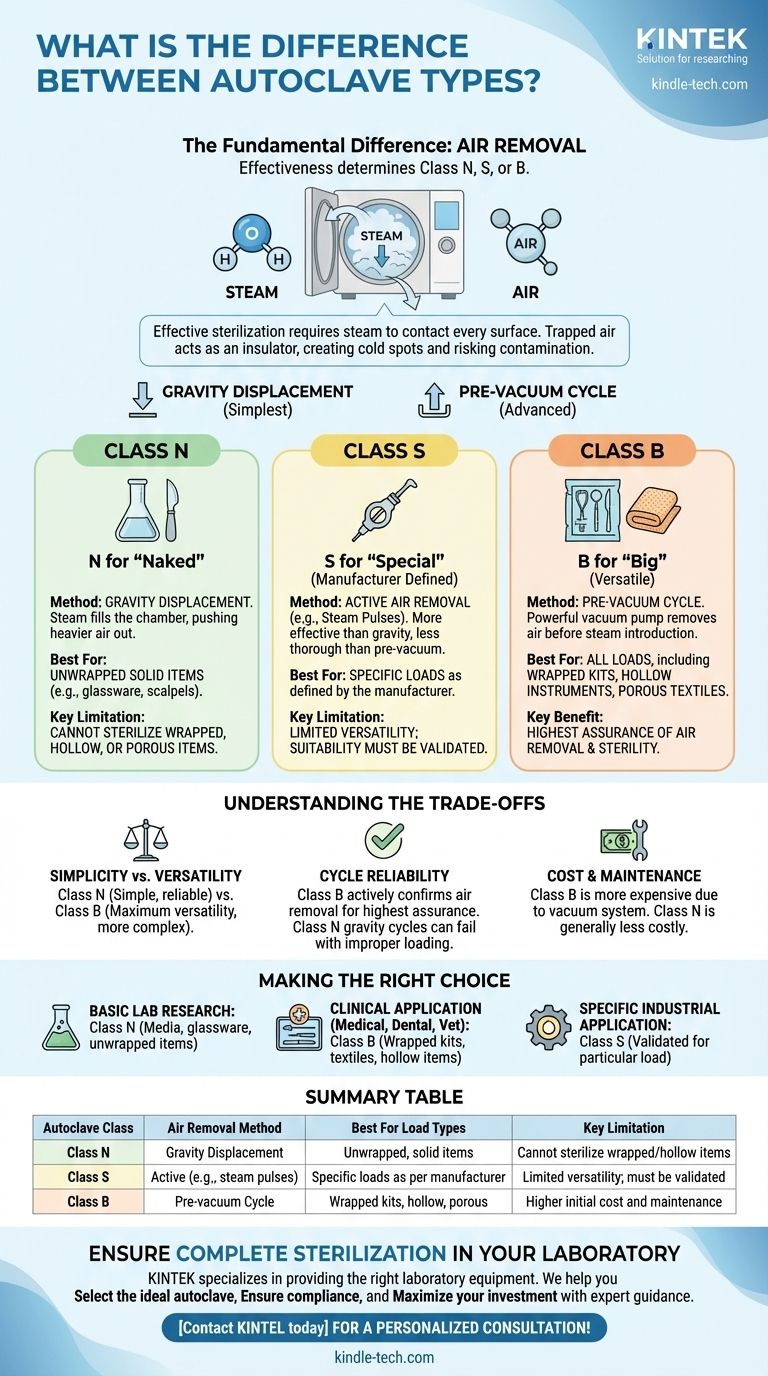
The fundamental difference between autoclave types lies in how effectively they remove air from the sterilization chamber. While they vary in size and operation, their classification into Class N, Class S, and Class B is determined by the method of air removal, which dictates the types of materials they can safely sterilize.
The critical distinction is not size or appearance, but the mechanism used to replace air with steam. An autoclave's ability to sterilize complex items like wrapped instruments or porous textiles depends entirely on its method for removing insulating air pockets.
The Core Principle: Why Air Removal is Critical
Effective sterilization requires saturated steam to make direct contact with every surface of the load. Air is a poor conductor of heat and acts as an insulator, preventing steam from reaching and sterilizing items.
The Problem of Trapped Air
If air is not completely removed from the chamber and the load, it creates "cold spots." These are areas where the temperature does not reach the required level for sterilization, leading to a failed cycle and a significant risk of contamination.
Two Solutions for Air Removal
Autoclaves solve this problem in two primary ways. The simplest method relies on gravity, while more advanced systems use a vacuum pump for active air removal. These methods define the different classes of autoclaves.
The Three Classes of Autoclaves
The most widely accepted classification system sorts autoclaves into three types, each suited for different sterilization loads.
Class N Autoclaves
This is the most basic type of autoclave. The 'N' stands for "naked," referring to the unwrapped solid items it is designed to sterilize.
Class N autoclaves use a gravity displacement method. Steam is pumped into the chamber, and because it is less dense than air, it fills the top and pushes the colder, heavier air out through a port at the bottom. This method is only effective for simple, solid objects like glassware or scalpels.
Class B Autoclaves
This is the most advanced and versatile type of autoclave. The 'B' stands for "big," referring to its ability to handle the widest range of sterilization loads.
Class B autoclaves use a pre-vacuum cycle. Before introducing steam, a powerful vacuum pump actively removes air from the chamber. This process ensures there are no trapped air pockets, allowing steam to penetrate complex loads like porous materials (gowns, dressings), hollow instruments (tubes, dental handpieces), and wrapped surgical kits.
Class S Autoclaves
This class represents a middle ground between N and B. The 'S' stands for "special," as these autoclaves are designed for specific loads as defined by the manufacturer.
Class S autoclaves employ an active method of air removal that is more effective than gravity but may not be as thorough as a Class B vacuum pump. This often involves a series of steam flushes and pressure pulses to push air out. Their suitability depends entirely on the specific instruments you need to sterilize.
Understanding the Trade-offs
Choosing an autoclave involves balancing capability against complexity and cost. Each class presents a distinct set of advantages and limitations.
Simplicity vs. Versatility
Class N autoclaves are simple, reliable, and generally less expensive. However, their use is strictly limited to unwrapped, non-porous, solid items.
Class B autoclaves offer maximum versatility and can sterilize virtually any medical or laboratory load. This capability comes with increased mechanical complexity due to the vacuum pump.
Cycle Reliability
Because a Class B autoclave actively confirms air removal via its vacuum system, it provides the highest assurance of a successful sterilization cycle, especially for challenging loads. Gravity displacement cycles can fail if items are loaded incorrectly, preventing air from escaping.
Cost and Maintenance
The inclusion of a vacuum pump and more complex control systems makes Class B autoclaves more expensive to purchase and maintain than their Class N counterparts. Class S models fall somewhere in between, depending on their specific mechanisms.
Making the Right Choice for Your Application
Your choice should be dictated entirely by the types of materials you need to sterilize now and in the future.
- If your primary focus is basic lab research: A Class N autoclave is often sufficient for sterilizing media, glassware, and other unwrapped solid instruments.
- If your primary focus is a medical, dental, or veterinary clinic: A Class B autoclave is essential to safely sterilize wrapped instrument kits, textiles, and hollow items.
- If your primary focus is a specific industrial application: A Class S autoclave might be a cost-effective solution if it is specifically validated for your particular load type.
Ultimately, understanding how an autoclave removes air is the key to selecting the right tool for ensuring total sterility.
Summary Table:
| Autoclave Class | Air Removal Method | Best For Load Types | Key Limitation |
|---|---|---|---|
| Class N | Gravity Displacement | Unwrapped, solid items (e.g., glassware) | Cannot sterilize wrapped, hollow, or porous items |
| Class S | Active (e.g., steam pulses) | Specific loads as per manufacturer | Limited versatility; suitability must be validated |
| Class B | Pre-vacuum Cycle | Wrapped kits, hollow instruments, porous textiles | Higher initial cost and maintenance complexity |
Ensure Complete Sterilization in Your Laboratory
Choosing the correct autoclave is critical for the safety and efficiency of your operations. KINTEK specializes in providing the right laboratory equipment for your specific sterilization needs.
We help you:
- Select the ideal autoclave (Class N, S, or B) based on your load types—from simple glassware to complex surgical kits.
- Ensure compliance and reliability with equipment validated for your applications.
- Maximize your investment with expert guidance and support.
Don't compromise on sterility. Let our experts guide you to the perfect solution for your lab's requirements.
Contact KINTEL today for a personalized consultation!
Visual Guide
Related Products
- Portable High Pressure Laboratory Autoclave Steam Sterilizer for Lab Use
- Laboratory Horizontal Autoclave Steam Sterilizer Lab Microcomputer Sterilizer
- Desktop Fast High Pressure Laboratory Autoclave Sterilizer 16L 24L for Lab Use
- Portable Digital Display Automatic Laboratory Sterilizer Lab Autoclave for Sterilization Pressure
- Laboratory Sterilizer Lab Autoclave Herbal Powder Sterilization Machine for Plant
People Also Ask
- What precautions should be taken during autoclave in laboratory? A Complete Safety Guide to Prevent Burns and Explosions
- What is the importance of using a laboratory autoclave in ZSM-5 synthesis? Achieve Perfect Zeolite Crystallization
- What extreme conditions does a laboratory autoclave simulate? Testing Wear Resistance of Nuclear Fuel Cladding
- What are the two types of autoclave used in the laboratory? Gravity vs. Pre-Vacuum Explained
- What is the primary function of a laboratory autoclave in the pre-treatment of medical plastic waste for liquid fuel?