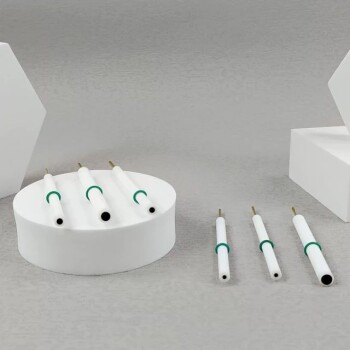
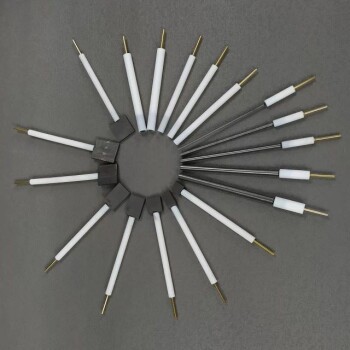
The Glassy Carbon Electrode (GCE) acts as a high-purity, inert foundation. Its primary function in Mott-Schottky testing is to provide a conductive substrate with negligible background capacitance. This ensures that the measured impedance signals at specific frequencies—typically around 1 kHz—are derived strictly from the semiconductor properties of the coated thin-film material, such as its flat-band potential and carrier type.
Core Takeaway: In Mott-Schottky analysis, the GCE serves as a "silent" conductive platform that isolates the electrochemical signature of the active material by eliminating substrate interference and parasitic capacitance.
The Role of Chemical Inertness and Stability
Minimizing Background Noise
The GCE is selected for its extremely low background capacitance, which is critical when measuring the depletion layer of a semiconductor. Because the substrate contributes no significant signal, the charge accumulation captured during the test reflects the intrinsic properties of the coating, such as rGO/Ti3CNTx.
Ensuring a Wide Potential Window
The GCE offers a wide electrochemical window, meaning it remains stable across a broad range of voltages without undergoing redox reactions. This stability allows researchers to scan the necessary potential range to generate a linear Mott-Schottky plot without the substrate catalyzing side reactions.
Maintaining Chemical Neutrality
As a chemically inert material, the GCE does not react with the electrolyte or the catalyst during testing. This ensures that the interface between the electrode and the semiconductor film remains uncontaminated, preserving the accuracy of kinetic parameters and carrier density calculations.
Mechanical and Conductive Precision
Facilitating Efficient Charge Transfer
Despite its carbon-based structure, the GCE provides excellent electrical conductivity. This ensures that electrons move efficiently between the active material and the current collector, allowing for the precise measurement of capacitance-voltage relationships.
Providing a Defined Geometric Surface Area
The mechanical hardness of the GCE allows it to be polished to a mirror-like, flat surface. This provides a clear and repeatable geometric surface area, which is essential for calculating current density and ensuring the uniform loading of catalyst slurries.
Improving Coating Adhesion
A properly prepared GCE surface ensures tight contact between the active material and the substrate. This contact is vital for Mott-Schottky analysis, as any delamination or poor connectivity would introduce resistance errors that distort the resulting flat-band potential derivation.
Understanding the Trade-offs
Sensitivity to Surface Preparation
While the GCE is an ideal substrate, its performance is highly dependent on manual polishing. Any residual contaminants or scratches on the surface can introduce local hotspots or parasitic capacitance, leading to non-linearities in the Mott-Schottky plot.
Limitations in Film Adhesion
The smooth, inert nature of glassy carbon can sometimes make it difficult for certain thin films to adhere strongly. If the slurry or ink does not have the correct viscosity or binder, the material may flake off during the potential sweep, resulting in inconsistent impedance data.
How to Apply This to Your Research
Making the Right Choice for Your Goal
To maximize the accuracy of your Mott-Schottky measurements, consider how you utilize the GCE based on your specific testing requirements:
- If your primary focus is determining carrier type (n-type vs p-type): Ensure the GCE is polished to a mirror finish to minimize surface states that could mask the slope of the Mott-Schottky plot.
- If your primary focus is calculating flat-band potential: Use a consistent frequency, such as 1 kHz, to ensure that the capacitance contribution from the GCE background remains at its absolute minimum.
- If your primary focus is catalyst stability: Leverage the GCE’s wide potential window to conduct long-term cycling before performing Mott-Schottky analysis to see how the semiconductor properties evolve.
By serving as a neutral yet highly conductive stage, the glassy carbon electrode ensures that the data you collect is a true reflection of your material's electronic structure rather than a localized artifact of the testing setup.
Summary Table:
| Key Feature | Role in Mott-Schottky Testing | Impact on Research Data |
|---|---|---|
| Chemical Inertness | Prevents redox reactions with electrolytes | Ensures high purity of measured signals |
| Low Background Capacitance | Minimizes substrate interference | Isolates the semiconductor's intrinsic properties |
| Wide Potential Window | Enables broad voltage scans | Prevents substrate-catalyzed side reactions |
| High Conductivity | Facilitates efficient electron transfer | Accurate measurement of capacitance-voltage curves |
| Defined Surface Area | Provides a flat, polishable geometric area | Essential for precise current density calculations |
Elevate Your Electrochemical Research with KINTEK
Precision in Mott-Schottky analysis starts with the right equipment. KINTEK specializes in high-performance laboratory solutions, offering premium electrolytic cells and electrodes, including high-purity glassy carbon options designed for minimal background noise and maximum stability.
Whether you are characterizing semiconductors, developing next-gen batteries, or working with high-temperature high-pressure reactors, our comprehensive portfolio—ranging from CVD/PECVD furnaces to precision hydraulic presses and advanced cooling systems—is engineered to meet the rigorous demands of modern material science.
Ready to optimize your lab's performance? Contact our experts today to discover how KINTEK can provide the reliable tools and consumables you need to achieve breakthrough results.
References
- Muhammad Abiyyu Kenichi Purbayanto, Agnieszka Jastrzębska. Ambient Processed rGO/Ti<sub>3</sub>CNT<sub><i>x</i></sub> MXene Thin Film with High Oxidation Stability, Photosensitivity, and Self-Cleaning Potential. DOI: 10.1021/acsami.3c07972
This article is also based on technical information from Kintek Solution Knowledge Base .
Related Products
- Glassy Carbon Electrochemical Electrode
- Glassy Carbon Sheet RVC for Electrochemical Experiments
- Conductive Carbon Cloth Carbon Paper Carbon Felt for Electrodes and Batteries
- Copper Sulfate Reference Electrode for Laboratory Use
- Graphite Disc Rod and Sheet Electrode Electrochemical Graphite Electrode
People Also Ask
- How do the glassy carbon electrode, SCE, and graphite rod work together in an enzymatic fuel cell? Optimize EFC Testing
- Why is glassy carbon selected for mediator-assisted indirect oxidation of glycerol? The Key to Unbiased Research
- What are the functions of a glassy carbon electrode in CV testing of antioxidants? Enhance Your Redox Analysis Accuracy
- What characteristics make glassy carbon electrodes suitable as anodes? Ideal for Pure Molten Salt Electrolysis
- What are the primary physicochemical reasons for selecting a carbon electrode as the anode in aluminum recovery? 5 Keys