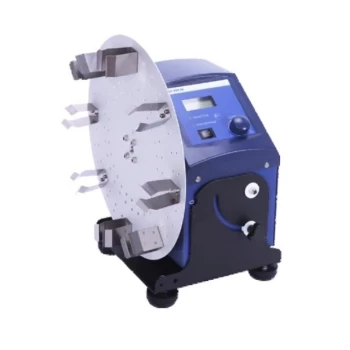
An end-over-end rotator is a fundamental requirement for conducting valid kinetic experiments with Zero-Valent Iron (ZVI). Because ZVI particles have a high density, this specific method of agitation is the only reliable way to maintain full particle suspension, ensuring that mass transfer resistance does not artificially limit the reduction rate of Chlorendic Acid.
Core Insight By delivering continuous, uniform mechanical power, the rotator overcomes the natural tendency of heavy iron particles to settle. This eliminates physical diffusion barriers, ensuring that the measured data reflects true chemical kinetics—specifically reliable pseudo-first-order kinetic constants.
The Challenge of Heterogeneous Reactions
The Problem of High Density
Zero-Valent Iron (ZVI) particles are significantly denser than the aqueous solution containing the Chlorendic Acid.
Without constant, vigorous intervention, gravity causes these particles to settle rapidly to the bottom of the reaction vessel.
Mass Transfer Resistance
In any reaction involving a solid catalyst and a liquid reactant, the reactant must physically travel to the solid surface.
If the mixing is insufficient, a stagnant layer of liquid forms around the particles.
This creates "mass transfer resistance," where the speed of the reaction is limited by how fast molecules can swim through the liquid, rather than how fast the chemical reaction actually occurs.
Why the Rotator is the Solution
Uniform Mechanical Power
An end-over-end rotator provides a specific type of kinetic energy that is superior to standard magnetic stirring for this application.
It ensures that the mechanical power is distributed evenly throughout the sample.
This prevents the formation of "dead zones" where particles might accumulate and become inactive.
Maximizing Surface Contact
The primary goal of the rotator is to keep the ZVI fully suspended.
Full suspension ensures that the maximum surface area of the iron is constantly exposed to the bulk solution.
This allows Chlorendic Acid molecules to contact the ZVI surface efficiently and uniformly.
Understanding the Trade-offs
Equipment Constraints
Using an end-over-end rotator often limits the volume of the reaction vessels compared to overhead stirrers.
You must ensure your sample size is appropriate for the rotator's capacity while still yielding enough volume for sampling.
Energy vs. Abrasion
While high energy is needed for suspension, excessive agitation can sometimes cause particle attrition (grinding).
However, in this specific context, the risk of poor suspension outweighs the risk of attrition, making the rotator the superior choice for accuracy.
Making the Right Choice for Your Experiment
If your primary focus is Data Accuracy: Prioritize the end-over-end rotator to eliminate mass transfer effects and obtain true pseudo-first-order kinetic constants.
If your primary focus is Experimental Consistency: Ensure the rotation speed is high enough to keep the specific particle size of your ZVI completely suspended throughout the entire duration of the experiment.
Proper mixing transforms your data from a measurement of diffusion into a measurement of true chemical reactivity.
Summary Table:
| Feature | End-Over-End Rotator Benefit | Impact on Kinetic Data |
|---|---|---|
| Particle Suspension | Maintains full suspension of high-density ZVI | Eliminates physical diffusion barriers |
| Mixing Uniformity | Distributes mechanical power evenly | Prevents "dead zones" and inactive particles |
| Surface Exposure | Maximizes contact between ZVI and solution | Ensures true chemical reaction rate measurements |
| Kinetic Reliability | Overcomes mass transfer resistance | Provides valid pseudo-first-order constants |
Optimize Your Kinetic Research with KINTEK Precision
Achieving accurate, reproducible results in Chlorendic Acid reduction requires more than just high-quality reagents—it demands the right laboratory environment. KINTEK specializes in providing high-performance laboratory equipment designed to meet the rigorous demands of chemical research.
From high-temperature high-pressure reactors and autoclaves to advanced crushing, milling, and shakers, our comprehensive range ensures your experiments are never limited by equipment constraints. Whether you are working on battery research, material synthesis, or environmental remediation, our expert team is ready to provide the high-quality tools and consumables your lab needs to succeed.
Ready to elevate your lab's performance? Contact KINTEK today to find the perfect solution for your research needs!
References
- Min Sik Kim, Anh Le‐Tuan Pham. Reduction of chlorendic acid by zero-valent iron: Kinetics, products, and pathways. DOI: 10.1016/j.jhazmat.2019.121269
This article is also based on technical information from Kintek Solution Knowledge Base .
Related Products
- Laboratory Disc Rotary Mixer for Efficient Sample Mixing and Homogenization
- Laboratory Vortex Mixer Orbital Shaker Multifunctional Rotation Oscillation Mixer
- Vacuum Sealed Continuous Working Rotary Tube Furnace Rotating Tube Furnace
- Rotating Platinum Disk Electrode for Electrochemical Applications
- Laboratory Planetary Ball Mill Rotating Ball Milling Machine
People Also Ask
- What is a laboratory mixer used for? Choose the Right Tool for Liquids or Solids
- What is a laboratory mixer? A Guide to Achieving Perfect Sample Homogeneity
- What are laboratory mixers used for? Achieve Perfect Sample Homogeneity and Reliable Results
- How does a high-efficiency homogenizing mixer contribute to the preparation of Tobermorite and Xonotlite precursors?
- Why is precision mixing required for concrete corrosion studies? Ensure Data Integrity through Homogenization