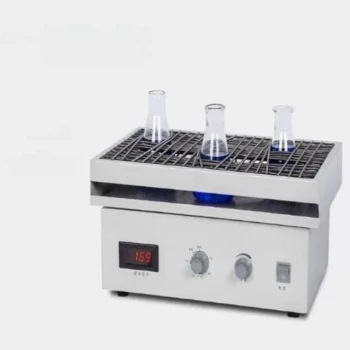
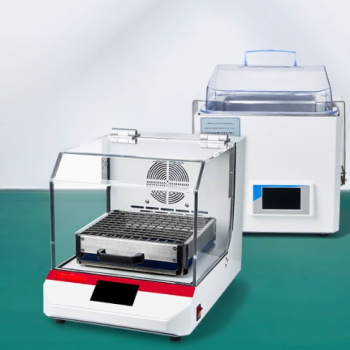
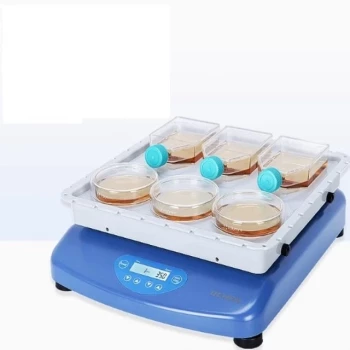
The constant temperature shaker serves as the essential environmental regulator for adsorption kinetics experiments. It provides a synchronized combination of precise thermal control and continuous mechanical agitation to ensure that adsorbent particles and methylene blue molecules interact under standardized conditions. By maintaining these variables, the shaker allows researchers to isolate the actual rate of adsorption from external physical interferences, such as mass transfer resistance.
A constant temperature shaker is critical for obtaining accurate kinetic data because it eliminates external mass transfer barriers and provides a stable thermal environment. This ensures that the measured adsorption rates reflect the intrinsic properties of the material rather than physical limitations of the experimental setup.
The Mechanics of Adsorption Control
Overcoming External Diffusion Resistance
In a static solution, a "liquid film" or boundary layer forms around the adsorbent particles, slowing the movement of methylene blue molecules. Mechanical oscillation (typically between 150 and 200 rpm) creates enough fluid turbulence to strip away this boundary layer, a process known as eliminating external mass transfer resistance. This ensures the solute can reach the active sites on the adsorbent surface without delay.
Maximizing Interaction Surface Area
For adsorbents like biochar or porous carbon, it is vital that particles do not settle at the bottom of the flask. The shaker provides continuous power to keep these particles uniformly suspended throughout the solution. This maximizes the available surface area and ensures a high frequency of collisions between the dye molecules and the adsorbent's active sites.
Accelerating Molecular Migration
Continuous agitation provides the kinetic energy necessary to drive methylene blue molecules toward the pores of the material. This accelerated migration shortens the time required to reach adsorption equilibrium. Without this input, the experiment might yield artificially slow kinetics that do not represent the material's true performance.
The Impact of Precise Thermal Regulation
Maintaining Thermal Equilibrium
Adsorption is a temperature-sensitive process that can be either endothermic or exothermic. A constant temperature shaker (often maintaining 25°C or 30°C within ±1°C) prevents ambient room fluctuations from skewing the results. This stability is a prerequisite for the accurate determination of thermodynamic parameters and the spontaneity of the reaction.
Validating Mathematical Models
To fit data into models like Pseudo-second-order kinetics or Langmuir isotherms, the experimental conditions must remain constant. Any variation in temperature during the run would change the energy of the system, making the resulting curves mathematically unreliable. Precise regulation ensures that the maximum adsorption capacity calculated is reproducible and scientifically valid.
Understanding the Trade-offs
The Risk of Excessive Agitation
While high speeds eliminate diffusion resistance, setting the RPM too high can be counterproductive. Excessive mechanical force may cause particle attrition, physically breaking down fragile adsorbents and artificially increasing the surface area. This leads to inaccurate data that overestimates the material's natural adsorption rate.
Sensitivity to Thermal Lag
Even with a high-quality shaker, there is often a thermal lag between the equipment's sensor and the actual solution inside the flask. Researchers must allow sufficient time for the methylene blue solution to reach the target temperature before adding the adsorbent. Failing to account for this initial "warm-up" period can introduce significant errors in initial rate measurements.
How to Apply This to Your Project
Making the Right Choice for Your Goal
- If your primary focus is determining true kinetic rates: Set the agitation speed high enough to reach a "plateau" where further increases in RPM no longer change the adsorption rate, ensuring mass transfer resistance is fully eliminated.
- If your primary focus is thermodynamic analysis: Conduct separate runs at three or more distinct, strictly controlled temperatures (e.g., 20°C, 30°C, and 40°C) to calculate enthalpy and entropy changes accurately.
- If your primary focus is testing fragile or modified media: Use the lowest effective RPM that keeps particles suspended to avoid physical degradation of the adsorbent structure during the experiment.
Proper calibration of your shaker’s temperature and rotation speed is the most critical step in transforming raw methylene blue data into a definitive adsorption profile.
Summary Table:
| Feature | Function in Adsorption Experiments | Impact on Kinetic Data |
|---|---|---|
| Mechanical Agitation | Eliminates external mass transfer resistance (boundary layer) | Ensures intrinsic adsorption rates are measured |
| Thermal Regulation | Maintains stable temperature within ±1°C | Validates thermodynamic parameters and models |
| Particle Suspension | Prevents settling and maximizes surface area exposure | Maximizes collisions between solute and adsorbent |
| Kinetic Energy Input | Accelerates molecular migration to adsorbent pores | Shortens time to reach adsorption equilibrium |
Elevate Your Research Precision with KINTEK Solutions
Achieving repeatable and scientifically valid results in adsorption kinetics requires equipment that offers uncompromising stability. KINTEK specializes in high-performance laboratory equipment designed to meet the rigorous demands of material science and chemical research.
Whether you are studying methylene blue removal or developing advanced porous carbons, our comprehensive portfolio has you covered. We offer:
- Precision Shakers & Cooling Solutions: Including constant temperature shakers, ULT freezers, and freeze dryers to maintain your experimental integrity.
- Advanced Thermal Processing: A full range of high-temperature furnaces (muffle, vacuum, CVD, and tube) for adsorbent synthesis.
- Sample Preparation: Hydraulic pellet presses, crushing systems, and high-quality ceramic crucibles.
- Specialized Reactors: High-temperature high-pressure reactors and autoclaves for complex chemical interactions.
Don't let equipment variability compromise your data. Contact KINTEK today to find the perfect shaker or thermal solution tailored to your specific research goals and ensure your laboratory is equipped for excellence.
References
- Fei Jiang, Bin Gao. Remarkable synergy between sawdust biochar and attapulgite/diatomite after co-ball milling to adsorb methylene blue. DOI: 10.1039/d3ra01123b
This article is also based on technical information from Kintek Solution Knowledge Base .
Related Products
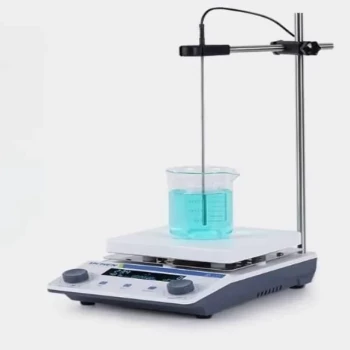
- Laboratory Small Constant Temperature Heated Magnetic Stirrer Heater and Stirrer
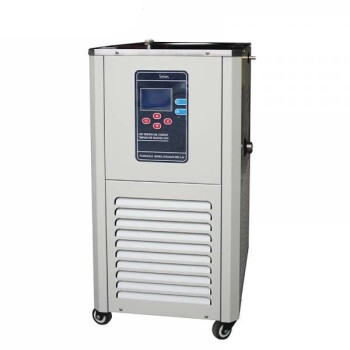
- High Temperature Constant Temperature Heating Circulator Water Bath Chiller Circulator for Reaction Bath
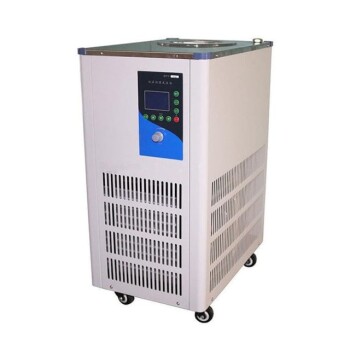
- 5L Heating Chilling Circulator Cooling Water Bath Circulator for High and Low Temperature Constant Temperature Reaction
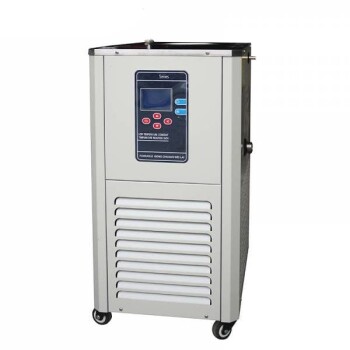
- 50L Chiller Water Bath Cooling Circulator Low Temperature Constant Temperature Reaction Bath
- 10L Heating Chilling Circulator Cooling Water Bath Circulator for High and Low Temperature Constant Temperature Reaction
People Also Ask
- What role does a magnetic stirrer with heating play in ZnO nanoparticle synthesis? Precision Control for Quality Results
- What role does a constant temperature heating magnetic stirrer play in MFC-HAp synthesis? Achieve Material Homogeneity
- What is the function of a laboratory magnetic stirrer in Ni–Cr–P electrodeposition? Optimize Ion Transport & Coating
- Why is a laboratory magnetic stirrer required for benzoic acid esters? Boost Reaction Speed & Yield with High RPM
- What role does a laboratory magnetic stirrer play in TiO2 and TiO2-Ag sol preparation? Master Chemical Kinetics