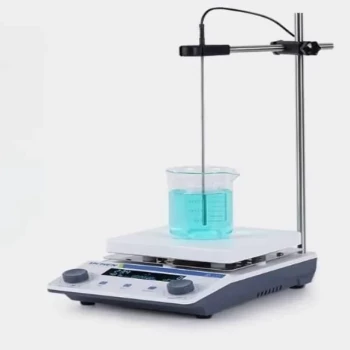
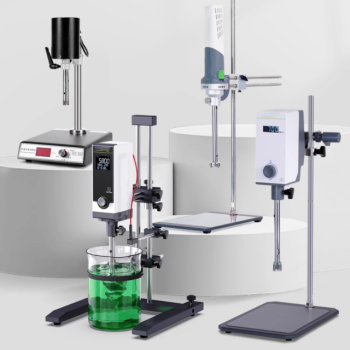
In the acidification pretreatment of aluminum sludge, the laboratory magnetic stirrer functions as the critical engine for kinetic acceleration. It utilizes high-speed mechanical shear and convection to force the interaction between dry solid sludge particles and liquid sulfuric acid reagents.
Core Insight: The magnetic stirrer is not merely a blending tool; it is a kinetic driver. By creating intensive homogenization, it overcomes the physical barriers of the solid-liquid interface, significantly accelerating the dissolution of aluminum ions within the required timeframe.
Mechanisms of Action
High-Speed Mechanical Shear
The device operates by generating vigorous mechanical shear, typically running at speeds such as 800 rpm.
This creates a high-energy environment within the reaction vessel. The force is necessary to break down the physical resistance of dry aluminum sludge particles.
Induced Convection
Beyond simple rotation, the stirrer creates strong convection currents throughout the mixture.
This ensures that the sulfuric acid reagents are continuously cycled past the sludge particles. This prevents localized depletion of the acid and ensures fresh reactants are always available at the particle surface.
Accelerating Dissolution Kinetics
Enhancing Solid-to-Liquid Transfer
The primary goal of this pretreatment is moving aluminum components from the solid phase to the liquid phase.
Without aggressive agitation, this transfer is slow and inefficient. The magnetic stirrer ensures that the dissolution kinetics are fast enough to make the process viable.
Thorough Homogenization
The stirrer guarantees that the mixture remains homogeneous throughout the process.
This prevents the sludge from settling or clumping, which would otherwise shield inner particles from the acid. Uniform exposure is required to maximize the recovery of aluminum ions.
Understanding the Operational Trade-offs
Dependence on Shear Rate
The efficiency of the acidification process is highly sensitive to the stirring speed.
If the RPM drops below the threshold (e.g., 800 rpm), the mechanical shear may be insufficient to fully suspend the dry sludge. This leads to incomplete dissolution and wasted reagents.
Kinetic Limits
While stirring accelerates physical contact, it cannot change the chemical limits of the reagents.
The stirrer ensures the reaction happens as fast as chemically possible, but it does not alter the fundamental solubility of the sludge in sulfuric acid. It removes physical barriers, not chemical ones.
Optimizing the Pretreatment Process
To ensure the highest recovery of aluminum during acidification, consider the following operational priorities:
- If your primary focus is Reaction Speed: Maintain high RPM (around 800) to maximize shear force and minimize the time required for solid-liquid mass transfer.
- If your primary focus is Yield Efficiency: Ensure continuous, uninterrupted agitation to prevent sedimentation and guarantee every sludge particle is fully exposed to the acid.
The magnetic stirrer transforms a static chemical potential into a dynamic, high-yield extraction process.
Summary Table:
| Feature | Role in Acidification Pretreatment | Key Benefit |
|---|---|---|
| High-Speed Shear | Breaks down dry sludge particle resistance at 800+ RPM | Rapid solid-liquid phase transfer |
| Induced Convection | Continually cycles sulfuric acid past particle surfaces | Prevents localized reagent depletion |
| Homogenization | Maintains a uniform mixture and prevents clumping | Maximizes aluminum ion recovery yield |
| Kinetic Driving | Overcomes physical barriers at the reaction interface | Accelerates dissolution to chemical limits |
Optimize Your Sludge Recovery with KINTEK Precision
Maximize your extraction efficiency and ensure complete homogenization in your acidification processes. KINTEK specializes in high-performance laboratory equipment designed for rigorous research environments. From advanced magnetic stirrers, shakers, and homogenizers to our robust high-temperature high-pressure reactors and autoclaves, we provide the tools necessary to accelerate your dissolution kinetics.
Whether you are performing complex battery research or refining industrial aluminum sludge, our comprehensive range of PTFE products, ceramics, and crucibles ensures chemical compatibility and durability.
Ready to enhance your lab's kinetic performance? Contact KINTEK today to discover how our tailored solutions can streamline your pretreatment workflows and boost your yield efficiency!
References
- Rizkiy Amaliyah Barakwan, Arseto Yekti Bagastyo. Recovery of Alum from Surabaya Water Treatment Sludgeusing Electrolysis with Carbon-Silver Electrodes. DOI: 10.12911/22998993/109861
This article is also based on technical information from Kintek Solution Knowledge Base .
Related Products
- Laboratory Small Constant Temperature Heated Magnetic Stirrer Heater and Stirrer
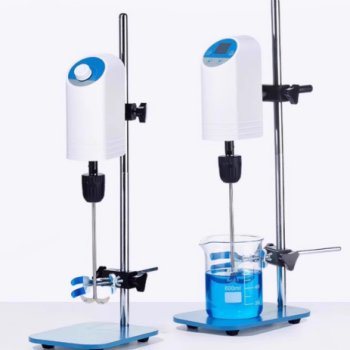
- High Performance Laboratory Stirrers for Diverse Applications
- Custom PTFE Teflon Parts Manufacturer for Magnetic Stirring Bar
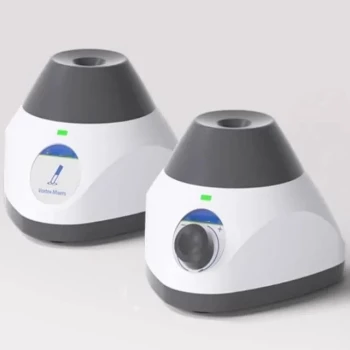
- Laboratory Vortex Mixer Orbital Shaker Multifunctional Rotation Oscillation Mixer
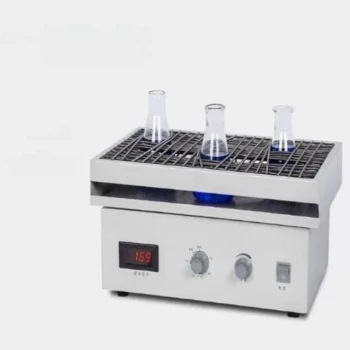
- Laboratory Multifunctional Small Speed-Adjustable Horizontal Mechanical Shaker for Lab
People Also Ask
- What role does a magnetic stirrer with heating play in ZnO nanoparticle synthesis? Precision Control for Quality Results
- What role does a constant temperature heating magnetic stirrer play in MFC-HAp synthesis? Achieve Material Homogeneity
- What is the function of a laboratory magnetic stirrer in Ni–Cr–P electrodeposition? Optimize Ion Transport & Coating
- Why is a laboratory magnetic stirrer required for benzoic acid esters? Boost Reaction Speed & Yield with High RPM
- What role does a laboratory magnetic stirrer play in TiO2 and TiO2-Ag sol preparation? Master Chemical Kinetics