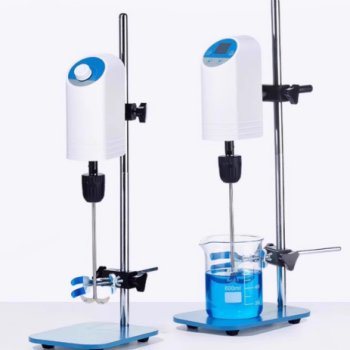
In the co-precipitation synthesis of Fe3O4 nanoparticles, the magnetic stirrer and nitrogen protection serve as the primary controls for physical uniformity and chemical purity, respectively. The magnetic stirrer provides the continuous mechanical power necessary to mix iron salts with alkaline reagents, which directly dictates the particle size distribution. Simultaneously, the nitrogen environment acts as a chemical shield, excluding oxygen to prevent the oxidation of vulnerable Fe2+ ions, ensuring the formation of a high-purity spinel structure.
Success in synthesizing magnetic nanoparticles hinges on controlling two distinct variables: homogeneity and oxidation state. Mechanical stirring governs the physical nucleation of crystals, while nitrogen preserves the chemical integrity required for magnetism.
The Role of the Magnetic Stirrer: Physical Homogeneity
The magnetic stirrer is not merely a tool for agitation; it is the primary mechanism for ensuring that the reaction occurs uniformly at a molecular level.
Achieving Molecular-Level Mixing
The stirrer generates continuous and uniform mechanical power. This forces the precursor solutions—specifically the iron salts and the alkaline precipitating agent—to mix thoroughly. Without this forced convection, the reaction would rely on passive diffusion, leading to uneven reaction zones.
Controlling Particle Size Distribution
The uniformity of mixing is directly responsible for the size of the resulting nanoparticles. Thorough mixing ensures that the alkaline reagent contacts the iron solution evenly, promoting uniform nucleation. This prevents localized "hotspots" of high concentration, which causes uneven grain growth and results in a product with inconsistent particle sizes.
The Role of Nitrogen Protection: Chemical Purity
While the stirrer manages the physical shape of the particles, nitrogen protection preserves their chemical identity. This is particularly critical when working with iron in alkaline environments.
Preventing Fe2+ Oxidation
The synthesis of Fe3O4 (magnetite) requires a specific ratio of ferrous (Fe2+) and ferric (Fe3+) ions. However, Fe2+ is highly unstable and prone to unwanted oxidation, especially under the alkaline conditions required for co-precipitation. Nitrogen gas effectively displaces atmospheric oxygen from the reaction vessel, eliminating the agent responsible for this oxidation.
Ensuring Magnetic Properties
By maintaining an inert atmosphere, nitrogen ensures the final product retains a high-purity spinel structure. If oxygen were present, the Fe2+ would oxidize into non-magnetic or weakly magnetic phases (such as alpha-hematite). Therefore, the nitrogen blanket is essential for securing the material's optimal magnetic properties.
Common Pitfalls to Avoid
Understanding the limitations of these tools is as important as understanding their functions. Neglecting either variable leads to specific failure modes.
The Risk of Inadequate Stirring
If the stirring speed is insufficient or inconsistent, the chemical environment becomes heterogeneous. This leads to segregation, where some particles grow much larger than others. The result is a polydisperse sample that behaves unpredictably in magnetic applications.
The Consequence of Oxygen Leakage
Even a minor failure in the nitrogen seal can compromise the entire batch. If oxygen enters the system, the magnetic saturation of the nanoparticles will drop significantly. The product may visually resemble Fe3O4, but its chemical composition will be degraded, rendering it less effective for high-performance applications.
How to Apply This to Your Project
To maximize the quality of your synthesis, you must prioritize your controls based on your specific requirements.
- If your primary focus is Monodispersity (Uniform Size): Prioritize the calibration of your magnetic stirrer to ensure vigorous, constant speed that facilitates rapid, molecular-level diffusion.
- If your primary focus is High Magnetic Saturation: Prioritize the integrity of your nitrogen flow, ensuring the system is completely purged of oxygen before and during the addition of alkaline reagents.
By balancing continuous mechanical power with a strict inert atmosphere, you ensure the production of Fe3O4 nanoparticles that are both physically uniform and magnetically strong.
Summary Table:
| Factor | Primary Function | Impact on Nanoparticles |
|---|---|---|
| Magnetic Stirrer | Mechanical Power & Mixing | Ensures molecular-level homogeneity and uniform particle size distribution. |
| Nitrogen Protection | Inert Atmosphere Shielding | Prevents Fe2+ oxidation to maintain high-purity spinel structure and magnetism. |
| Stirring Speed | Convection Control | Prevents localized hotspots and grain growth segregation. |
| Oxygen Exclusion | Chemical Stabilization | Protects magnetic saturation by preventing formation of non-magnetic phases. |
Elevate Your Nanoparticle Research with KINTEK
Precision in synthesis requires precision in equipment. KINTEK specializes in providing high-performance laboratory solutions tailored for advanced material science. Whether you are refining Fe3O4 co-precipitation or exploring complex battery research, our comprehensive range of products ensures your results are consistent and reproducible.
Our value to your laboratory:
- Advanced Magnetic Stirrers & Homogenizers: Achieve perfect molecular-level mixing and monodispersity.
- Inert Atmosphere Solutions: From high-temperature vacuum and atmosphere furnaces to specialized reactors for oxygen-free synthesis.
- Comprehensive Material Support: High-purity ceramics, crucibles, and PTFE consumables designed for harsh alkaline environments.
Don't let inconsistent stirring or oxygen leakage compromise your magnetic saturation. Contact KINTEK today to discover how our high-precision equipment and consumables can optimize your synthesis workflows.
References
- Saeid Fallahizadeh, Majid Kermani. Enhanced photocatalytic degradation of amoxicillin using a spinning disc photocatalytic reactor (SDPR) with a novel Fe3O4@void@CuO/ZnO yolk-shell thin film nanostructure. DOI: 10.1038/s41598-023-43437-8
This article is also based on technical information from Kintek Solution Knowledge Base .
Related Products
- Laboratory Small Constant Temperature Heated Magnetic Stirrer Heater and Stirrer
- Custom PTFE Teflon Parts Manufacturer for Magnetic Stirring Bar
- High Performance Laboratory Stirrers for Diverse Applications
- Three-dimensional electromagnetic sieving instrument
- Custom PTFE Teflon Parts Manufacturer for PTFE Stirring Bar Recovery Rod
People Also Ask
- What role does a magnetic stirrer with heating play in ZnO nanoparticle synthesis? Precision Control for Quality Results
- What role does a constant temperature heating magnetic stirrer play in MFC-HAp synthesis? Achieve Material Homogeneity
- What is the function of a laboratory magnetic stirrer in Ni–Cr–P electrodeposition? Optimize Ion Transport & Coating
- Why is a laboratory magnetic stirrer required for benzoic acid esters? Boost Reaction Speed & Yield with High RPM
- What role does a laboratory magnetic stirrer play in TiO2 and TiO2-Ag sol preparation? Master Chemical Kinetics