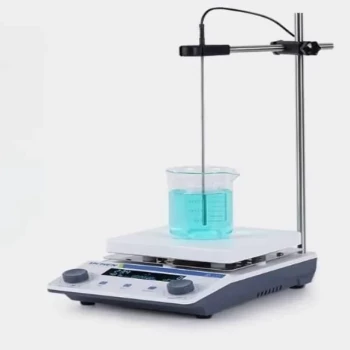
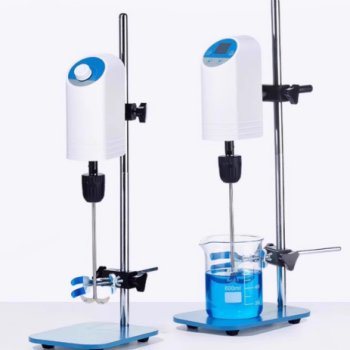
A heating magnetic stirrer is the linchpin of reproducibility in the synthesis of Zinc Oxide (ZnO) nanoparticles. It simultaneously provides the thermal activation energy required to dissolve precursors (such as zinc acetate) and the mechanical shear necessary to achieve a homogeneous mixture at the molecular level. Without this dual function, the solution would suffer from incomplete dissolution and thermal gradients, leading to inconsistent particle growth.
Core Takeaway The heating magnetic stirrer transforms a simple mixture into a uniform chemical environment by synchronizing temperature and kinetic energy. This uniformity is the primary factor determining the final particle size distribution, purity, and morphology of the ZnO nanoparticles.
The Role of Controlled Thermal Energy
Providing Activation Energy
The chemical transformation of precursors requires a specific thermal threshold. By maintaining a stable environment (typically around 85–90 °C), the device supplies the necessary activation energy to initiate the reaction between zinc acetate and solvents or capping agents.
Ensuring Complete Dissolution
Thermal energy is essential for the physical breakdown of solid precursors. It ensures that agents like zinc acetate and polyethylene glycol (PEG) dissolve completely to form a homogeneous melt or solution, preventing solid residues that could contaminate the final product.
Maintaining Reaction Stability
Precise temperature regulation prevents fluctuations that could alter reaction kinetics. A stable thermal environment ensures the precursors reach an ideal chemical state prior to the addition of precipitating agents like sodium hydroxide.
The Function of Mechanical Agitation
Achieving Molecular-Level Mixing
Continuous rotation creates forced convection within the vessel. This drives the thorough mixing of zinc precursors and capping agents (like Carboxymethyl Cellulose or PEG) at a molecular level, rather than just a macroscopic blend.
Controlling Particle Morphology
The consistency of the stirring directly influences the physical structure of the nanoparticles. By eliminating concentration gradients in the solution, the stirrer ensures that nucleation and growth occur evenly, which is vital for controlling the particle size distribution and shape.
Preventing Component Segregation
In complex syntheses, particularly those involving dopants like silver or manganese, mechanical agitation is critical. It ensures that doping ions are distributed uniformly within the zinc oxide crystal lattice, preventing localized segregation that would degrade the material's properties.
Common Pitfalls and Trade-offs
The Risk of Thermal Gradients
If the heating element acts unevenly or the stirring speed is too low, "hot spots" can form in the solution. This leads to rapid nucleation in some areas and slow growth in others, resulting in a product with a wide, unpredictable range of particle sizes.
Mechanical Limitations
While higher stirring speeds generally improve homogeneity, excessive agitation can introduce air bubbles or splash the solution on container walls where it cannot react. Finding the optimal rotation speed is a trade-off between thorough mixing and maintaining physical containment of the reaction.
Making the Right Choice for Your Goal
To optimize your ZnO synthesis, align your equipment usage with your specific scientific objective:
- If your primary focus is Uniform Particle Size: Prioritize consistent stirring speeds to eliminate concentration gradients that cause uneven crystal growth.
- If your primary focus is High-Purity Doping: Ensure vigorous, continuous agitation to force the uniform distribution of dopant ions into the crystal lattice.
- If your primary focus is Precursor Efficiency: Focus on precise thermal control (e.g., 90 °C) to guarantee the complete dissolution of capping agents before precipitation begins.
Mastering the variable of heat and agitation is the first step toward moving from experimental randomness to engineered precision.
Summary Table:
| Feature | Impact on ZnO Synthesis | Key Benefit |
|---|---|---|
| Thermal Energy | Provides activation energy & facilitates dissolution | Ensures reaction stability and precursor efficiency |
| Mechanical Agitation | Ensures molecular-level mixing and prevents segregation | Controls particle morphology and size distribution |
| Temperature Control | Prevents thermal gradients and "hot spots" | Guarantees consistent nucleation and crystal growth |
| Stirring Consistency | Uniformly distributes dopants (e.g., Ag or Mn) | Produces high-purity materials with enhanced properties |
Elevate Your Nanomaterial Precision with KINTEK
Consistency is the bedrock of nanotechnology. At KINTEK, we specialize in the high-performance laboratory equipment essential for your synthesis success. From precision heating magnetic stirrers and shakers that ensure uniform particle morphology to advanced crushing and milling systems for post-synthesis processing, we provide the tools needed to move from experimental randomness to engineered excellence.
Our extensive portfolio also includes high-temperature furnaces (muffle, vacuum, CVD), high-pressure reactors, and specialized PTFE and ceramic consumables designed to withstand rigorous chemical environments. Whether you are researching battery materials or developing advanced doped oxides, KINTEK delivers the reliability your lab demands.
Ready to optimize your synthesis workflow? Contact our technical experts today to find the perfect equipment solution for your research goals!
References
- Asanda Mtibe, Maya Jacob John. Fabrication of a Polybutylene Succinate (PBS)/Polybutylene Adipate-Co-Terephthalate (PBAT)-Based Hybrid System Reinforced with Lignin and Zinc Nanoparticles for Potential Biomedical Applications. DOI: 10.3390/polym14235065
This article is also based on technical information from Kintek Solution Knowledge Base .
Related Products
- Laboratory Small Constant Temperature Heated Magnetic Stirrer Heater and Stirrer
- Custom PTFE Teflon Parts Manufacturer for Magnetic Stirring Bar
- High Performance Laboratory Stirrers for Diverse Applications
- Custom PTFE Teflon Parts Manufacturer for PTFE Stirring Bar Recovery Rod
- 10L Heating Chilling Circulator Cooling Water Bath Circulator for High and Low Temperature Constant Temperature Reaction
People Also Ask
- What role does a magnetic stirrer with heating play in ZnO nanoparticle synthesis? Precision Control for Quality Results
- What role does a constant temperature heating magnetic stirrer play in MFC-HAp synthesis? Achieve Material Homogeneity
- What is the function of a laboratory magnetic stirrer in Ni–Cr–P electrodeposition? Optimize Ion Transport & Coating
- Why is a laboratory magnetic stirrer required for benzoic acid esters? Boost Reaction Speed & Yield with High RPM
- What role does a laboratory magnetic stirrer play in TiO2 and TiO2-Ag sol preparation? Master Chemical Kinetics