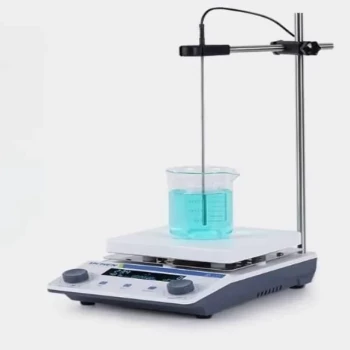
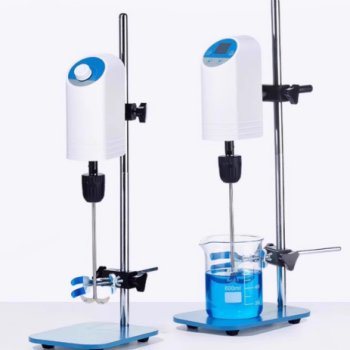
The primary function of the magnetic stirring hot plate in this synthesis is to facilitate the transition from a liquid solution to a homogeneous viscous gel. It achieves this by simultaneously maintaining a constant temperature of approximately 80 °C to evaporate excess moisture and providing continuous agitation to dissolve zirconium nitrate, aluminum nitrate, and urea fuel in deionized water.
The device is critical for quality control; it eliminates solute concentration gradients during the evaporation phase. This ensures that the components are uniformly distributed within the resulting gel, which is a prerequisite for a successful and consistent microwave combustion reaction.
The Role of Controlled Agitation
Dissolution of Precursors
The first task of the hot plate is to ensure the complete dissolution of the solid precursors.
You are mixing zirconium nitrate, aluminum nitrate, and urea fuel into deionized water.
Without mechanical agitation, these solids may settle or dissolve unevenly, leading to inconsistencies in the final nanocomposite structure.
Creating "Forced Convection"
The magnetic stirrer drives a rotor within the solution to create continuous macroscopic movement.
This establishes an environment of forced convection.
By keeping the fluid in constant motion, you eliminate concentration gradients. This ensures that the chemical composition is identical in every part of the beaker, rather than having pockets of higher or lower concentration.
Thermal Management and Phase Change
Controlled Evaporation
The synthesis requires the removal of excess moisture to proceed to the combustion stage.
The hot plate maintains a steady temperature, typically around 80 °C.
This specific thermal set-point is aggressive enough to evaporate water but controlled enough to prevent premature reaction or violent boiling.
Formation of the Viscous Gel
The ultimate goal of this stage is a physical phase change.
As moisture evaporates under constant stirring, the transparent solution transforms into a viscous gel.
This gel state locks the components in place, preserving the uniform distribution achieved during mixing. This uniformity is vital for the subsequent microwave combustion process.
Common Pitfalls and Trade-offs
The Risk of Inadequate Stirring
If the stirring speed is too low, you risk the formation of local "hot spots" or concentration gradients.
This can result in a gel where the fuel (urea) and oxidizers (nitrates) are not perfectly mixed.
The downstream effect is often an uneven combustion reaction, leading to a nanocomposite with poor structural integrity or phase purity.
Temperature Stability
Relying on a hot plate requires vigilance regarding temperature fluctuation.
If the temperature drops significantly below 80 °C, the evaporation process slows, delaying gel formation.
Conversely, excessive heat can cause the solvent to evaporate too rapidly, potentially causing solutes to precipitate out of solution before a proper gel network is formed.
Optimizing the Synthesis Process
If your primary focus is Phase Purity:
- Prioritize vigorous, consistent stirring to eliminate all concentration gradients, ensuring the fuel and oxidizers are perfectly stoichiometric throughout the gel.
If your primary focus is Process Efficiency:
- Ensure the temperature is strictly maintained at 80 °C to minimize the time required to evaporate moisture without compromising the gel structure.
Success in solution combustion synthesis relies on the uniformity of the precursor gel.
Summary Table:
| Feature | Role in Synthesis | Impact on Final Composite |
|---|---|---|
| Constant Heating (80 °C) | Facilitates controlled moisture evaporation | Prevents premature reactions and ensures stable gelation |
| Magnetic Agitation | Dissolves precursors (Nitrates & Urea) | Eliminates solute concentration gradients |
| Forced Convection | Maintains macroscopic fluid movement | Guarantees identical chemical composition throughout |
| Phase Transition | Converts liquid to homogeneous viscous gel | Preserves uniform distribution for microwave combustion |
Elevate Your Material Synthesis with KINTEK Precision
Achieving the perfect viscous gel for zirconia-alumina nanocomposites requires uncompromising thermal stability and agitation. At KINTEK, we specialize in providing high-performance laboratory equipment tailored for advanced material research. From precision magnetic stirring hot plates and homogenizers to high-temperature muffle and vacuum furnaces for final combustion, our solutions ensure your research is consistent and repeatable.
Whether you are focusing on phase purity or process efficiency, our comprehensive range—including high-temperature reactors, ceramic crucibles, and milling systems—is designed to meet the rigorous demands of nanotechnology and battery research.
Ready to optimize your lab's performance? Contact KINTEK today to find the perfect tools for your next breakthrough!
References
- Hamed Nayebzadeh, Mohammad Tabasizadeh. Application of microwave irradiation for fabrication of sulfated ZrO2–Al2O3 nanocomposite via combustion method for esterification reaction: process condition evaluation. DOI: 10.1007/s40097-019-0304-y
This article is also based on technical information from Kintek Solution Knowledge Base .
Related Products
- Laboratory Small Constant Temperature Heated Magnetic Stirrer Heater and Stirrer
- Custom PTFE Teflon Parts Manufacturer for Magnetic Stirring Bar
- Automatic High Temperature Heated Hydraulic Press Machine with Heated Plates for Lab
- Automatic Heated Hydraulic Press Machine with Heated Plates for Laboratory Hot Press 25T 30T 50T
- Automatic Heated Hydraulic Press Machine with Heated Plates for Laboratory Hot Press
People Also Ask
- What role does a magnetic stirrer with heating play in ZnO nanoparticle synthesis? Precision Control for Quality Results
- What role does a constant temperature heating magnetic stirrer play in MFC-HAp synthesis? Achieve Material Homogeneity
- What is the function of a laboratory magnetic stirrer in Ni–Cr–P electrodeposition? Optimize Ion Transport & Coating
- Why is a laboratory magnetic stirrer required for benzoic acid esters? Boost Reaction Speed & Yield with High RPM
- What role does a laboratory magnetic stirrer play in TiO2 and TiO2-Ag sol preparation? Master Chemical Kinetics