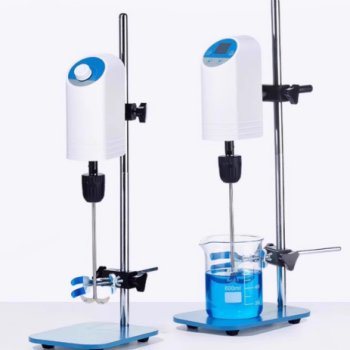
Continuous magnetic stirring is critical for maintaining the cellulose/MoS2 composite in a highly suspended state within the reaction solution. This mechanical agitation counteracts gravity to prevent particle settling, effectively eliminating mass transfer resistance so Cr(VI) ions can rapidly reach active catalytic sites. Furthermore, it ensures the entire reaction volume receives uniform exposure to both light irradiation and heat.
The primary function of stirring is to eliminate mass transfer limitations and maintain a stable slurry, ensuring consistent interaction between photons, the catalyst surface, and the heavy metal ions.
Mechanics of the Heterogeneous System
Maintaining Active Surface Area
The cellulose/MoS2 composite acts as a solid heterogeneous catalyst within an aqueous solution. Without active mechanical intervention, gravity naturally causes these particles to settle at the bottom of the reactor.
Continuous stirring counteracts this sedimentation, ensuring the particles remain in a highly suspended state. This maintains the maximum possible effective surface area, keeping the active sites physically available to the liquid reactants.
Eliminating Mass Transfer Resistance
For the reduction reaction to occur, Cr(VI) ions must physically travel from the bulk liquid to the active sites on the composite surface.
In a stagnant system, this movement is slow and inefficient. Stirring creates a dynamic flow that removes mass transfer resistance, ensuring that Cr(VI) ions are rapidly and continuously transported to the catalyst surface for processing.
Ensuring Uniform Light Utilization
Photocatalysis is driven by photon absorption. If the catalyst precipitates, particles at the bottom shield one another, and the bulk of the material sits in darkness.
Magnetic stirring creates a stable slurry system where particles circulate through the illuminated zones. This guarantees uniform light exposure across the entire reaction medium, preventing drops in efficiency caused by light blockage or incomplete utilization.
Thermal Homogeneity
Temperature often influences reaction kinetics. The primary reference notes that continuous operation ensures the system receives uniform heat distribution.
This prevents localized "hot spots" or cold zones, ensuring that kinetic data collected from the experiment accurately reflects the properties of the composite rather than thermal inconsistencies.
Common Pitfalls to Avoid
The Risk of Inadequate Suspension
If the stirring speed is insufficient, a gradient will form where the catalyst concentration is higher at the bottom than the top.
This creates a "dead zone" where light cannot penetrate the dense slurry at the bottom, and an inactive zone at the top where light is present but the catalyst is absent. This leads to incomplete degradation and unreliable experimental data.
Mass Transfer Limitations
Failing to eliminate mass transfer resistance is a common source of error in kinetic studies.
If the system is not stirred vigorously enough, the reaction rate becomes limited by how fast the ions can swim to the catalyst (diffusion control) rather than how fast the catalyst can react (kinetic control). This obscures the true efficiency of your MoS2 composite.
Optimizing Your Experimental Setup
To ensure accurate and reproducible results during Cr(VI) reduction, you must treat the physical dynamics of the solution as a key variable.
- If your primary focus is Kinetic Accuracy: Ensure the stirring speed is high enough that increasing it further does not change the reaction rate, confirming you have eliminated mass transfer resistance.
- If your primary focus is Material Efficiency: Maintain a uniform suspension to guarantee that every milligram of your composite is actively participating in photon absorption and ion reduction.
By maintaining a stable, well-mixed slurry, you ensure that the limiting factor in your process is the chemistry of the catalyst, not the physics of the reactor.
Summary Table:
| Key Function | Role in Photocatalysis | Impact on Efficiency |
|---|---|---|
| Suspension Maintenance | Prevents catalyst sedimentation (settling) | Maximizes active surface area exposure |
| Mass Transfer | Eliminates resistance between ions and catalyst | Ensures rapid transport of Cr(VI) to active sites |
| Light Distribution | Circulates particles through illuminated zones | Guarantees uniform photon absorption |
| Thermal Homogeneity | Distributes heat evenly throughout the reactor | Prevents localized thermal inconsistencies |
Elevate Your Research with KINTEK Precision
Maximize the efficiency of your photocatalytic reactions with KINTEK’s industry-leading laboratory equipment. Whether you are performing Cr(VI) reduction or developing advanced MoS2 composites, our magnetic stirrers, high-temperature reactors, and crushing systems provide the stability and precision required for reproducible results.
Why choose KINTEK?
- Comprehensive Solutions: From high-pressure autoclaves to specialized ceramics and crucibles.
- Precision Control: Our stirring and thermal equipment eliminate mass transfer resistance and ensure uniform heat distribution.
- Expert Support: Specialized tools for battery research, homogenization, and material processing tailored to your lab's needs.
Contact KINTEK today to find the perfect equipment for your laboratory!
References
- Chunxiang Lin, Minghua Liu. One-pot synthesis of cellulose/MoS2 composite for efficient visible-light photocatalytic reduction of Cr(VI). DOI: 10.15376/biores.14.3.6114-6133
This article is also based on technical information from Kintek Solution Knowledge Base .
Related Products
- Laboratory Small Constant Temperature Heated Magnetic Stirrer Heater and Stirrer
- Custom PTFE Teflon Parts Manufacturer for Magnetic Stirring Bar
- High Performance Laboratory Stirrers for Diverse Applications
- Three-dimensional electromagnetic sieving instrument
- Custom PTFE Teflon Parts Manufacturer for PTFE Stirring Bar Recovery Rod
People Also Ask
- What role does a magnetic stirrer with heating play in ZnO nanoparticle synthesis? Precision Control for Quality Results
- What role does a constant temperature heating magnetic stirrer play in MFC-HAp synthesis? Achieve Material Homogeneity
- What is the function of a laboratory magnetic stirrer in Ni–Cr–P electrodeposition? Optimize Ion Transport & Coating
- Why is a laboratory magnetic stirrer required for benzoic acid esters? Boost Reaction Speed & Yield with High RPM
- What role does a laboratory magnetic stirrer play in TiO2 and TiO2-Ag sol preparation? Master Chemical Kinetics